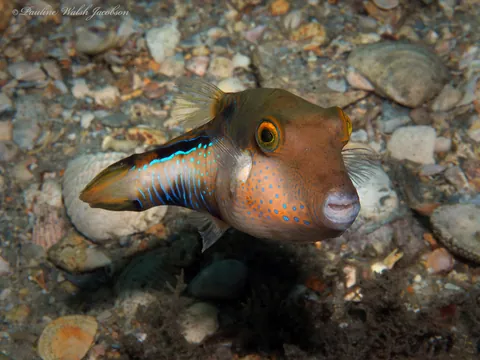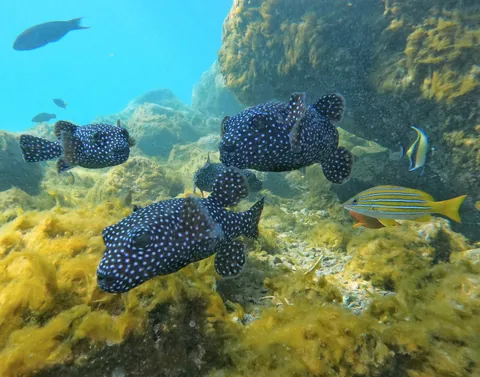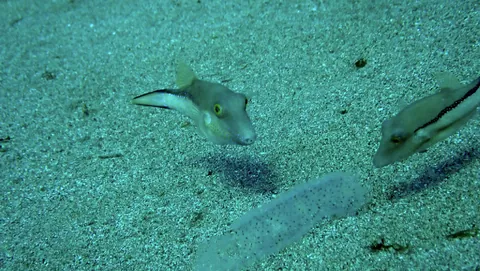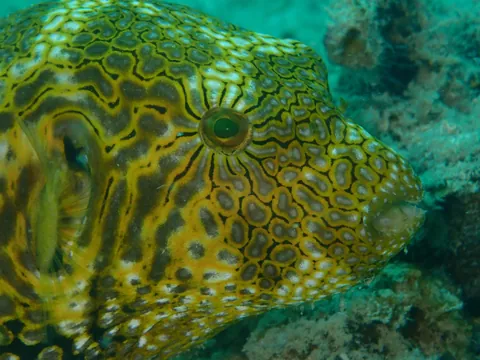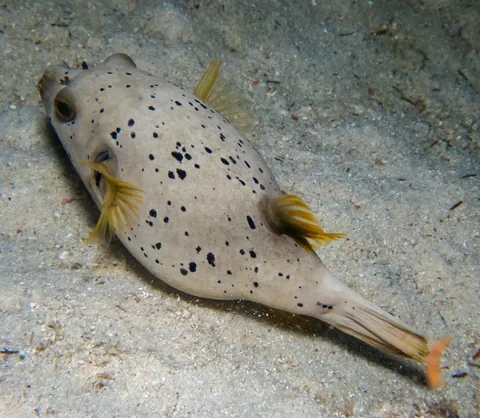
Blackspotted puffer
Arothron nigropunctatus
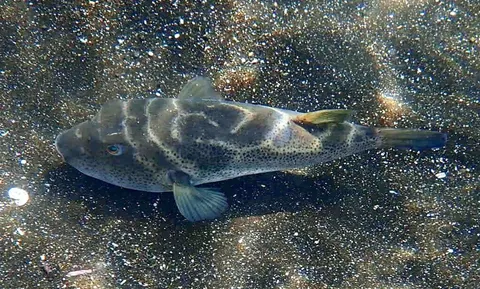
Sphoeroides testudineus
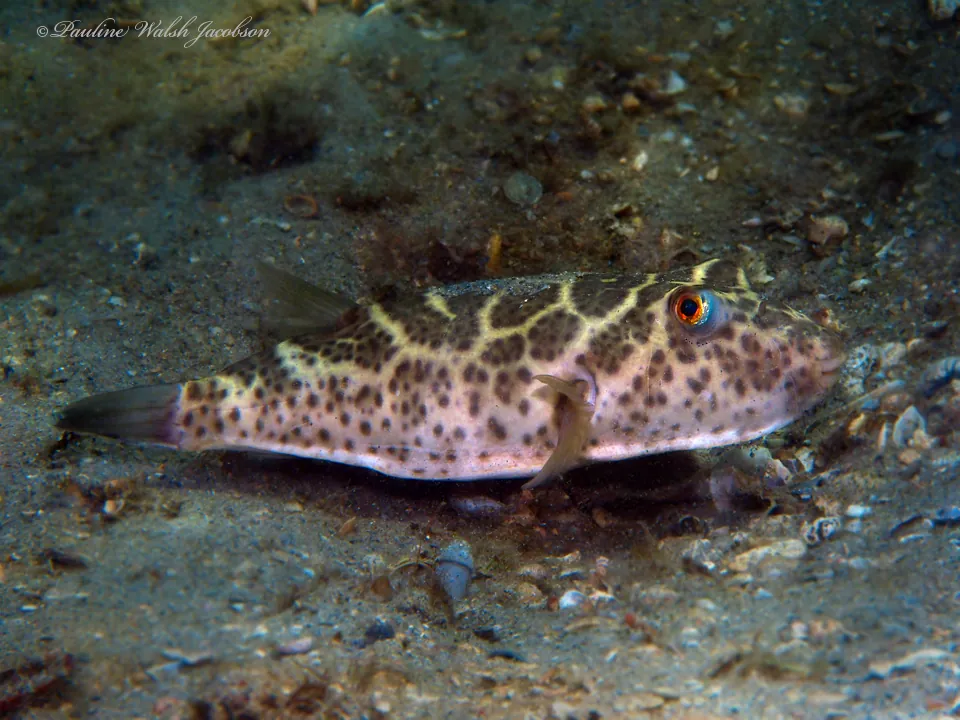
The checkered puffer looks like it is wearing a target on its back. Slow and unbothered in the shallows, it relies on toxin and a trick of inflation rather than speed to stay safe.
Also known as: puffer
Several similar puffers share its coastal range, but none of them shares its back pattern: the bold, bulls-eye network of lines on the midback belongs to this species alone.
This puffer grows up to 38.8 cm, though most seen are closer to 20 cm. Its body is pale tan to yellowish, marked on the midback with a bold, bulls-eye pattern of dark gray to olive lines forming a square or polygon network. Small dark brown spots dot the cheeks and lower sides, while the belly stays plain white. The tail fin carries dark bands.
This species lives in shallow, sheltered waters from 1 to 48 m deep: bays, seagrass beds, tidal creeks, and mangrove swamps, sometimes pushing into brackish or even freshwater. It is common along quiet coastlines but rarely seen on coral reefs.
When frightened, this puffer can bury itself in the sand or swallow water to inflate its body into a ball, making it too large and awkward for most predators to swallow. It does not form true schools but can gather in large, loose aggregations. Its flesh is highly toxic.
This fish is so toxic that it has been used to poison cats and dogs.
Describe what you saw and we name it, then keep every species you find in your Oceandex.