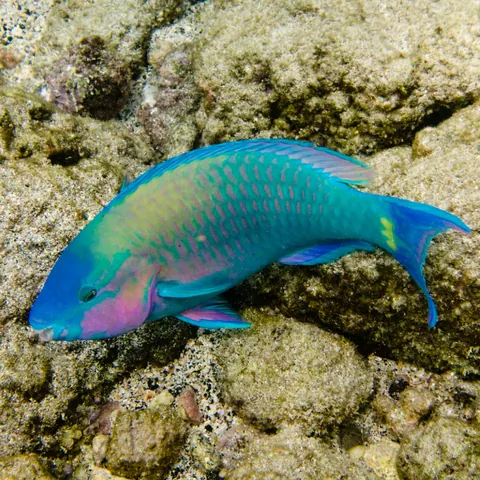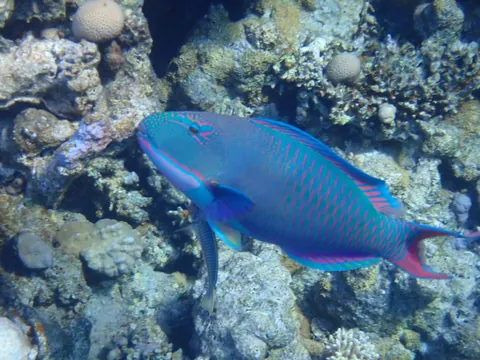
Bicolour parrotfish
Cetoscarus bicolor
Scarus frenatus
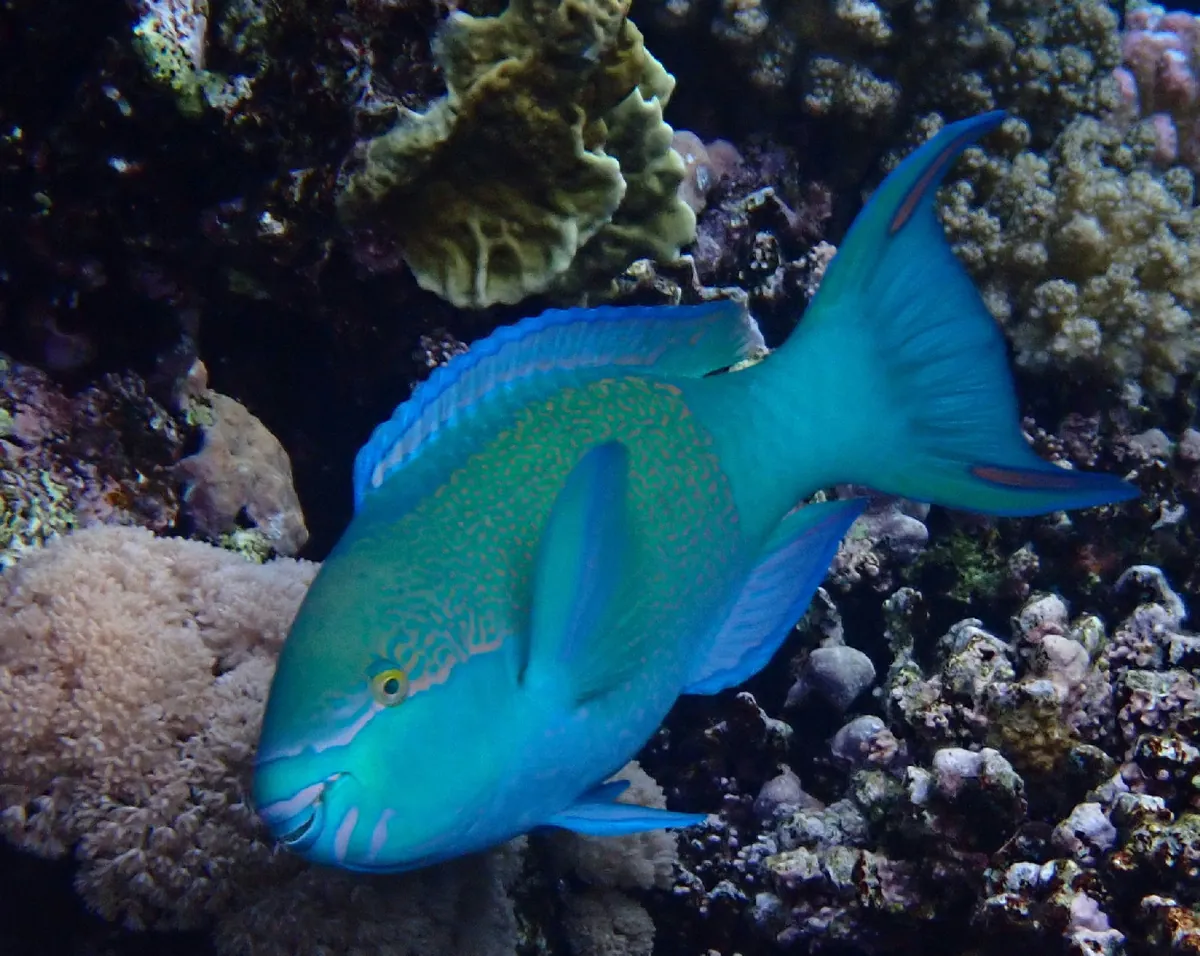
The bridled parrotfish is a reef grazer that scrapes algae off hard bottom in the zone right on the seabed. It grows to 47 cm. Like many parrotfish it changes its look completely as it grows, so a young fish and a big male barely look like the same species. It is usually seen alone, but it will join a mixed feeding school of other reef fish while it grazes.
Also known as: birdled parrotfish, bridled parrotfish, six-banded parrotfish, vermiculate parrotfish, vermiculate parrotfish, parrotfish, birdled parrotfish, sixband parrotfish, six banded parrotfish, sixband parrotfish, six-banded parrot-fish
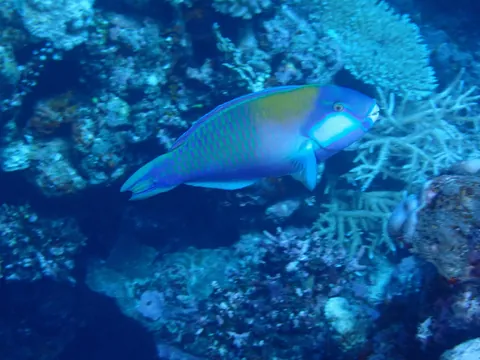
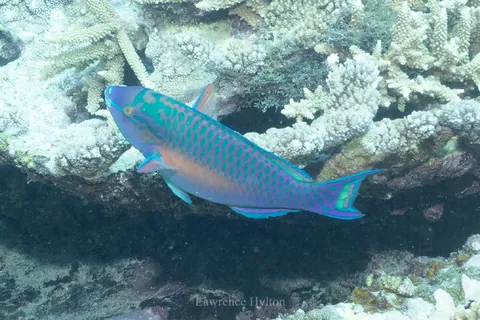
On a large male, look for the split: the back half of the body and the lower half of the head are suddenly much lighter than the front, with a clear line between the two, and the tail is blue-green with a wide orange crescent. On a smaller reddish-brown fish, count the dark stripes running the length of the body, six or seven of them. Both are fixed patterns and readable from a few metres away.
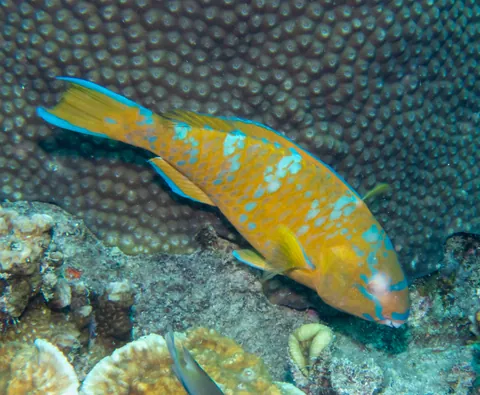
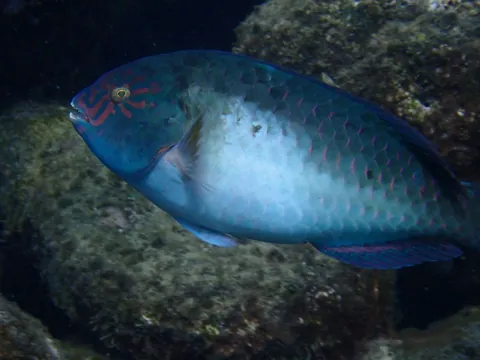
In its first adult phase the fish is reddish to brown, with red fins and six or seven dark stripes running the length of the body. Large males look quite different. Their body keeps a dark front end, but the rear of the body and the lower half of the head turn abruptly much paler, so the fish looks as if it has been split into a dark and a light part with a hard edge between them. The tail of a large male is blue-green with a big orange crescent across it.
It ranges across the Indo-Pacific, from the Red Sea east into the central Pacific, and from southern Japan south to Western Australia and Lord Howe Island. It is absent from Hawaii. It is a fish of exposed outer reefs, where the swell hits, and it is found from 1 m down to 25 m, sometimes in extremely shallow water. Young fish stay somewhere calmer, among the coral and rubble of lagoon reefs.
Describe what you saw and we name it, then keep every species you find in your Oceandex.