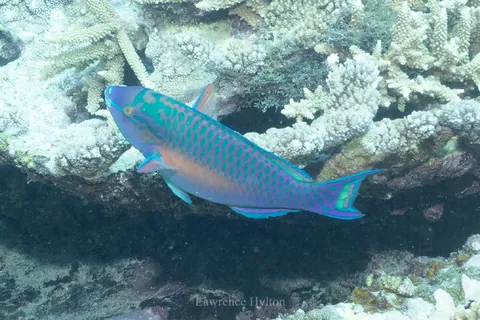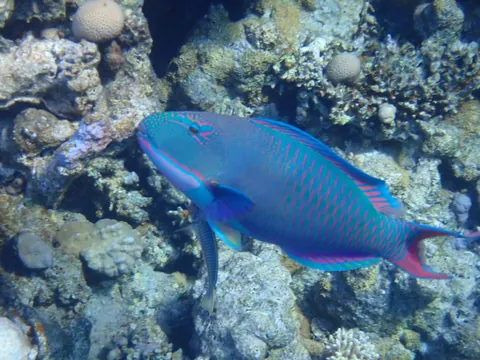
Bicolour parrotfish
Cetoscarus bicolor
Scarus psittacus
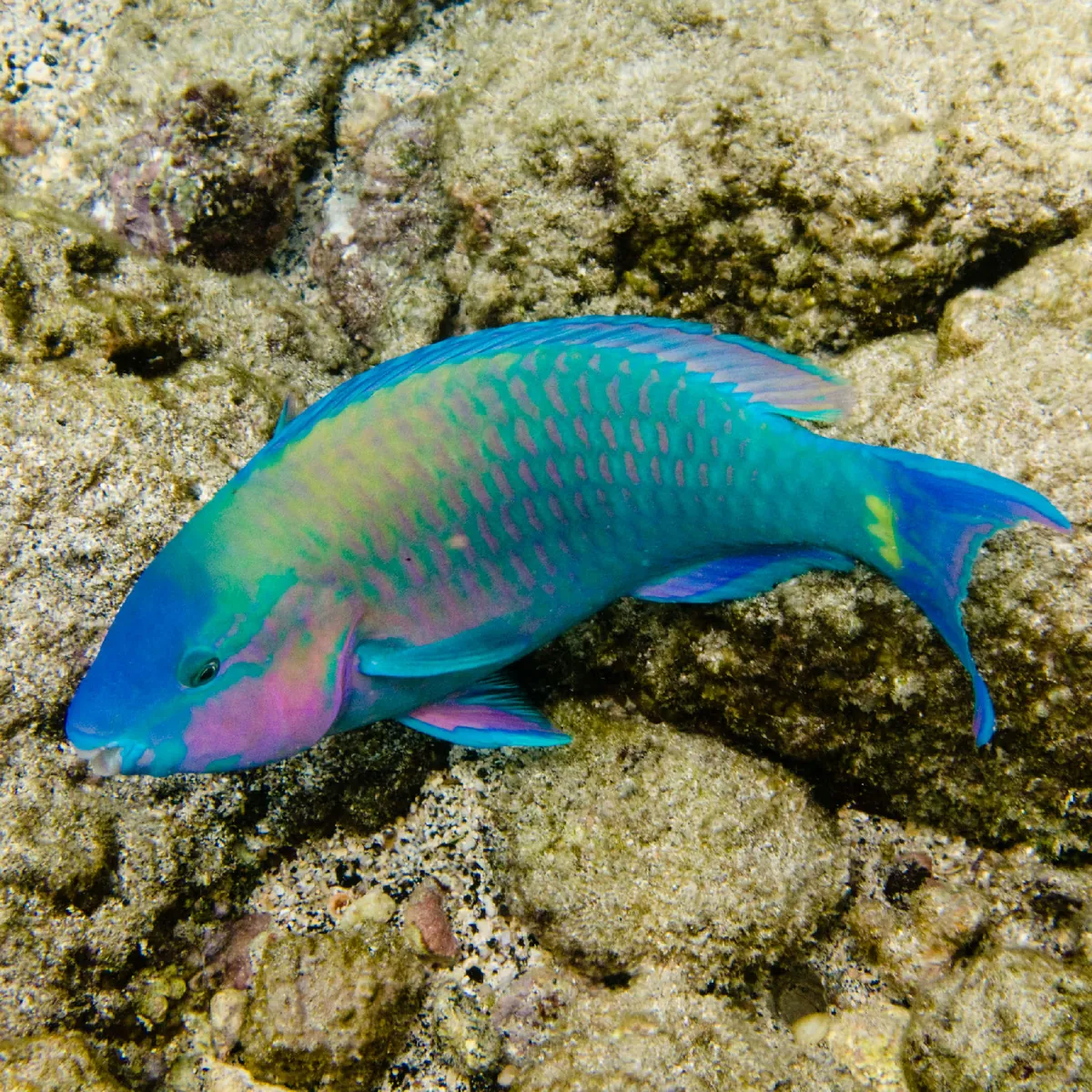
Few reef fish change as much in a lifetime as this one. A common parrotfish starts out a plain red-brown, then a lucky few turn green, pink and lavender as they take charge of a group. Almost all of them begin life as females. When no big male is around, the top female in the group simply becomes one. At about 34 cm it is a medium-sized parrotfish, and on many Indo-Pacific reefs it is the one you meet most often.
Also known as: palenose parrotfish, common parrotfish, palenose parrotfish, palenosed parrot, rosy-cheek parrotfish, common parrotfish, common parrotfish, rosy-cheek parrotfish, parrotfish, parrotfish psittacus, palenosed parrot, palenose parrotfish, common parrotfish
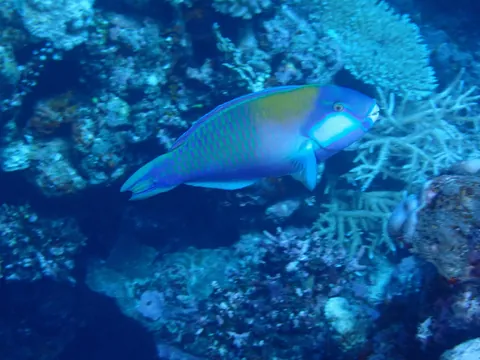
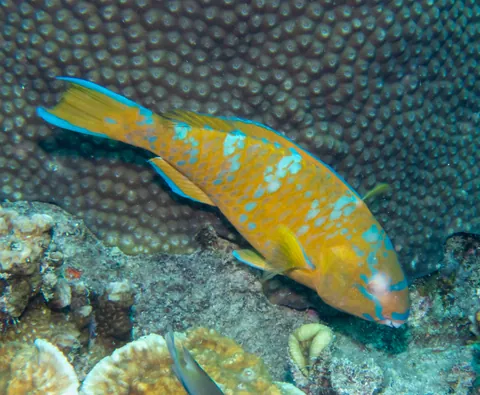
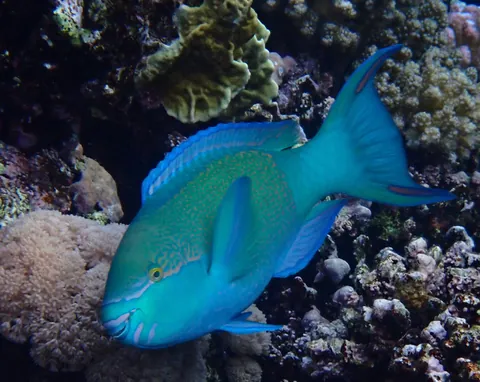
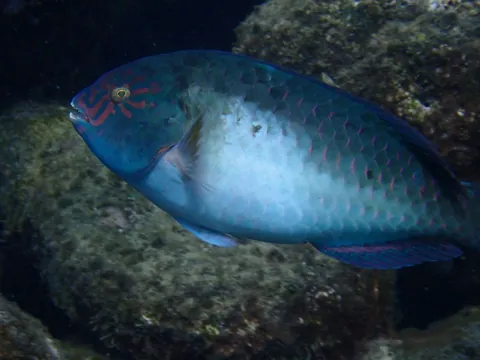
Reef flats are full of parrotfish, and colour alone will mislead you, since this species wears two different outfits. Use the front of the head instead. In both phases the snout is noticeably paler than the rest of the fish, which is why it is also called the palenose parrotfish. On a drab brown early-phase fish that pale face is the giveaway at viewing distance.
There are two very different looks. Early-phase fish are reddish brown to grey, broken up by a few paler blotches. Later-phase males are pale green to tan, with salmon pink or blue edges to the scales. Their faces carry blue bands: one runs from the upper lip back across the cheek, another sits behind the eye, and more mark the lower lip and chin. A breeding male can turn a bright yellow all over. The tail is cut inwards in the middle, shallowly in small fish and deeply in big males. As in all parrotfish, the teeth are fused into plates, but here the lips cover most of them.
This is a fish of shallow, sunlit reef. Look for it on reef flats, in lagoons and along seaward reef fronts, from 2 to 25 m. It favours spots where fine, thread-like algae grow thickly over the rock and coral, and it often moves in small feeding groups rather than alone. The range is wide across the tropical Indo-Pacific, from the Red Sea and the Gulf of Aden east to Hawaii, north to southern Japan and south to Australia.
It is common enough to be netted in small fisheries, but not valued on the plate. The flesh is thought too soft to be good eating.
Describe what you saw and we name it, then keep every species you find in your Oceandex.