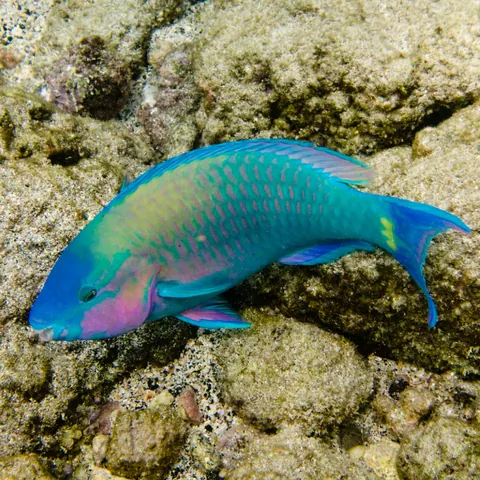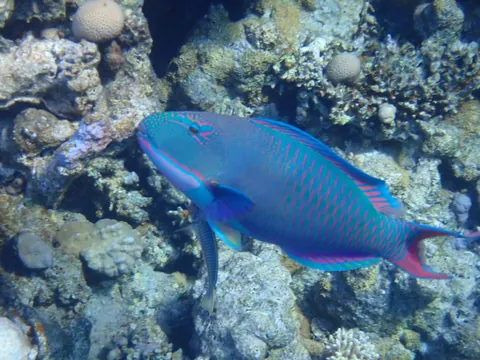
Bicolour parrotfish
Cetoscarus bicolor
Scarus ghobban
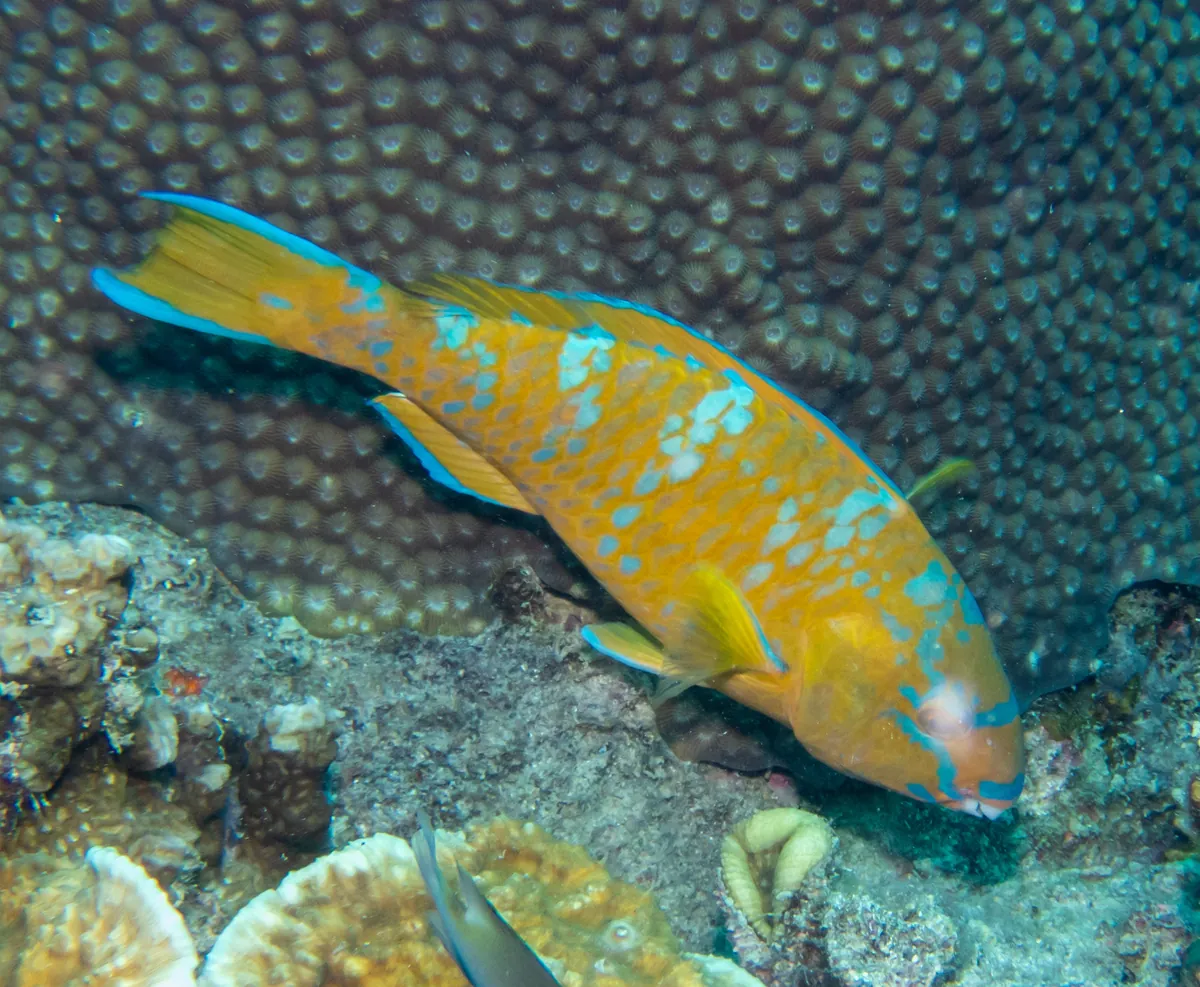
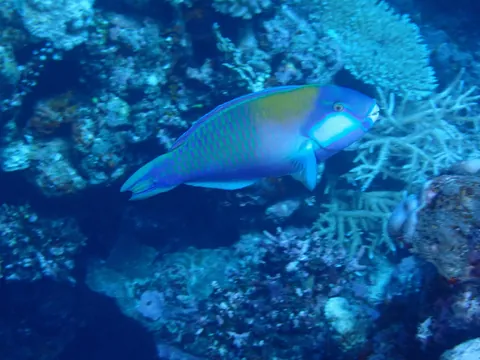
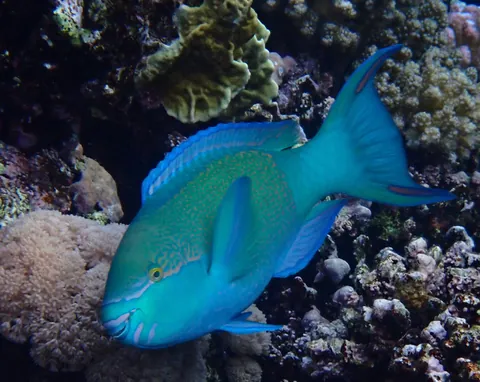
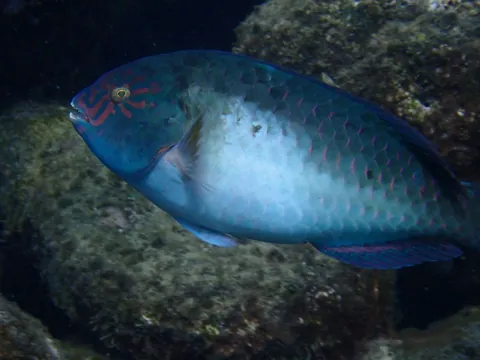
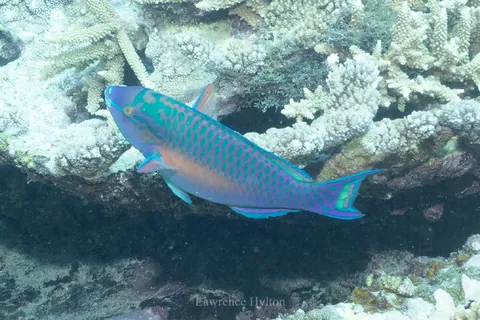
The blue-barred parrotfish is a large, heavy-bodied grazer of reefs and sandy ground. It feeds by scraping algae off rock and coral with its hard, beak-like mouth, and it can swing its lower jaw round very fast while it does so. This scraping breaks reef rock into fine sediment, so the fish is part of how sand is made and moved around a reef. Adults are often alone but sometimes gather in small groups. It reaches 75 cm, although most animals you meet are nearer 30 cm. Like other parrotfish, it starts life as a female and some individuals later turn into males, which is why the colours differ so much between animals.
Also known as: bluebarred parrotfish, blue-barred parrotfish, cream parrotfish, globe-headed parrotfish, green blotched parrotfish, cream parrotfish, flame-breasted parrot-fish, yellow scale parrot fish, globe-headed parrotfish, bluechin parrotfish, parrotfish, parrot fish, blue-barred parrotfish, bluebarred parrotfish, yellowscale parrotfish, green blotched parrotfish, blue barred parrotfish, blue-barred orange parrotfish, blue-barred parrotfish, blue-barred orange parrotfish, yellowscale parrotfish, blue-barred orange parrot-fish, flame-breasted parrot-fish
Colour will not settle this one, since it varies hugely with age and sex and overlaps with other large Indo-Pacific parrotfish. Size is a good first filter: this species reaches up to 75 cm, bigger than most reef parrotfish. On an adult male, the green gill-cover dot noted above is the fastest confirmation; on females and mid-sized fish, use the head banding already described rather than body colour alone.
Colour is variable and changes with age and sex. The general tone is blue-green to green, often with a pink or yellow wash on the underside, a pink stripe running along the middle of the back fin and the fin under the tail, and blue marks around the base of the side fin. Females are red on the head, belly and fins, with wavy black and white stripes along the side and dark green bands around the mouth and the eye. Large males are dark reddish brown towards the front, with a bright green dot high on the gill cover, at the end of a line running back from the mouth through the eye. Small females have a rounded tail; big adults have long points drawn out from the top and bottom of the tail.
This is an Indo-Pacific fish, found from East Africa east across to the islands of the central Pacific, north to Japan and south to Australia, with a separate population out at the Galapagos. It has also moved into the eastern Mediterranean through the Suez Canal, where it is still uncommon. Adults live on lagoon and seaward reefs and favour slopes and drop-offs, but also sandy bottoms, seagrass and thin, marginal reef. Males are usually found shallow, around the inner and outer edges of barrier reefs, while females tend to sit deeper. Small juveniles form groups inshore over algae-covered reef and will go into silty, murky water. The species is recorded from 1 m down to 90 m.
It is listed as Least Concern. Large numbers are caught for food, and many more are taken by accident in fisheries aimed at other species, but it is not a main target anywhere. The bigger long-term worry is the reef itself: this fish depends on coral reef, so it is likely to suffer as reefs decline.
This parrotfish can swing its lower jaw round at high speed. That fast rotation turns the mouth into an effective scraper and helps it strip fine sediment straight off the rock.
Describe what you saw and we name it, then keep every species you find in your Oceandex.