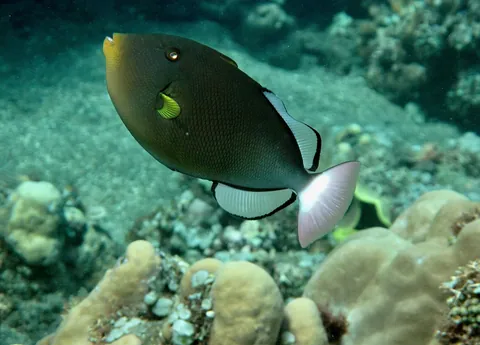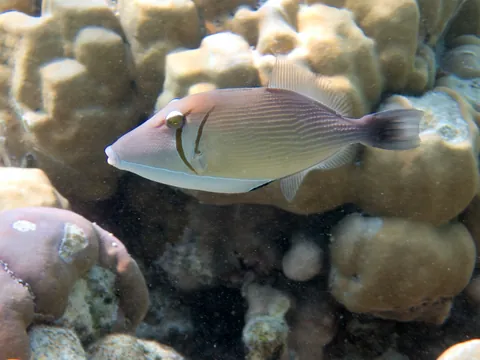
Boomerang triggerfish
Sufflamen bursa
Melichthys niger
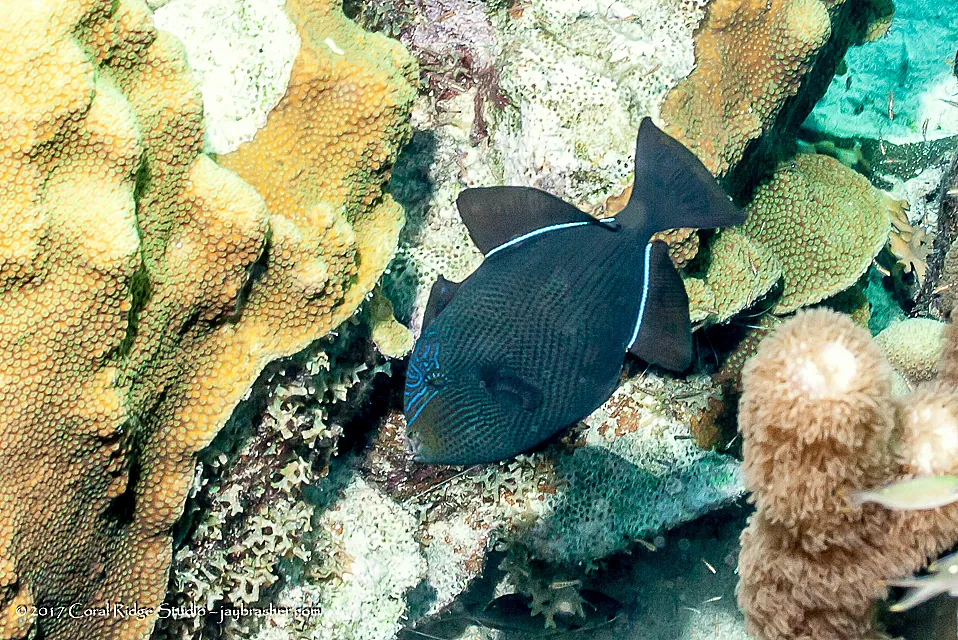
From a distance this triggerfish looks solid black, but a closer look under a torch reveals it's actually a shifting mix of dark blue-green and orange. It grows to about 50 cm, though most are closer to 30 cm.
Also known as: black durgon, ebony triggerfish, pigger, black oldwife, black durgon triggerfish, black durgeon
This species is easily confused with the very similar Indian triggerfish, especially in the aquarium trade. The clearest mark to check is the bright white line running along the edges of the dorsal and anal fins, rather than trying to judge the base body color, which shifts with light and mood.
This is a blimp-shaped triggerfish with bright white lines running along the edges of its dorsal and anal fins. Seen from afar it appears completely black, but up close it shows mottled dark blue-green coloring, often with orange near the front of the head. It can shift these colors depending on its surroundings.
It is found across the tropical Indo-Pacific and Red Sea, including around southern Africa, in open water, shallows, and exposed reef crests, usually near a slope or drop-off into deeper water. It gathers in small, loose groups, at depths of 2 to 75 m, mostly in the top 20 m.
It feeds on a wide mix of food: small fish, squid, shrimp, drifting zooplankton, and calcareous algae (algae that builds a hard, chalky skeleton). It sometimes swims well above the seabed to pick zooplankton out of the water.
In a bay in Brazil, groups of around 100 of these triggerfish gather around resting spinner dolphins to feed on their feces and vomit, and the fish have learned to recognize the posture a dolphin takes just before it releases waste.
Describe what you saw and we name it, then keep every species you find in your Oceandex.