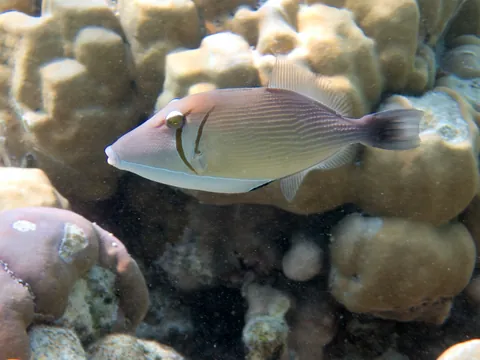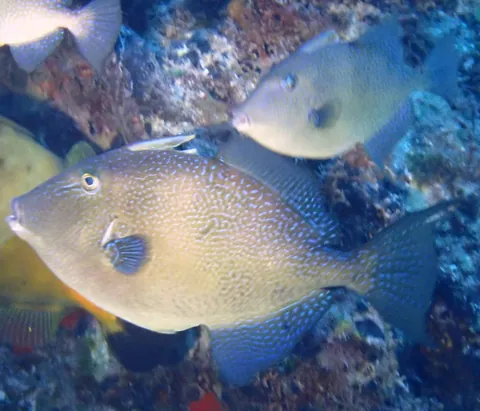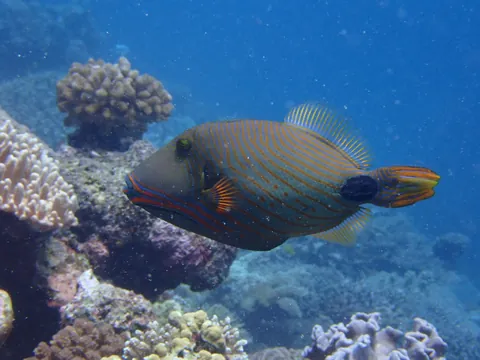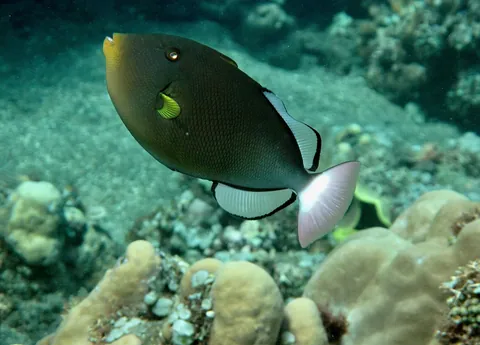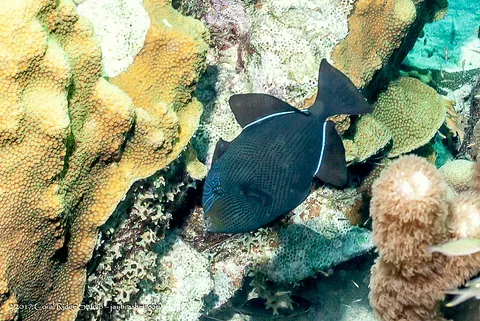
Black Triggerfish
Melichthys niger
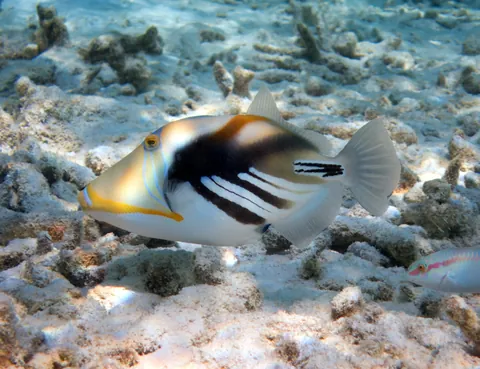
Balistoides conspicillum
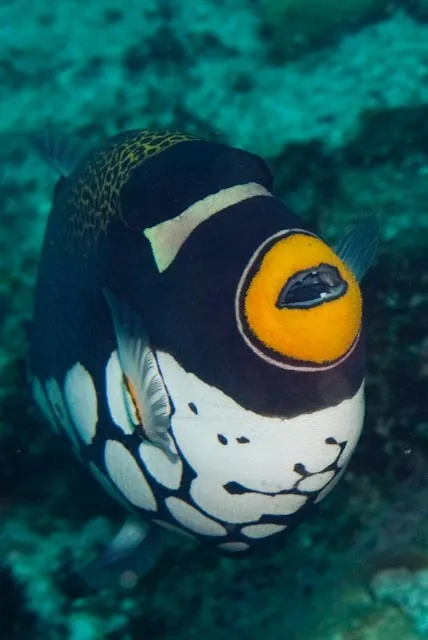
Few reef fish dress this loudly: a black, boxy body scattered with huge white polka dots below, a tangle of yellow lines above, and a mouth ringed like a target. It grows to about 50 cm and is one of the most recognisable fish on any Indo-Pacific reef.
Also known as: big-spotted triggerfish, bigspotted triggerfish, clown tiger, clown trigger-fish, big-spotted trigger-fish, clown trigger-fish, pogo panau
Nothing else on the reef combines huge white spots on a black body with that yellow-and-white ringed mouth, so the pattern alone confirms this species.
The body is stocky, oval, and flattened from side to side, with a large head making up roughly a third of its length. The mouth is small but armed with strong teeth. Like other triggerfish, it has a first dorsal fin made of stiff spines that lock upright, hidden in a groove along its back. The background colour is black, with the lower half of the body covered in large, rounded white spots. Around the first dorsal fin, fine yellow lines form a network like a leopard's coat. A yellow ring circles the mouth, itself bordered by a white ring, and a white stripe crosses the snout just below the eyes. The second dorsal and anal fins are white with a yellow line at the base, the tail is yellowish, and the base of the tail carries a yellow blotch and rows of small spiny scales.
It favours clear water along outer reef slopes and steep drop-offs, from just below the surface down to 75 m. Adults swim openly along these drop-offs but will dart into caves when approached. Juveniles are more secretive, tucked into small caves rich with invertebrate life, usually shallower than 20 m.
This is a solitary, daytime fish that holds a territory and can be difficult to find despite its bold colours. It becomes more aggressive and less sociable with age, and can be one of the more short-tempered fish on the reef. When threatened, it wedges itself into a crevice and locks its first dorsal spine upright, along with a smaller fin, making it very hard for a predator to pull out. Adults form harems after about a year of age. Pairs spawn over sandy patches, and the parents guard the nest for roughly eight days until the eggs hatch.
This species has not yet been formally assessed by the IUCN. It occurs at naturally low densities across most of its range, though it can be locally common on reefs with high biodiversity. Because it is one of the most sought-after aquarium fish, escaped or released individuals have shown up outside its natural range, including in the Red Sea and, in a single record, the Mediterranean.
Despite being one of the most prized fish in the aquarium trade, it is naturally uncommon to rare across most of its wild range.
Describe what you saw and we name it, then keep every species you find in your Oceandex.