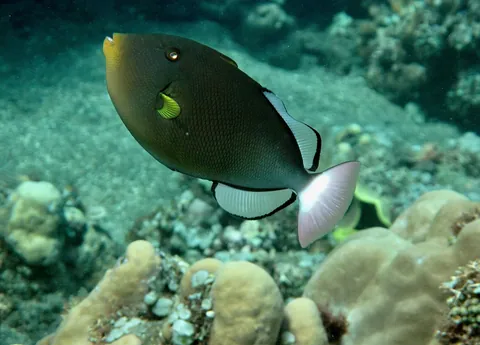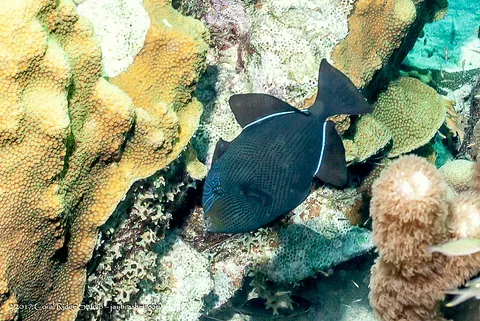
Black Triggerfish
Melichthys niger
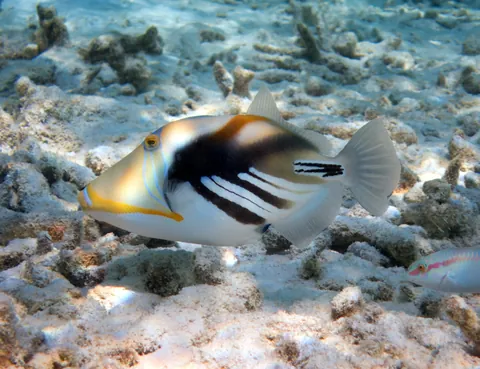
Sufflamen bursa
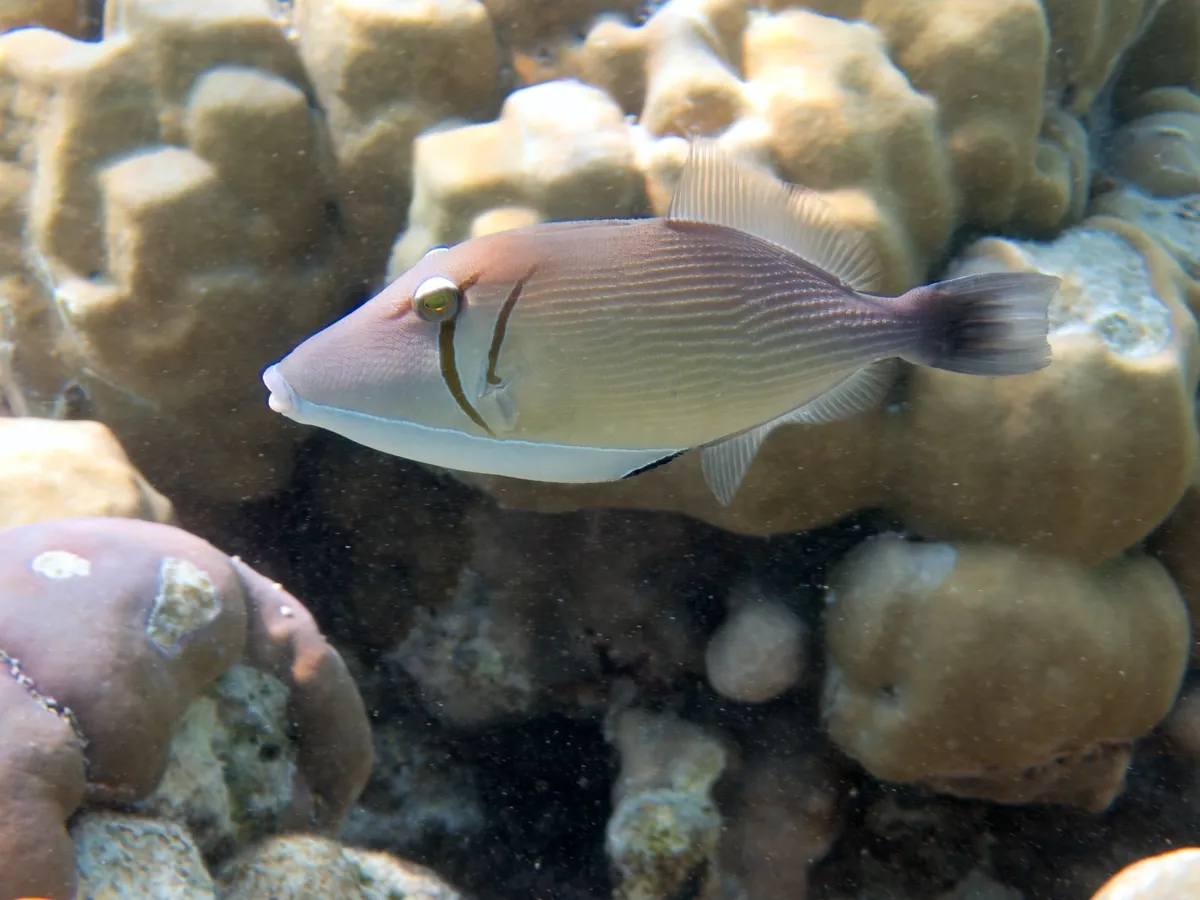
Named for the two curved stripes that wrap behind its eyes like a Hawaiian lei, this triggerfish is one of the more relaxed reef bullies, patrolling its patch alone or in pairs. It grows to about 25 cm.
Also known as: pallid triggerfish, scimitar triggerfish, scythe triggerfish, scythe triggerfish, boomerang triggerfish, boomerang triggerfish, scythe triggerfish, pallid triggerfish, lei trigger, scimitar triggerfish, boomerang triggerfish, sycthe triggerfish, whiteline triggerfish, boomerang triggerfish, boomerang trigger-fish
The two stripes wrapping back from the eye keep their lei-like position even as their colour shifts between yellow and brown with the fish's mood - that fixed pattern, not the colour, is what confirms this species among other triggerfish.
The body is rectangular with a toothy, beak-like snout typical of triggerfish. Colouring is usually pale but can darken to brown with hints of purple on the anal, pelvic, and tail fins depending on the fish's mood. A single white stripe runs from the mouth to the base of the pectoral fin, and two more stripes - one through the eye, one behind it along the gill - wrap around the head, shifting between yellow and brown. Tiny barbs cover the scales.
It lives on coral reefs across the tropical and subtropical Pacific and Indo-Pacific, favouring warm, shallow water with sandy or reef bottoms just inshore of the surge zone, from exposed reef flats to deep drop-offs. At night, and when predators are near, it hides in reef crevices.
It is usually solitary but is often seen in pairs and sometimes trios, patrolling and hovering around reef areas with varied depth and plenty of hiding spots. It hunts shrimp, urchins, worms, crabs, and other invertebrates picked from rocks and coral, and it will flip sea urchins upside down to reach their less-spined underside.
Tiny barbs on its scales repel sea urchin spines, making it immune to their venom.
Describe what you saw and we name it, then keep every species you find in your Oceandex.