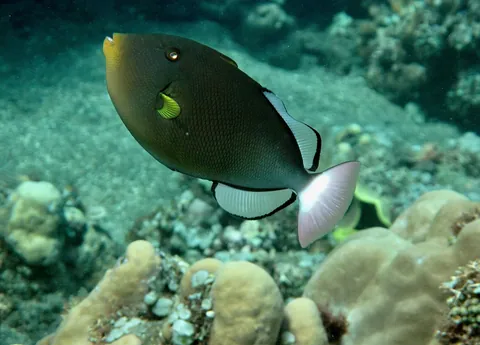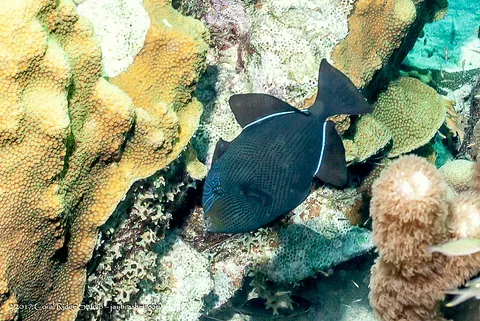
Black Triggerfish
Melichthys niger
Balistes capriscus
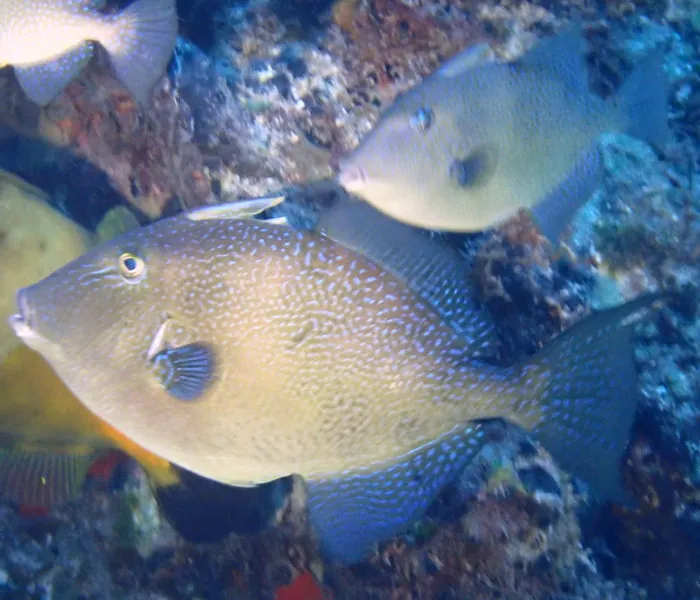
Plain compared to its flashier triggerfish relatives, the grey triggerfish makes up for its drab colour with clever, deliberate hunting habits. It grows to about 60 cm, though most individuals seen are closer to 44 cm.
Also known as: cucuyo, filefish, gray triggerfish, grey triggerfish, grey triggerfish, trigger fish, leatherjacket, gray triggerfish, pig-faced, turbot, triggerfish, file-fish
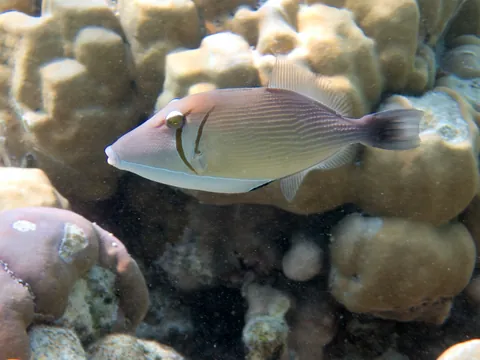
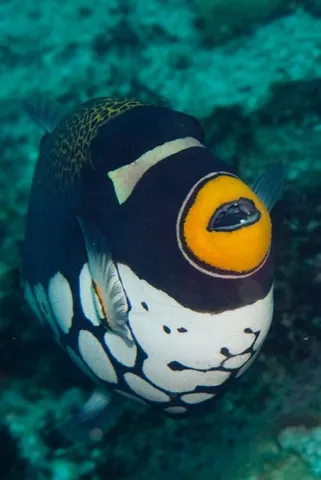
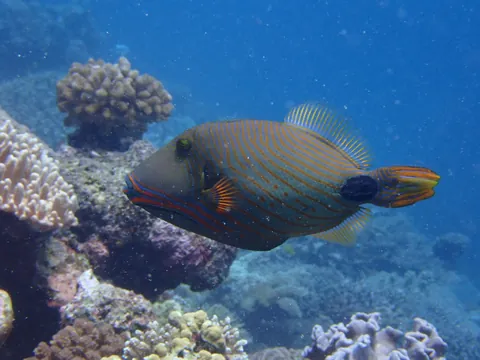
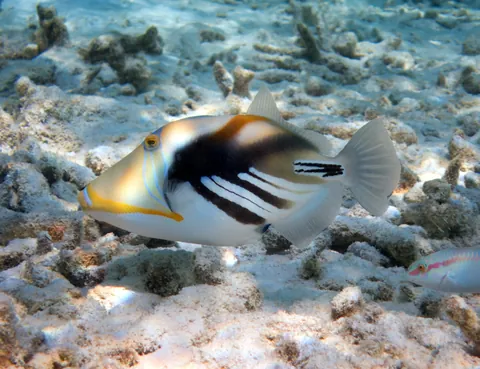
Most other triggerfish on the reef carry bold patterns or bright colours. This species stands out by its plainness: a plain grey, patternless body is the quickest way to tell it apart from its more colourful relatives.
This fish has a deep, flattened body covered in tough, leathery skin. It has a small, beak-like mouth at the tip of a pointed snout, and its eyes sit far back near the top of the head. Its colour is a plain, uniform grey over the whole body. The first spine of its front dorsal fin is thick and much longer than the two spines behind it. Its pectoral fins, the pair just behind the gills, are small and rounded.
Look for it over hard bottoms such as reefs and rocky ground, as well as in lagoons and bays, in shallow to moderately deep water down to around 55 m. It ranges through the shallow western Atlantic and also across the eastern Atlantic, including the Mediterranean Sea.
When threatened, this fish wedges itself into a crevice and locks a strong front dorsal spine upright. This makes it very hard to pull out. A second, smaller spine must be pressed down first to release the lock. It feeds on the seabed, using strong teeth to crack open shrimp, crabs, mollusks, sea urchins, sand dollars, starfish, and sea cucumbers. To dig prey out of sand, it hovers upright over the bottom and blasts jets of water from its mouth. This blows sand away, and it repeats the move until something edible turns up.
Anglers off Florida call it a notorious bait stealer. Its small, bony mouth lets it nibble bait off a hook without getting caught, so it takes a small, sharp hook to land one.
Describe what you saw and we name it, then keep every species you find in your Oceandex.