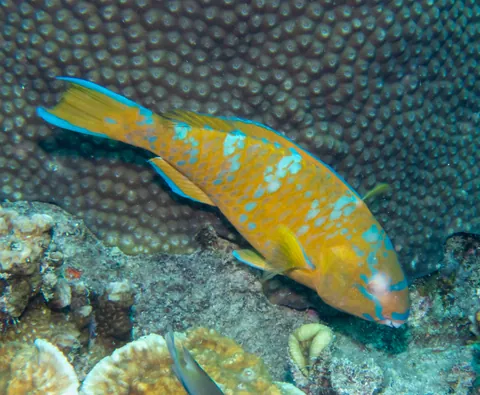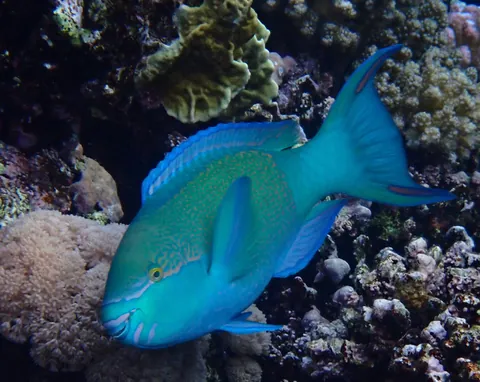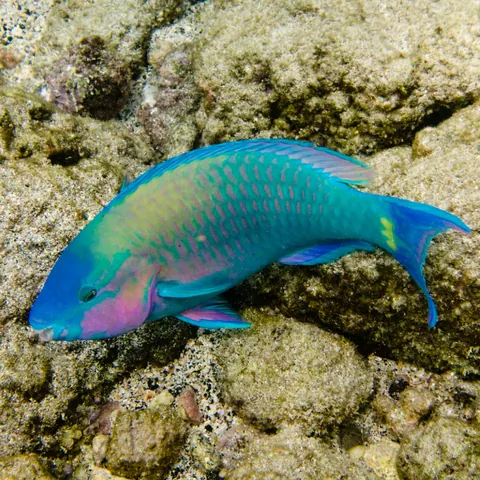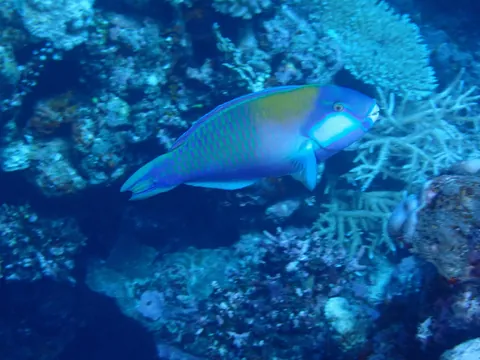
Bleeker's parrotfish
Chlorurus bleekeri
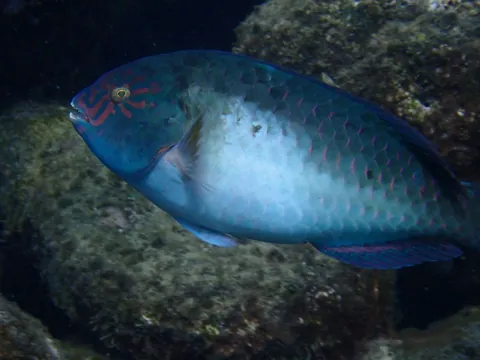
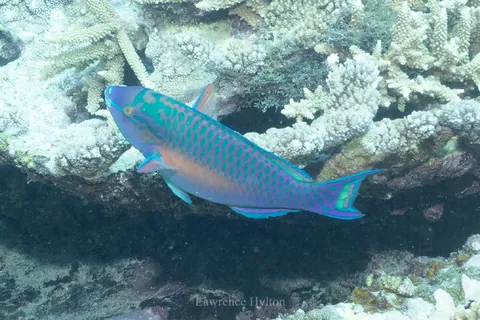
Cetoscarus bicolor
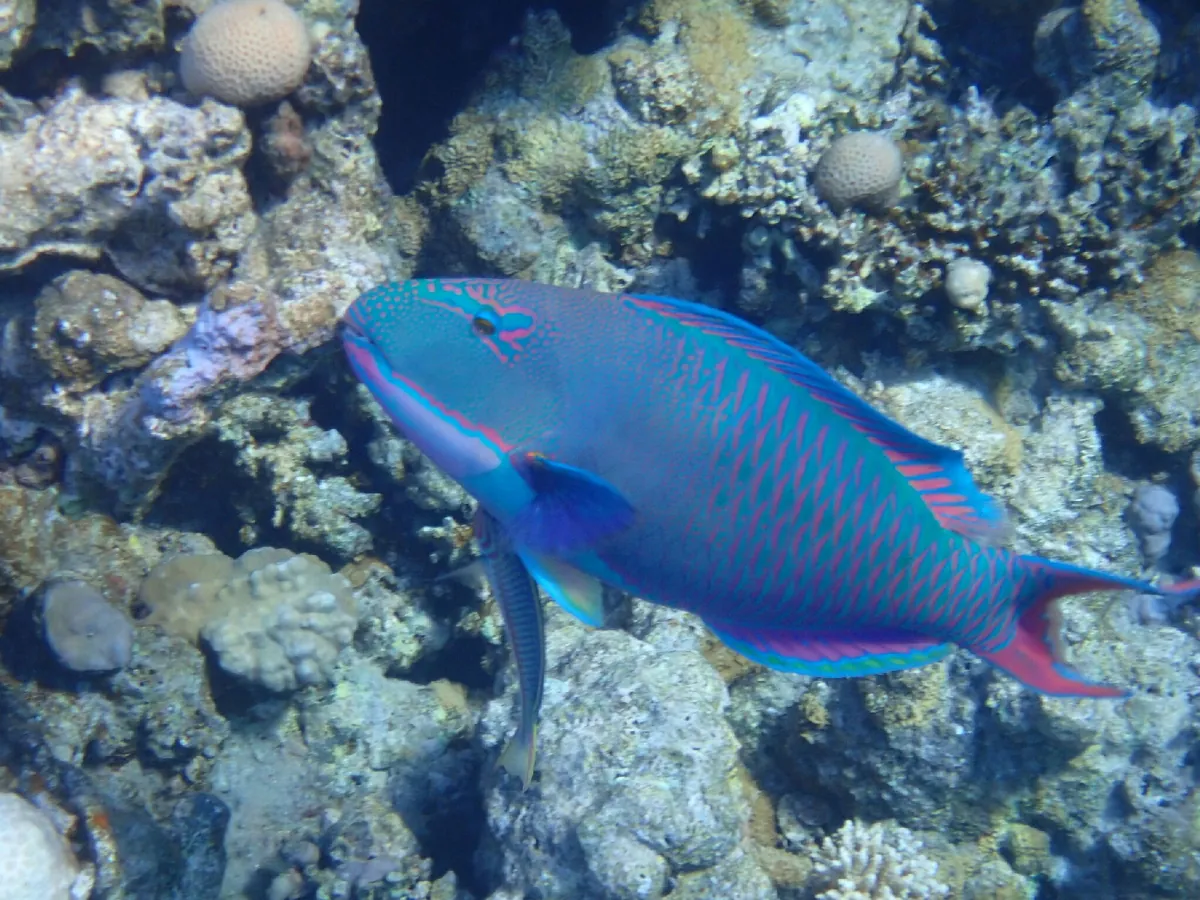
Few reef fish change as completely as this one. A bicolour parrotfish starts life as a small white fish with a black spot and an orange eye stripe, grows into a dark brown fish with a pale saddle, and may end as a green giant flecked with pink. It is one of the larger parrotfish, reaching about 50 cm.
Also known as: bumphead parrotfish, red-speckled parrotfish, two-colored parrotfish, spotted parrotfish, spotted parrot-fish, two-colour parrotfish, bumphead parrotfish, parrotfish, red-speckled parrotfish, two-colored parrotfish, bicolor parrotfish, bicolor parrotfish, two-colour parrotfish, spotted parrot-fish, two-coloured parrotfish
Reefs are full of parrotfish, and each one looks different at different ages, so colour alone will mislead you. Go by the stage. On a small white fish, it is the single dark spot on the back fin together with the orange line through the eye. On a dark brown adult, it is that one large pale patch high on the body, with no other markings to compete with it.
Juveniles are white, with a black spot on the back fin and an orange band running through the eye. In the first adult stage the fish is dark brown with a big cream patch on the upper part of the body. In the final stage the fish is mostly green, dusted with pink spots, with bright pink edges to the fins. The mouth is a hard beak, formed from teeth fused into plates, and the lower part is the working edge.
This is a coral reef fish, found in lagoons and on seaward reefs, in water of about 24 to 28 C. It lives between roughly 1 and 30 m, so most of its range is comfortable diving depth. Young fish keep to thick coral and to patches rich in algae, where there is food and cover from predators. Adults move out onto open reef and rocky ground, where there is more surface to graze. It is recorded from the Red Sea among other places.
Adult males hold territory, and that territory is a feeding ground. All of these fish are born female, and one turns male as it grows older, mostly when the group has no male in it. Because of that, the biggest fish in a population are usually the males. The fish feeds by scraping algae off rock and coral with the lower part of its beak. That grazing keeps algae from smothering the coral and stealing its light. It also grinds rock and coral as it goes, and what comes out the other end is fine sand.
The IUCN lists the bicolour parrotfish as Least Concern. That rating sits on top of a real dependence, because this fish cannot be separated from the reef it eats and lives on. When warming water bleaches coral, the reef structure breaks down and the algae it grazes go with it. Pollution, overfishing and coastal building add to the pressure, and nutrient-rich run-off from farmland feeds the very algae that harm coral. Protecting this parrotfish means protecting the reef itself.
This parrotfish and its Pacific counterpart, Cetoscarus ocellatus, were long counted as a single species, and the genus was thought to hold only one fish. Later work on their genes and their body shape found clear differences between the two, and they were split apart.
Describe what you saw and we name it, then keep every species you find in your Oceandex.