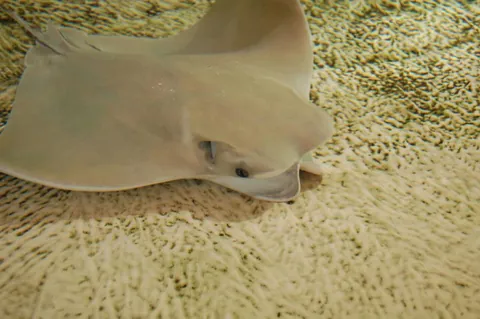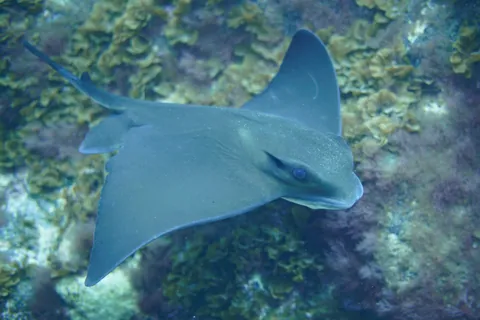
Common eagle ray
Myliobatis aquila
Myliobatis californica
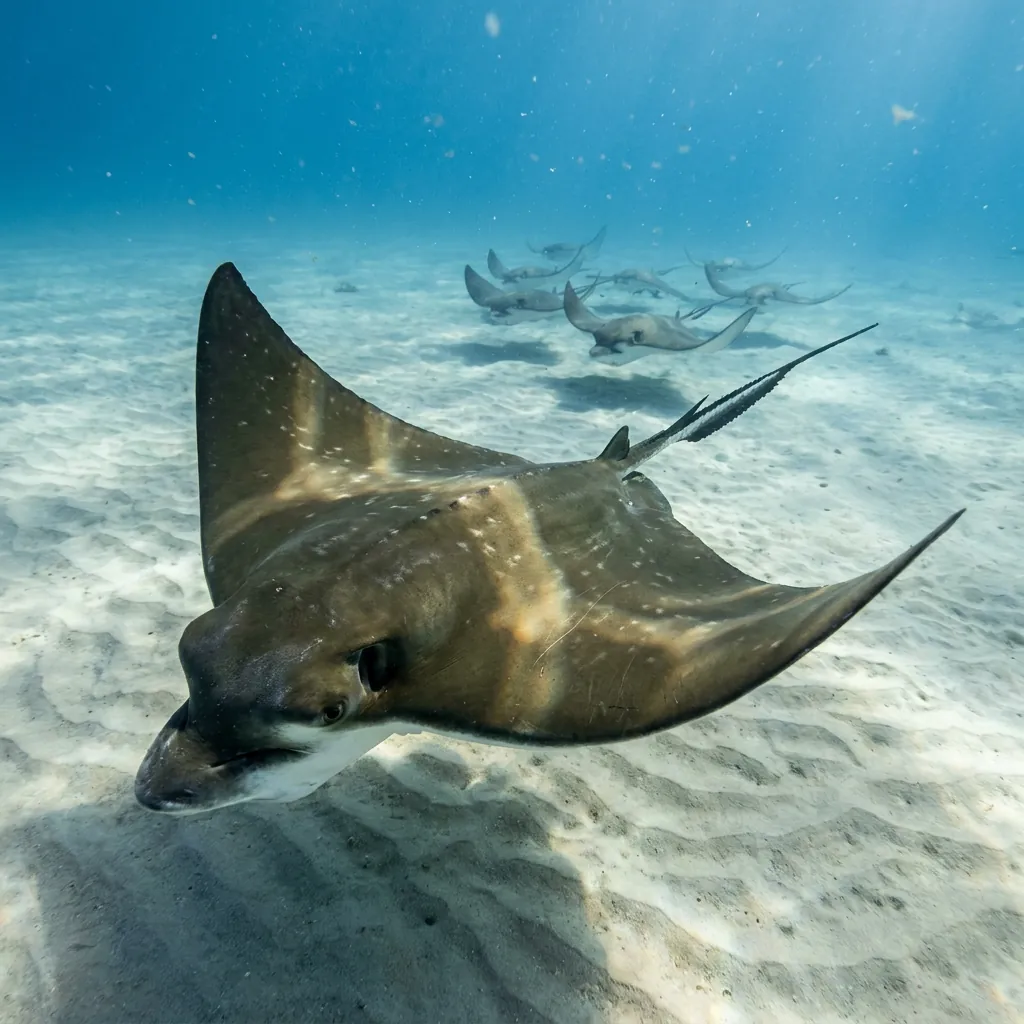
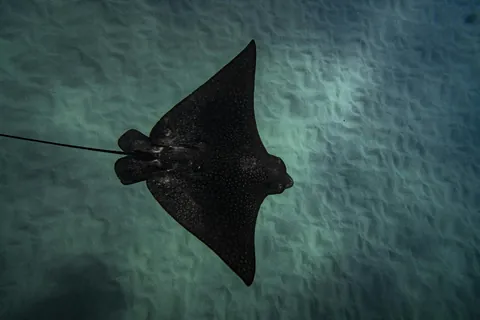
The bat ray glides over sandy bays like a dark shadow, its wing-like fins beating slowly through the water. It can weigh as much as 82 kg, yet spends much of its time quietly digging through the sand for buried prey.
It can be mistaken for other eagle rays with a similar diamond-shaped wing outline. Look for the clear dip in the top of the head between the eyes, a feature other rays lack.
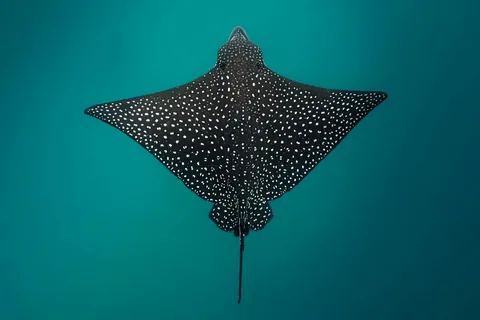
Its body forms a diamond shape, with broad, wing-like pectoral fins that end in blunt points. The head sits raised above the fins, with eyes set on either side, and there is a clear dip in the top of the head between the eyes. A long, whip-like tail trails behind, carrying at least one venomous spine near its base. The upper side is black or dark brown, while the underside is white.
It lives in muddy or sandy bays, estuaries, and sloughs, as well as kelp beds and rocky shorelines, from Oregon south to the Gulf of California. It stays mostly in shallow water close to shore but has been found down to 108 metres.
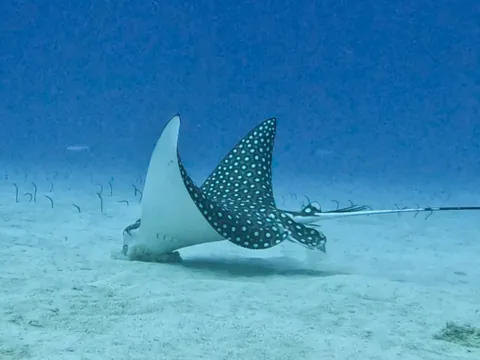
It digs through sand and mud using its wing-like fins and snout, sometimes cutting trenches to expose buried prey. It feeds mainly on clams, crabs, shrimp, and other invertebrates, along with small fish, and will eat whatever prey is most available in a given spot.
This ray gives birth to live young rather than laying eggs, with a gestation period of nine to twelve months following spring or summer mating. Pups emerge tail first with their fins wrapped around the body, and the young ray's spine is covered by a soft sheath that falls away within hours of birth.
This species is listed as least concern and is not commercially fished, though it is sometimes caught as bycatch. Its main predators are California sea lions, great white sharks, and broadnose sevengill sharks, and it relies on camouflage in the sand to avoid being seen.
It digs feeding pits in the sand that can stretch up to 4 metres long, and the leftover holes let smaller fish reach buried prey they could not dig out themselves.
Describe what you saw and we name it, then keep every species you find in your Oceandex.