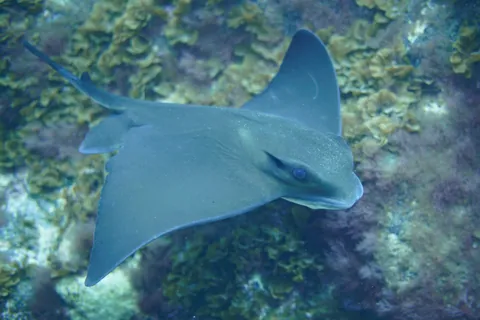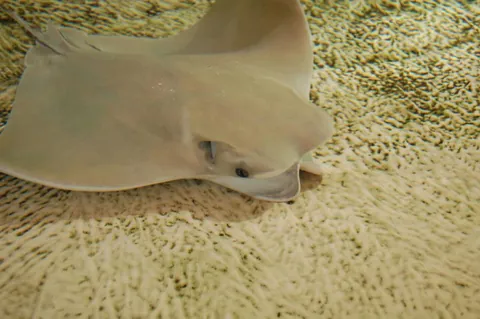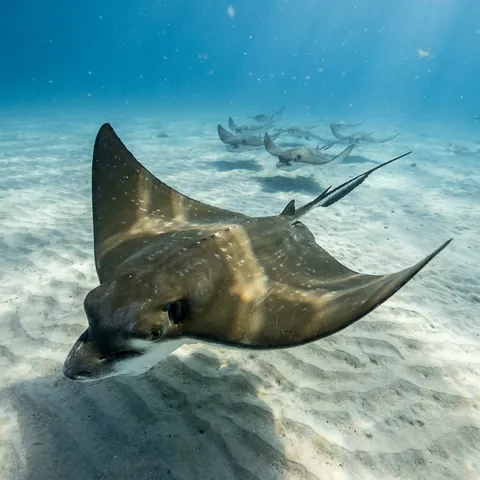
Bat Ray
Myliobatis californica
Aetobatus narinari
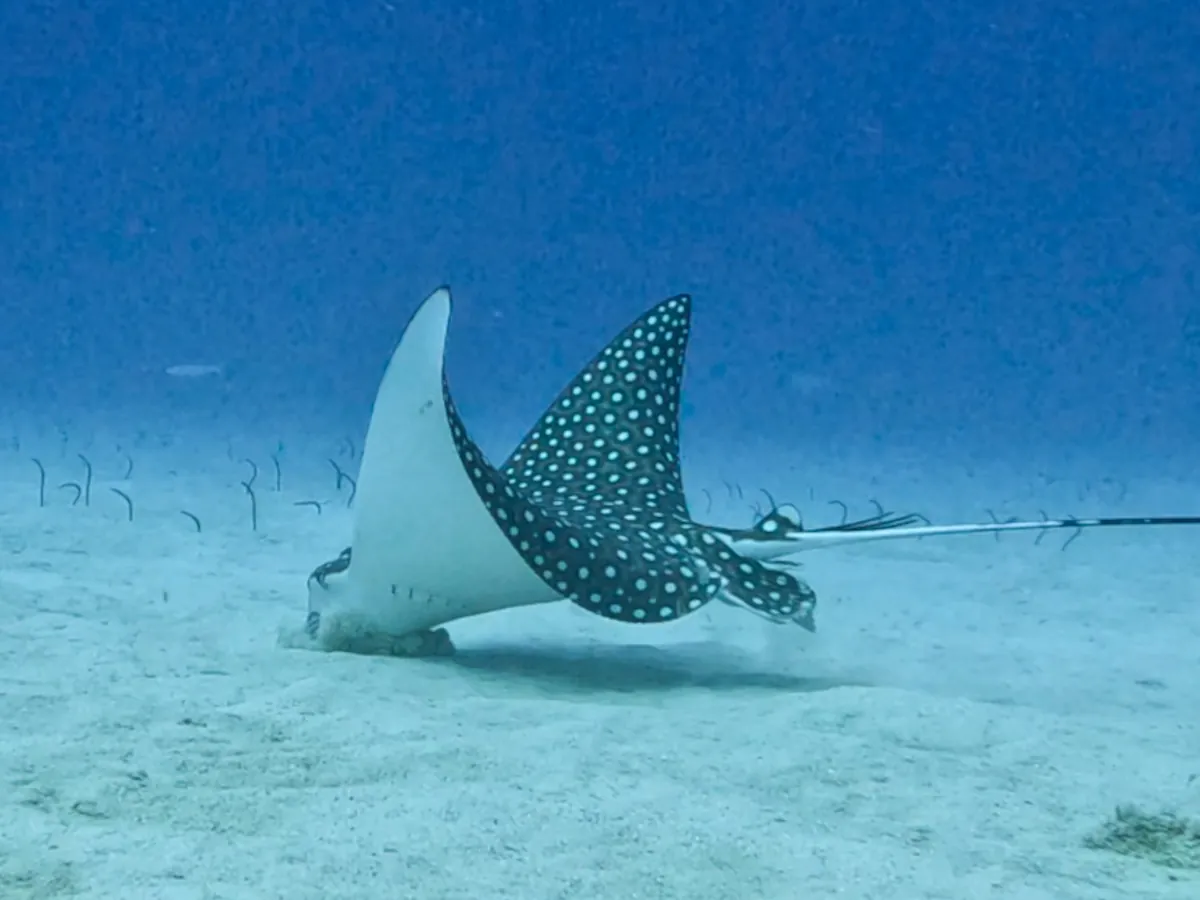
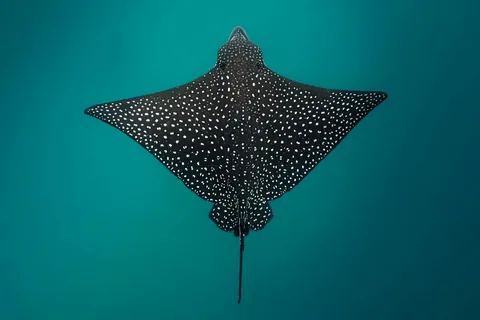
The spotted eagle ray is one of the most striking rays on the reef, its dark back scattered with bright white spots. It can reach 330 cm long and weigh up to 230 kg, and it is a common sight gliding over reefs and sandy bays in warm seas.
Also known as: aetobatus narinari, bishop ray, bonnet skate, duckbil ray, duckbill eagle-ray, duckbill ray, eagle ray, flying ray, lady ray, lang spotted eagle ray, leopard ray, mottled eagle ray, skate, spotted bonnetray, spotted duckbill ray, spotted duckbilled ray, spotted eagleray, spotted edgle-ray, spotted stingray, spotted whipray, spotted-eagle ray, sunfish, whip, whip ray, white-spotted eagle ray, whitespotted eagle ray
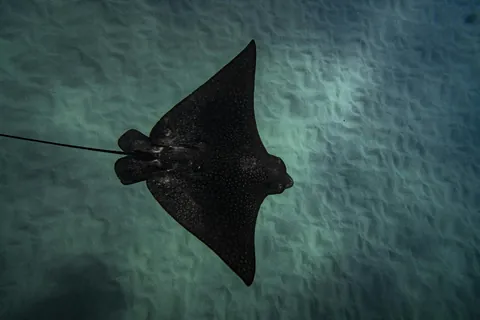
It shares its rounded, wing-like shape with cownose rays. The giveaway is the back: an eagle ray keeps its white spots on a dark background, while a cownose ray's back is a plain brown or olive.
It has a flat, wing-shaped disc with sharply angled corners, dark blue or black on top with white spots, and a white underside. Its snout is flat and rounded like a duck's bill. A long, whip-like tail trails behind, carrying two to six venomous spines near its base.
It lives in warm coastal waters worldwide, from shallow coral reefs and sandy bays down to about 80 m. It often swims well off the bottom, gliding in open water near the surface, sometimes alone and sometimes in schools.
Spotted eagle rays move more at certain tide stages and can cover long distances in a single day. They are one of the few rays known to leap clear of the water, sometimes jumping straight up or launching at an angle, often several times in a row.
It hunts bivalves, crabs, whelks, octopus, shrimp and worms buried in the sand, along with the occasional small fish. Its teeth are fused into flat, chevron-shaped plates strong enough to crush thick shells.
Females retain their fertilised eggs inside the body, where pups develop and are born live rather than hatching from an egg case outside. Genetic studies have also found that females can sometimes produce young without mating at all.
traumatogenic
The spotted eagle ray is listed as endangered. It is caught in coastal fisheries for its meat and cartilage, and some regions now limit or ban its capture and trade, while aquariums run breeding programmes to reduce the need for wild-caught animals.
Uniquely among rays, the spotted eagle ray digs into the sand with its snout to unearth buried prey, sending up a cloud of sand that puffs out through its gills.
Describe what you saw and we name it, then keep every species you find in your Oceandex.