Bat Ray
Myliobatis californica
Myliobatis aquila
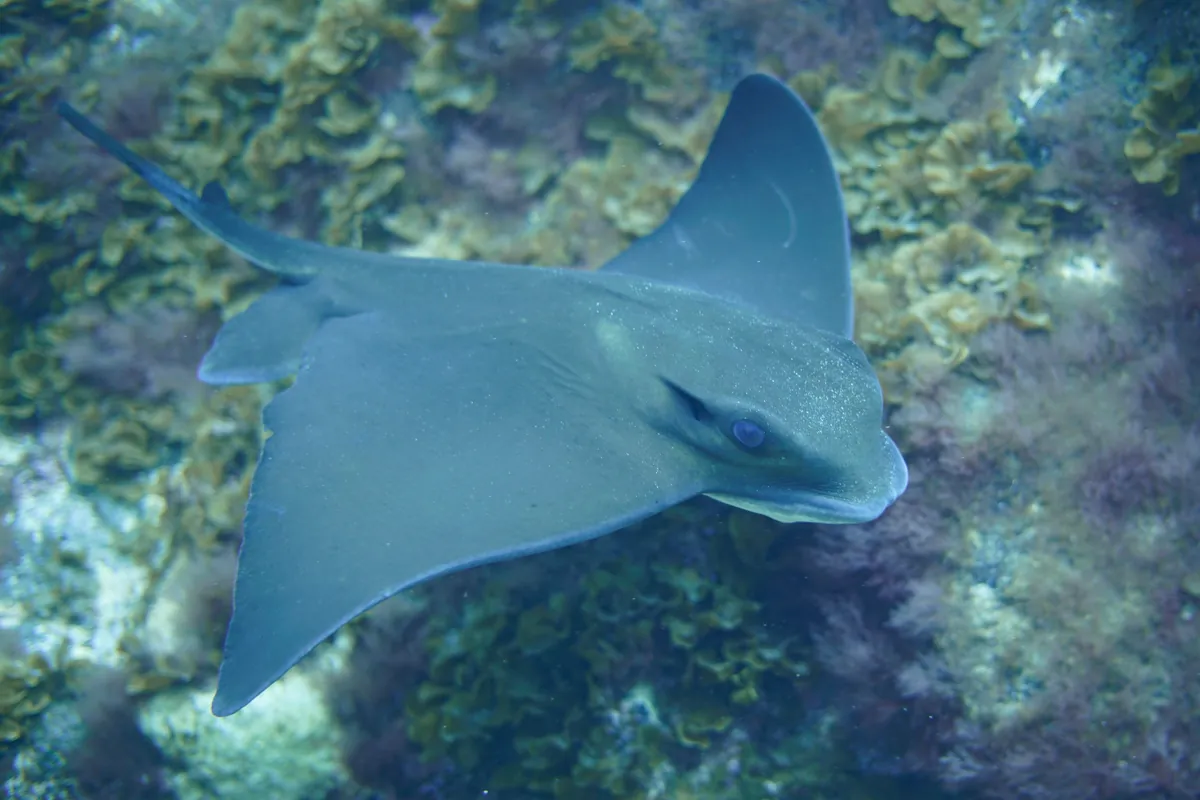
The common eagle ray is a broad-winged bottom feeder that digs through sand for shellfish. It can reach 183 cm across and weigh up to 14.5 kg, though most divers see smaller animals.
Also known as: spotted eagle ray, coryphaena hippurus lambouka common eagle ray, eagle ray, toadfish, sea eagle, common bull ray, whipray, mill skate, eagleray
Unlike eagle rays with spotted or patterned backs, this species has a plain, unmarked brown or black back, which is the simplest way to tell it apart.
The disc is broad with sharply angled corners and a short, rounded snout. The upper side is plain brown or blackish with no pattern, while the underside is white.
This ray lives in the eastern Atlantic from the British Isles to South Africa, in the Mediterranean Sea, and in the southwestern Indian Ocean. It is found both close to shore and out to deep water, usually over open sandy ground.
It feeds mainly on crustaceans and bivalve molluscs, digging them out of the seabed, along with worms, snails, sea pens, and fish. Larger rays eat more fish than smaller ones. Flat, plate-like teeth let it crush shells instead of biting.
This ray gathers in groups to breed and gives birth to live young rather than laying eggs. Pups feed first on their egg yolk and later on fluids from their mother before they are born.
This species is currently rated Data Deficient, meaning too little is known to judge its status with confidence. It is nonetheless caught as bycatch in parts of its range, especially the Mediterranean, and has become rare in some areas.
In a study comparing three cartilage fish in the Mediterranean, this ray had the lowest mercury levels of the three, likely because it eats mostly shellfish and worms rather than other fish.
Describe what you saw and we name it, then keep every species you find in your Oceandex.