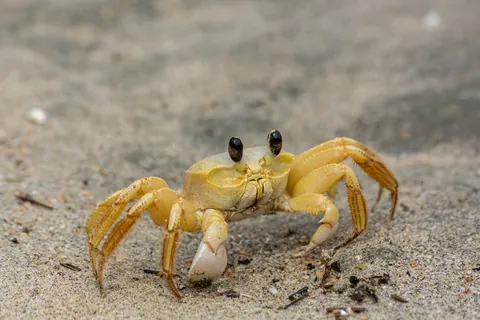
Atlantic Ghost Crab
Ocypode quadrata
Callinectes sapidus
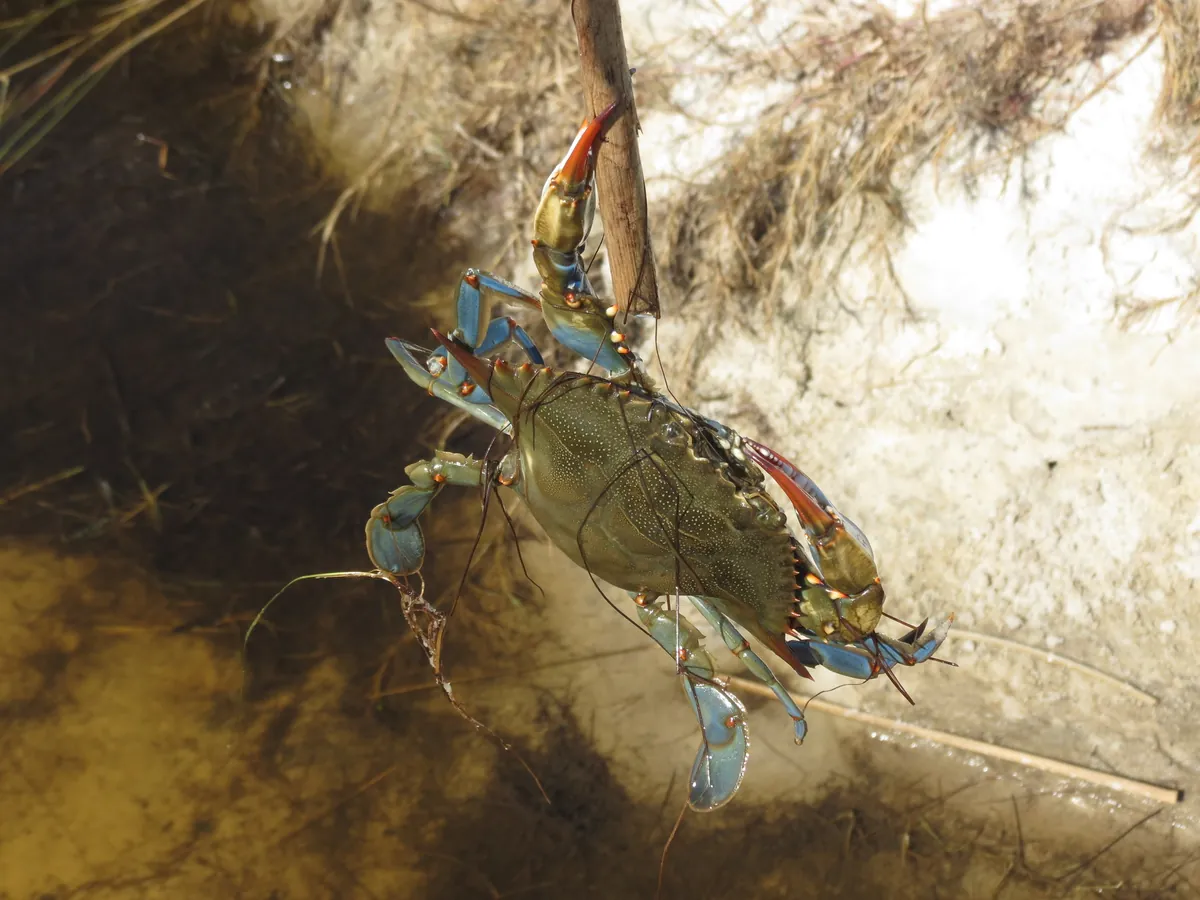
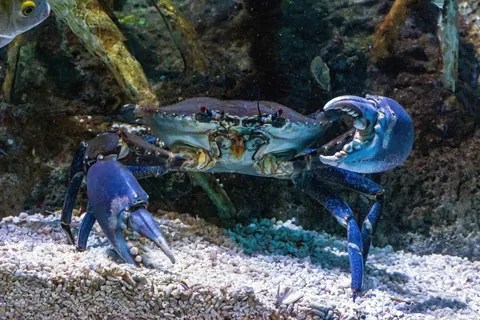
The Atlantic blue crab is an important catch along the US Atlantic and Gulf coasts, valued for its meat. It is easy to spot by its blue-tinted claws.
Also known as: common blue crab, softshell crab, hardshell crab, chesapeake bay swimming crab, blue crab, american blue crab, bluepoint
The blue crab belongs to the swimming crab family, alongside many similar-looking species, including its close look-alike the lesser blue crab. One feature marks out true Callinectes crabs from other swimming crabs: on males, the flap under the body forms a narrow T-shape, not the wider shapes seen on related crabs.
The blue crab has a wide, flat shell called a carapace. Its back legs are shaped like paddles, built for swimming. Males and females are easy to tell apart: males have a long, narrow flap under the body, while mature females have a wide, round one. Claw colour differs too - the fixed part of a male's claw is blue with red tips, while a female's is orange with purple tips. A young female has a pointed flap that turns round as she grows up.
This species lives along the western Atlantic coast, from the northeastern United States and the Gulf of Mexico south into South American waters. It mostly stays in shallow coastal water and estuaries, down to about 90 metres, usually shallower than 35. It has also reached parts of Europe and Asia, carried in ship ballast water.
Its scientific name comes from Greek and Latin: Callinectes means 'beautiful swimmer', and sapidus means 'tasty' - a fitting name for a crab so loved on dinner tables.
Describe what you saw and we name it, then keep every species you find in your Oceandex.