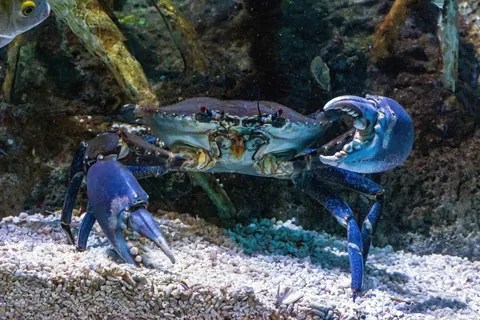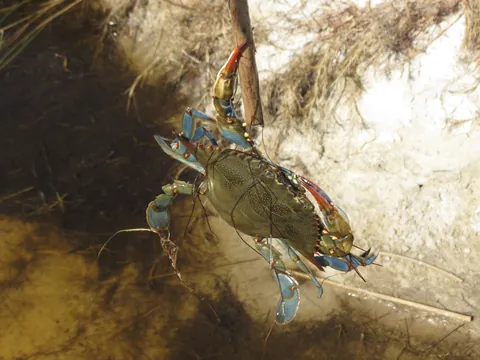
Atlantic Blue Crab
Callinectes sapidus
Cancer pagurus

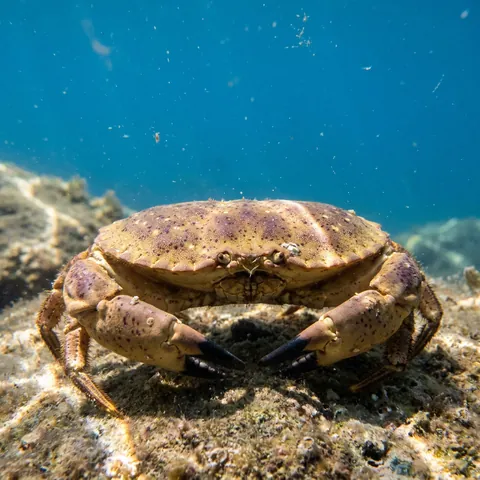
The edible crab is a heavy, reddish-brown crab known for the pie-crust ridge that runs around the front of its shell. It is the most fished crab in Western Europe, but on the reef it is very much a predator in its own right.
Also known as: brown crab
Its pie-crust shell edge sets it apart from other large crabs on the same reefs, but for a clear check, look at the claws: the fingertips are black, unlike most similar-sized crabs in its range.
Adults have a reddish-brown, oval shell, sometimes with white patches, while young crabs are more purple-brown. The front edge of the shell is folded into nine rounded lobes that look like the crimped edge of a pie crust. Its claws are strong and heavy, with black tips on the pincers, and its walking legs are lined with short stiff bristles and end in a sharp point.
It lives across the northeast Atlantic, from Norway south to North Africa, on mixed coarse ground, mud and sand. It usually stays in cracks and holes among rocks, from about 6 to 40 m, though it has been recorded as deep as 200 m. Smaller crabs can be found under rocks close to shore, just above the low-tide line.
This crab is nocturnal, staying buried in the seabed by day and coming out at night to hunt. It eats a range of crabs, small crustaceans and shellfish, ambushing prey or digging pits to reach molluscs buried in the sand. Mating happens in winter: the male stands guard over the female with his legs while she moults and they mate, and she later carries her eggs under her body until they hatch.
Its main predator is the octopus, which will even reach into fishermen's crab pots to pull one out.
Describe what you saw and we name it, then keep every species you find in your Oceandex.