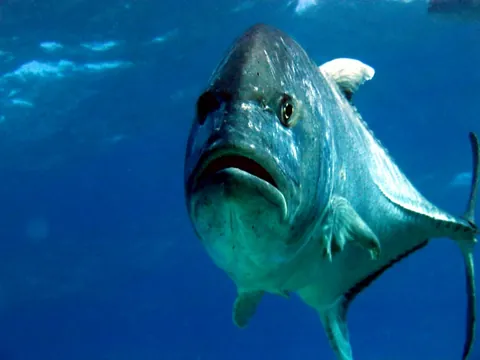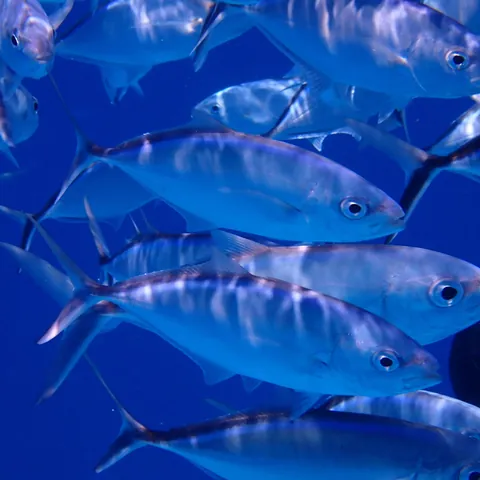
Bar Jack
Caranx ruber
Alectis alexandrina
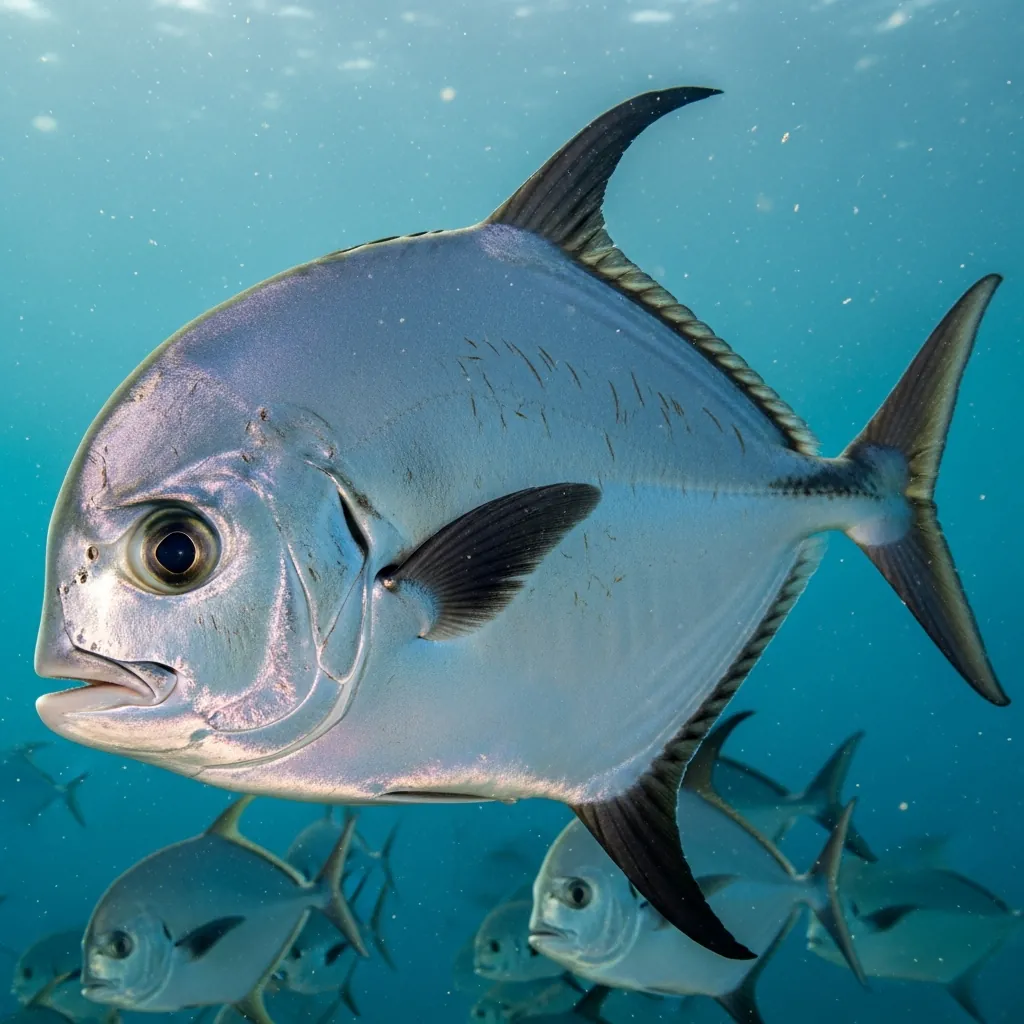
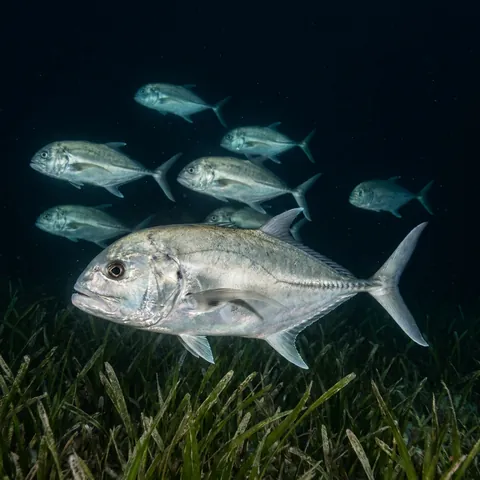
The Alexandria pompano is a big silver jack of the eastern Atlantic. It reaches about 1 m, though most fish seen are nearer 60 cm. Young ones trail long thread-like fins behind them and drift with the current, so they look almost nothing like the heavy, fast adults. Adults are strong swimmers and usually travel alone.
Also known as: alexandria pompano, carangue, pomp, pompano, threadfin horse mackerel, alexandria pompano
The fish it is most often taken for is the African pompano, which shares the tall silver body and the trailing fin threads. The head profile settles it. Seen from the side, the forehead of this species dips slightly inwards near the eyes, while the African pompano runs smoothly. That dip is the one mark to look for.
The body is tall, angular and squeezed flat from side to side, deepest between the second dorsal and anal fins. The back curves more strongly than the belly, and the fish grows longer in shape as it ages. The colour is bright silver, often with blue and green sheen, and the fins are pale silvery green to blue or almost clear. The pectoral fin is long and curved. Young fish trail very long thin filaments from the front of the dorsal and anal fins, and may show two dark bands low on the body. The skin looks bare, but it carries tiny scales set deep in the surface. Just before the tail there is a short row of scutes, hard raised scales along the lateral line.
This is a coastal fish of the warm eastern Atlantic, along West Africa from Morocco south to Angola. A few have turned up in the Mediterranean, and one as far in as the Adriatic. Adults keep to the lower part of the water column near the bottom, down to about 70 m, usually alone. Young fish live in open water instead and drift with the currents, sometimes ending up in the brackish water of river mouths.
Its first scientific name, Gallus, turned out to be already in use for a bird. The fish was then shuffled through at least six different genera before it finally settled in Alectis.
Describe what you saw and we name it, then keep every species you find in your Oceandex.