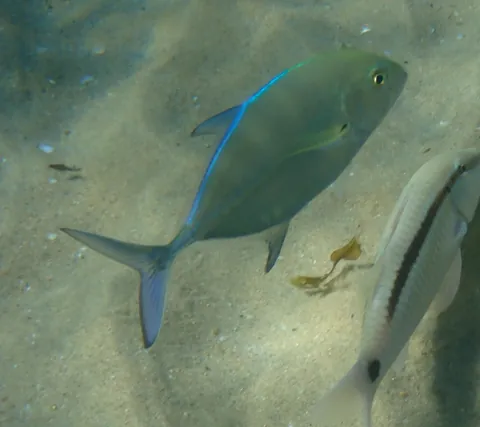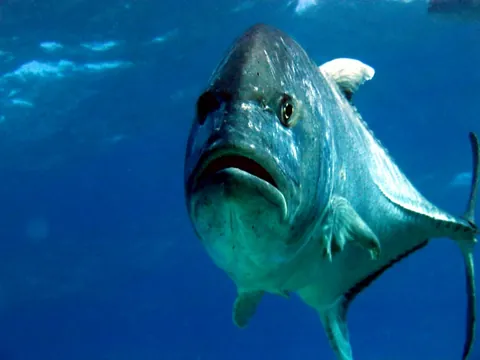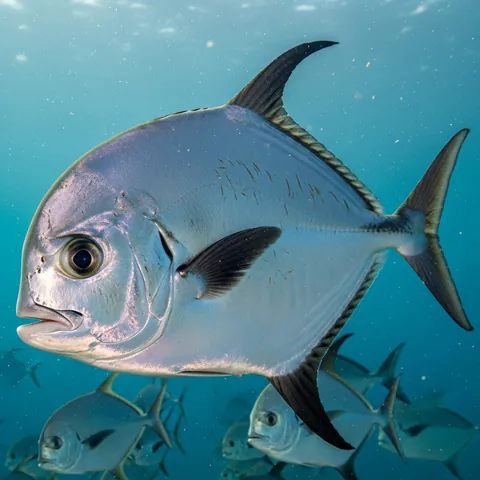
Alexandria pompano
Alectis alexandrina
Caranx sexfasciatus
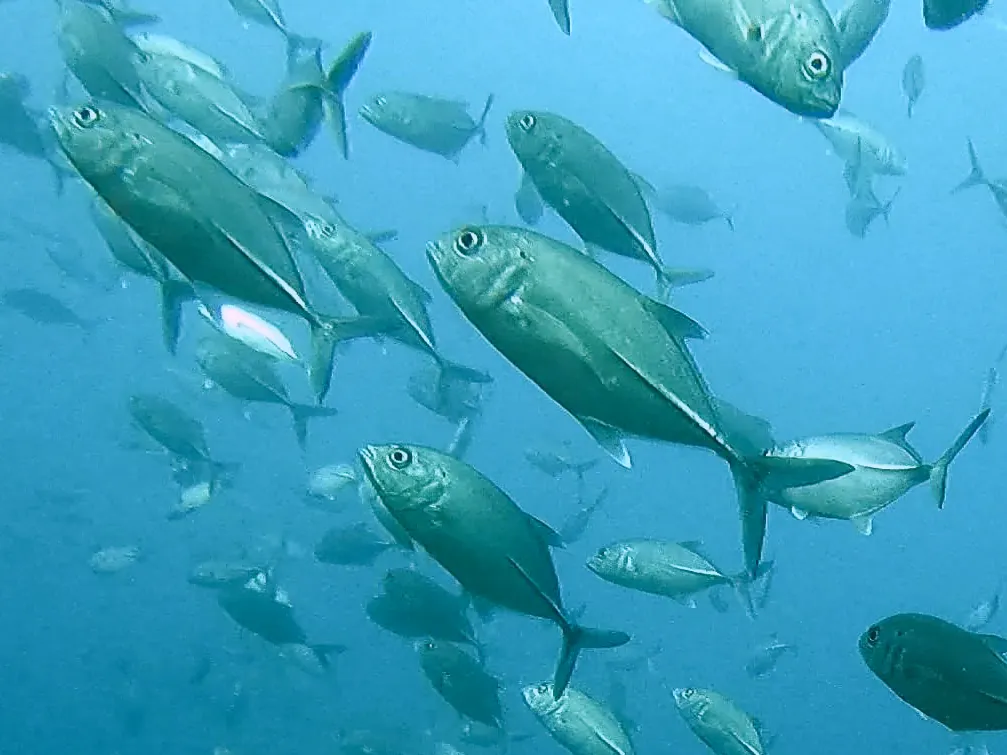
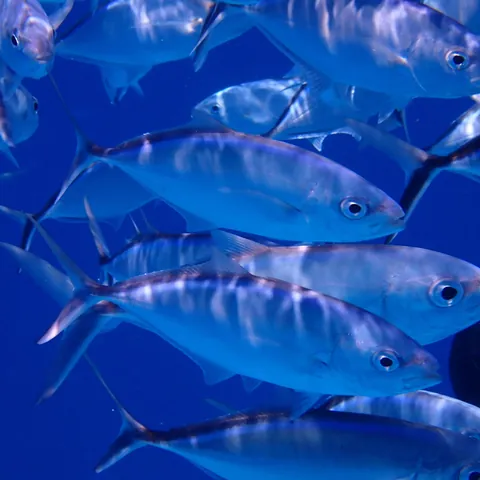
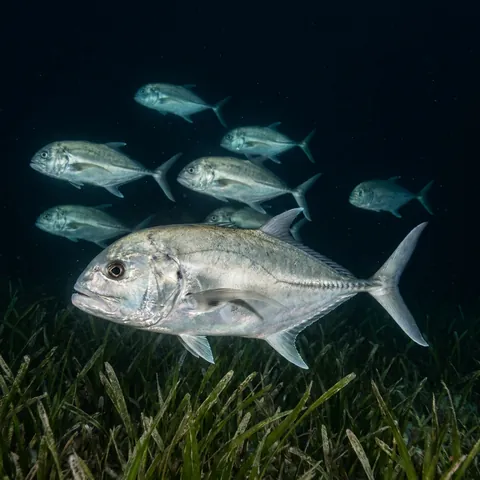
By day the bigeye trevally gathers in huge, slow-moving schools over the reef. At night it scatters to hunt alone in the dark.
Also known as: bigeye trevally, great trevally, kingfish, horse-eye jack, banded cavalla, yellow jack, big-eye kingfish, orange-spotted trevally, dusky jack, bigeye kingfish, horse mackerel, crevalle jack, big-eye trevally, bigeye trevally, jack, great trevally, dusk jack, horse mackerel trevally, giant trevally, six banded trevally, turrum, trevally, bigeye jack, tille jack, sixband trevally, bigeye jack, sixband trevally, great trevally, six-banded trevally, big-eye trevally, pinkit
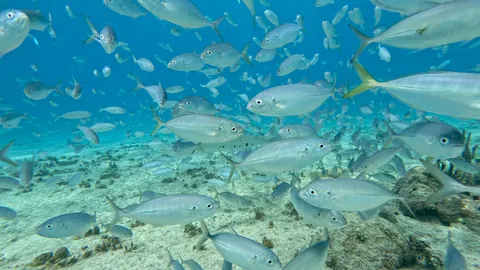
It looks similar to other large jacks and trevallies. But its huge, tightly packed daytime schools, milling slowly near reef passes, are unusual among jacks. That habit is the easiest way to spot it at a glance.
This is a silvery, oblong-bodied jack with a back that curves out a little more than its belly. It has a slightly pointed snout, a strongly forked tail, and long, sickle-shaped pectoral fins. It grows up to 120 cm and 18,000 g, though 60 cm is more typical.
It lives across the tropical and subtropical Indian and Pacific Oceans. Its range runs from the East African coast and Red Sea through South East Asia to Japan, and across the Pacific islands to the eastern Pacific coast. It is mostly found over coral and rocky reefs, in passes and along reef edges, sometimes moving into sandy bays and lagoons. It can also occur far offshore around seamounts, down to around 146 m, in warm water between 26 and 29°C.
During the day it mills in large, mostly stationary or slow-moving schools, often in passes or just outside the reef. At night these schools break up, and the fish scatter to hunt alone or in small groups, feeding mostly after dark rather than by day.
It hunts mainly at dusk and through the night, once its daytime schools have broken apart. It feeds mostly on small fish, along with a wide range of invertebrates such as shrimp, other crustaceans, squid, and jellyfish.
It reaches sexual maturity at around 42 cm, with spawning timing varying by region and possibly linked to the new moon. Before spawning, a pair breaks away from the main school and swims off together; the fish below turns dark black and chases off other fish approaching the pair. The two press their bellies together to spawn, then return to the school and turn back to their normal silvery colour.
During spawning, one fish in a breeding pair turns almost completely black for the moment of spawning, then turns back to its normal silver colour afterward.
Describe what you saw and we name it, then keep every species you find in your Oceandex.