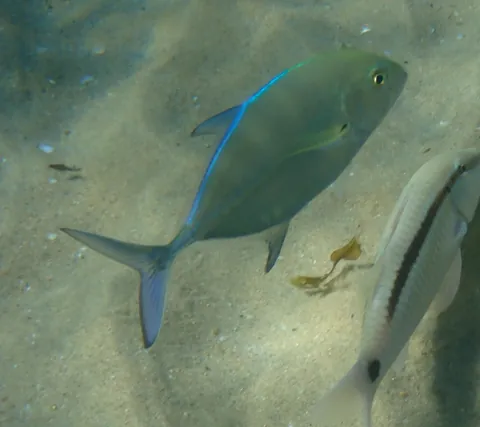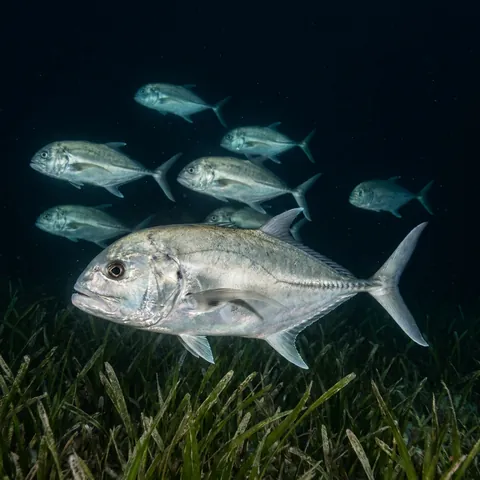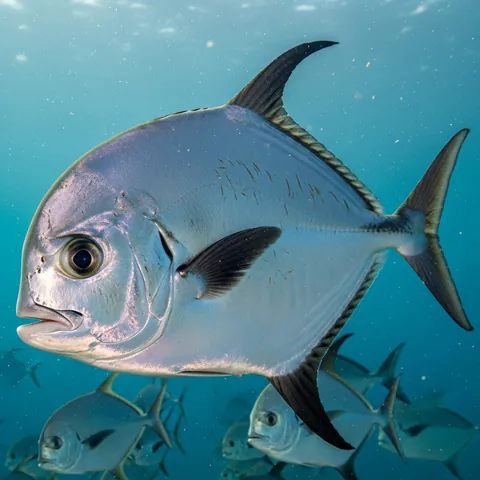
Alexandria pompano
Alectis alexandrina
Caranx ignobilis
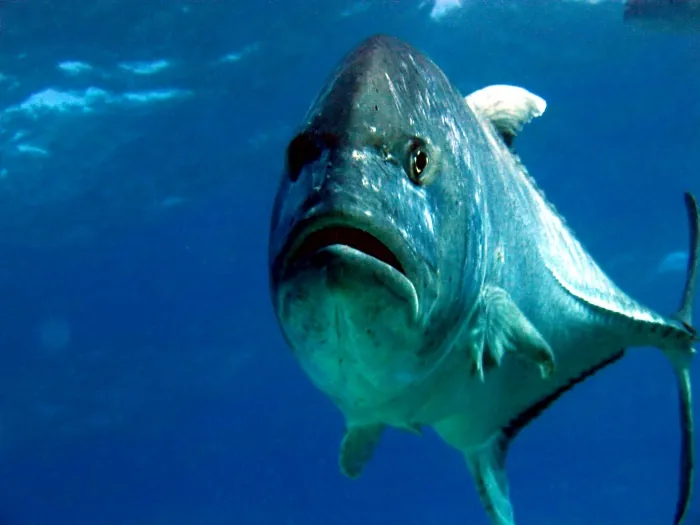
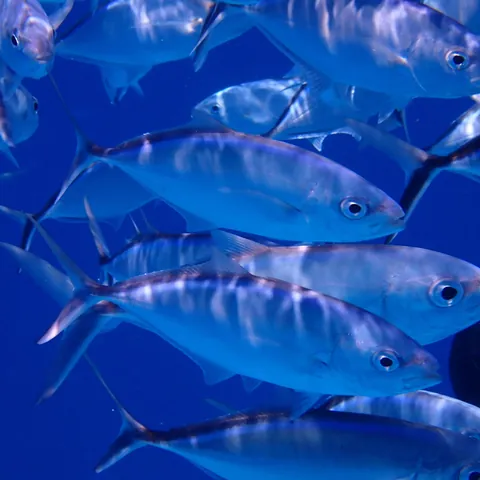
The giant trevally is the biggest of the jacks, a powerful reef predator that patrols atolls and drop-offs alone, only gathering with others of its kind to breed.
Also known as: caranx ignobilis, barrier trevally, big-headed jack, black ulua, forsskål's indo-pacific jack fish, giant kingfish, giant ulua, goyan fish, great trevally, horse mackerel, horse mackerel trevally, jack, kingfish, lowly trevally, pampano, trevally, white ulua, yellow-fin trevally, yellowfin jack
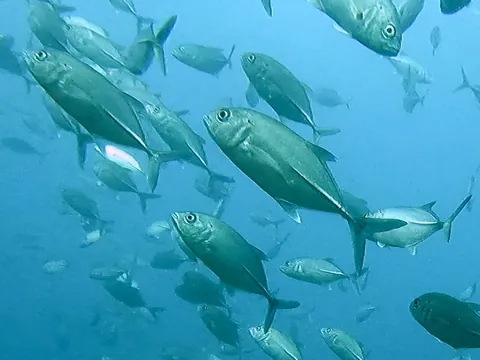
It looks like several other large jacks and trevallies. Look at the head: the giant trevally's forehead curves out steeply and bluntly above the eye, more so than in similar-looking trevally species.
This is a large, deep-bodied fish with a flat, oval shape. Its back curves out more steeply than its belly, especially near the head. It has a strongly forked tail and long, sickle-shaped pectoral fins that reach past the length of its head. It is the largest of all the jacks, reaching up to 170 cm and 80,000 g, though 100 cm is more typical.
It ranges across the tropical and subtropical Indo-Pacific, from the coast of East Africa and the Red Sea through to the islands of the central and western Pacific. As a young fish it uses estuaries and shallow coastal areas. As an adult it moves out to patrol outer reefs, drop-offs, and atolls, at depths from 10 to 188 m, in warm water between 26 and 29°C.
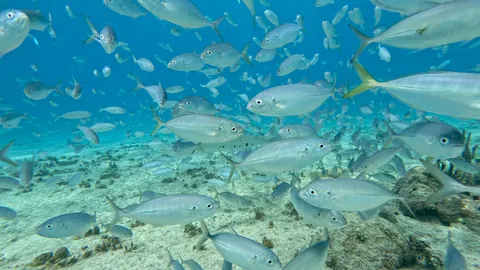
Once it reaches adulthood, the giant trevally is mostly alone, only forming schools to spawn or, more rarely, to feed together. Young fish school much more often, sometimes mixing with other trevally species. Adults tend to hold a home range along a stretch of reef or around a single atoll. They shift between favourite spots at different times of day and are most active around dawn and dusk.
It is a powerful hunter that feeds mainly on other fish, with crustaceans and cephalopods such as squid and octopus making up the rest of its diet. Depending on where it lives, it hunts mostly by day or mostly at night.
reports of ciguatera poisoning
Fishing pressure has hit some populations hard. In the main Hawaiian Islands, studies show this species now makes up only a tiny share of the top predators in fished areas. In untouched reefs, it holds a much bigger share. This has led to proposals such as banning commercial catches and raising minimum catch sizes in affected areas.
Its scientific name, ignobilis, is Latin for "unknown" or "ignoble" - an odd label for one of the largest, most powerful jacks on the reef.
Describe what you saw and we name it, then keep every species you find in your Oceandex.