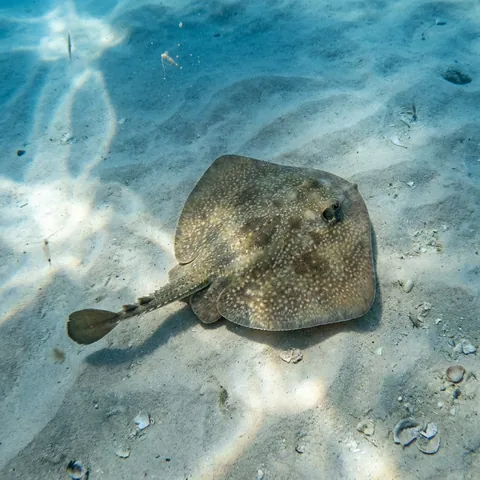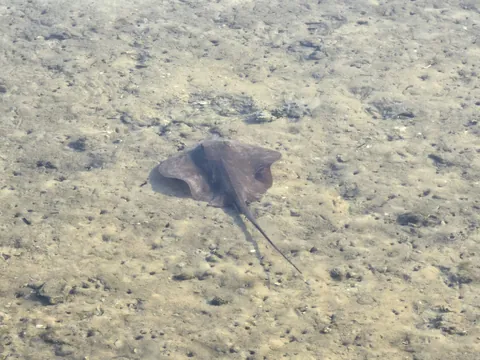
Atlantic Stingray
Hypanus sabinus
Urobatis jamaicensis
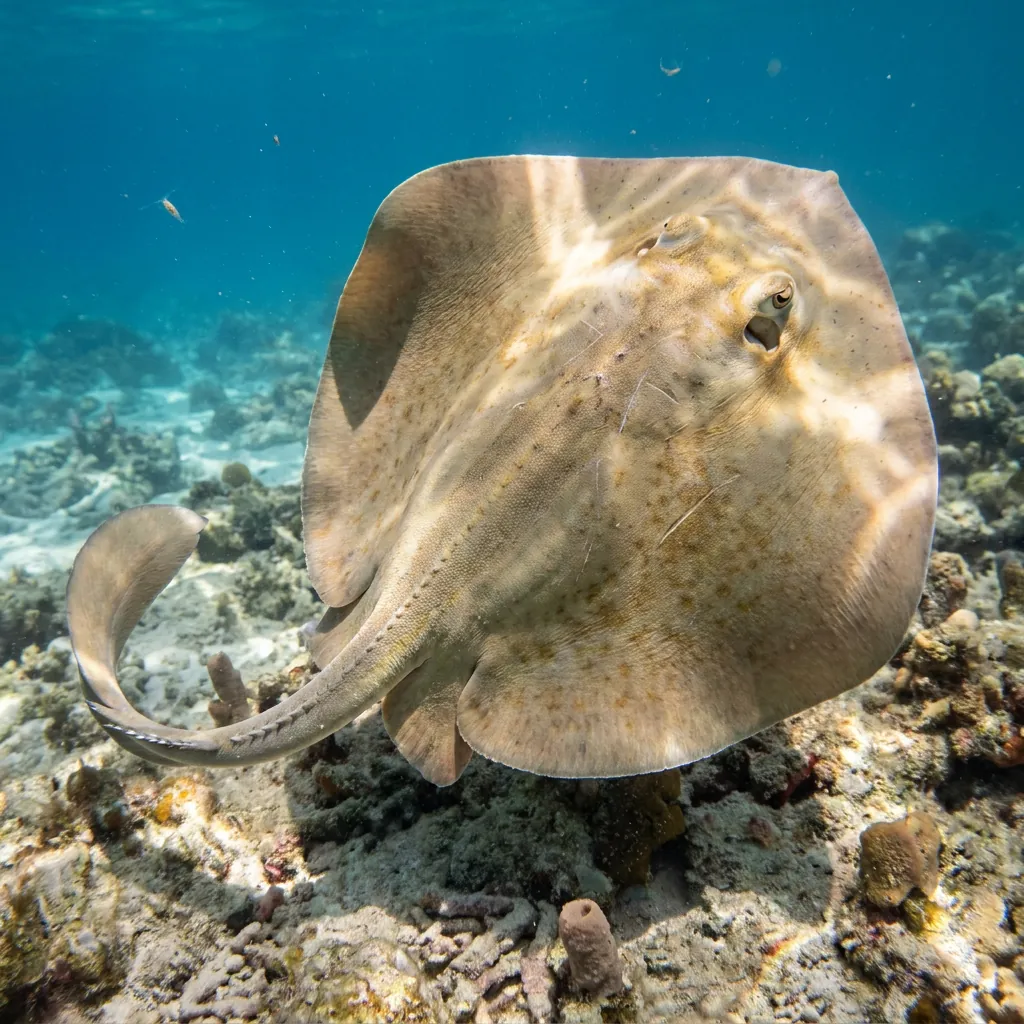
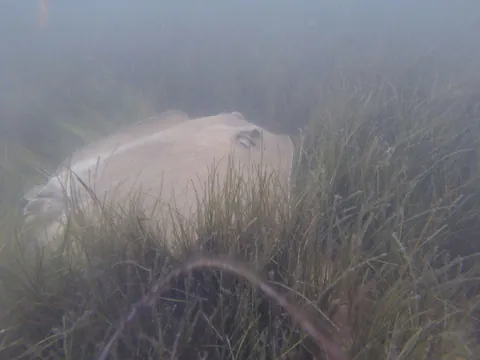
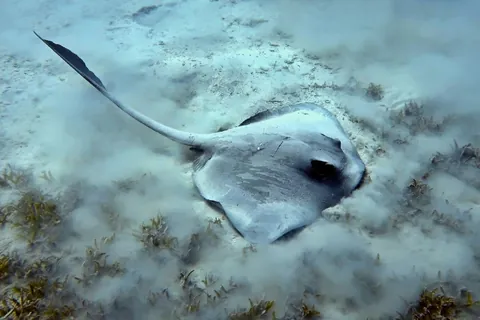
The yellow stingray spends most of the day hidden under a dusting of sand, all but invisible until it moves. It grows up to about 76 cm long, and its patterned disc can shift in tone within moments to match the seafloor around it.
Also known as: yellowspotted stingray, yellow spotted stingray
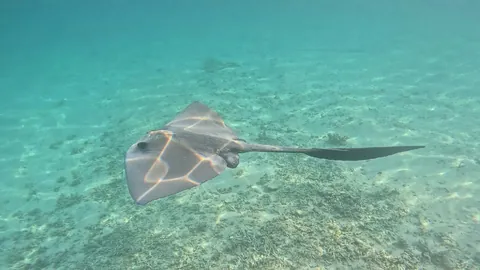
Many rays trail a long, thin, whip-like tail with no fin. This species is different: its short, thick tail ends in a small, leaf-shaped fin, a helpful way to tell it apart from whip-tailed rays.
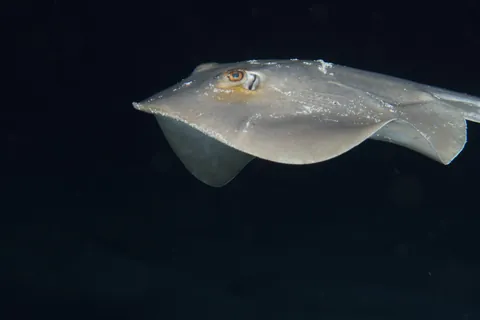
This is a small ray with a nearly circular disc, slightly longer than it is wide, and a short, blunt snout. Its tail is short and thick, making up less than half its total length, with a serrated spine partway along it. Colour and pattern vary a lot between individuals: some show fine dark green or brown markings on a pale background, others have bright white, yellow, or gold spots on a dark green or brown background. The underside is pale yellowish, greenish, or brownish white, with small dark spots near the edge of the disc and tail.
It lives in inshore waters of the Gulf of Mexico and the Caribbean, including Florida, the Bahamas, and the Antilles, and is most common in the Florida Keys. It stays on the bottom in bays, lagoons, estuaries, and calm surf zones, from the shallows down to about 25 metres, favouring hard bottoms covered in encrusting invertebrates as well as sand, mud, and seagrass beds.
By day it is mostly inactive, buried under a thin layer of sediment or lying still in vegetation, often near the boundary between sand and reef. Each eye sits on a raised mound with fine control over incoming light, giving it a near 360-degree view to spot approaching predators such as tiger sharks. To feed, it settles over prey and pins it to the bottom, sometimes fanning the sand with its disc to uncover buried shrimp, worms, clams, or small fish. It has even been seen raising the front of its disc to create a shaded hiding spot that lures in shelter-seeking animals.
Off Jamaica, yellow stingrays gather in remarkable numbers, up to one per square metre, beneath mangrove roots used as roosts by cattle egrets, likely drawn by the extra invertebrates the birds' droppings help sustain.
Describe what you saw and we name it, then keep every species you find in your Oceandex.