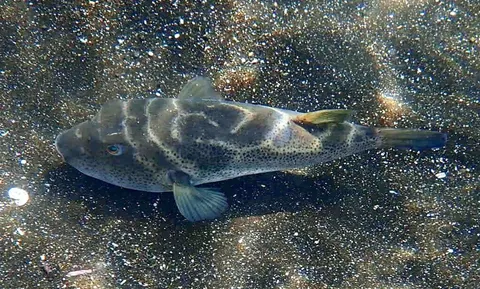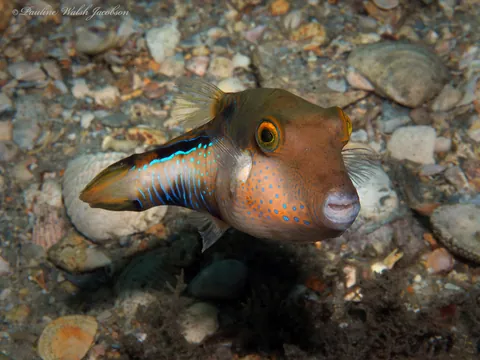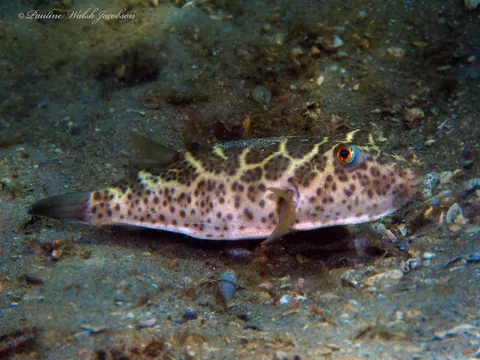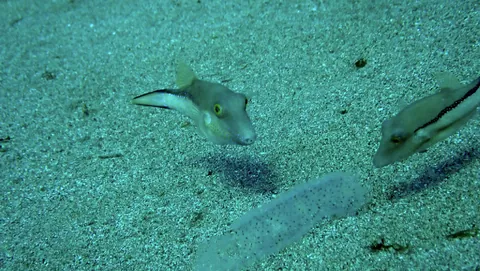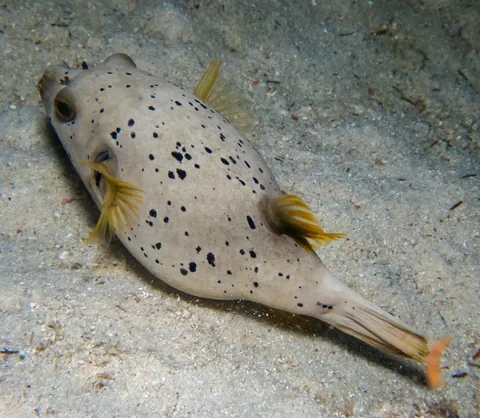
Blackspotted puffer
Arothron nigropunctatus
Arothron hispidus
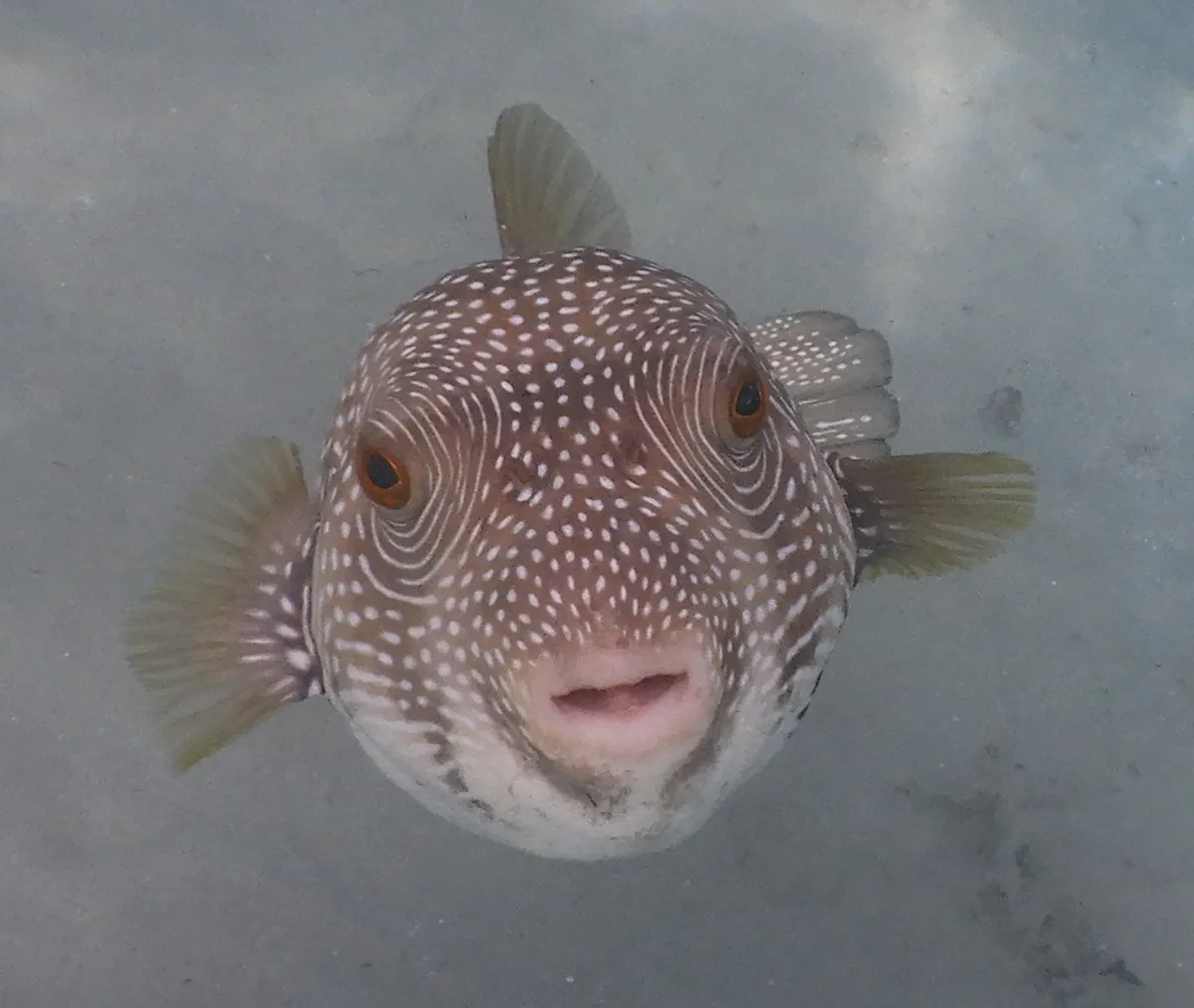
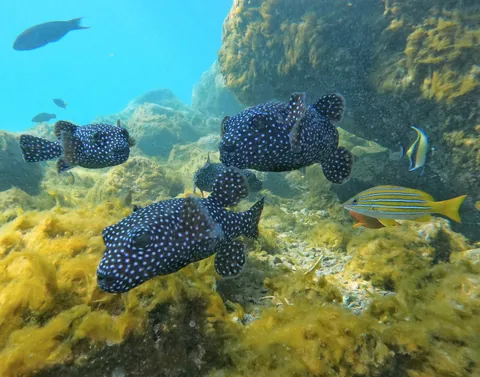
The white-spotted puffer is a medium to large pufferfish, reaching about 50 cm, found across a huge stretch of ocean from the Indo-Pacific to the eastern Pacific. It carries a potent poison, so admire it and leave it alone.
Also known as: pufferfish, stars and stripes puffer, stars-and-stripes pufferfish, stripebelly puffer, white spotted blow fish, whitespotted blaasop, whitespotted puffer, stars-and-stripes pufferfish, whitespotted puffer, white-spotted puffer, white spotted blow fish, whitespotted blaasop, stars and stripes puffer, stripebelly puffer, stars-and-stripes puffer, white-spotted puffer, stars and stripes toado, stars and stripes toadfish, ringed puffer, broad-barred toadfish, broad barred puffer, broad-barred puffer
Other Arothron puffers can also show a spotted body, but this species has a fixed field mark: the rings of white and dark grey that radiate around each eye, paired with a dark patch at the 'shoulder' above the pectoral fin.
The body is light grey, greyish or yellowish, covered all over with white spots. Around the eyes and pectoral fins, these spots merge into concentric rings of white and dark grey. The underside is white, and there is a dark patch above the pectoral fin, at the 'shoulder'. The back, sides and tail fin are covered in white spots, and the belly carries white bars.
It lives on outer reef slopes to at least 50 m, as well as on inner reef flats, in lagoons, estuaries and tidepools, in water from about 25 degrees C. Young fish are common in weedy patches within estuaries.
In 2018 a young white-spotted puffer turned up off Cyprus, the first confirmed record of this species in the Mediterranean Sea. Its eye-rings were still incomplete, a sign it was not yet fully grown.
Describe what you saw and we name it, then keep every species you find in your Oceandex.