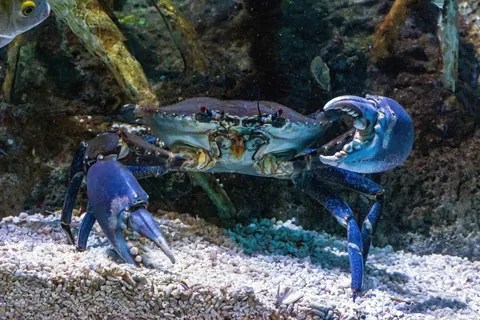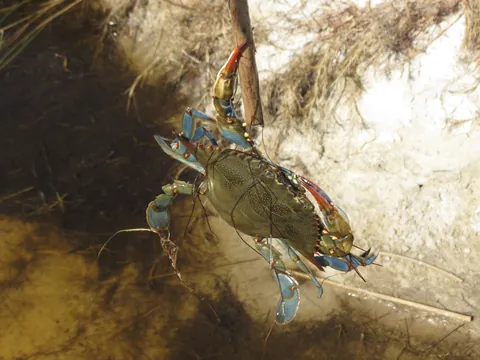
Atlantic Blue Crab
Callinectes sapidus
Pachygrapsus crassipes
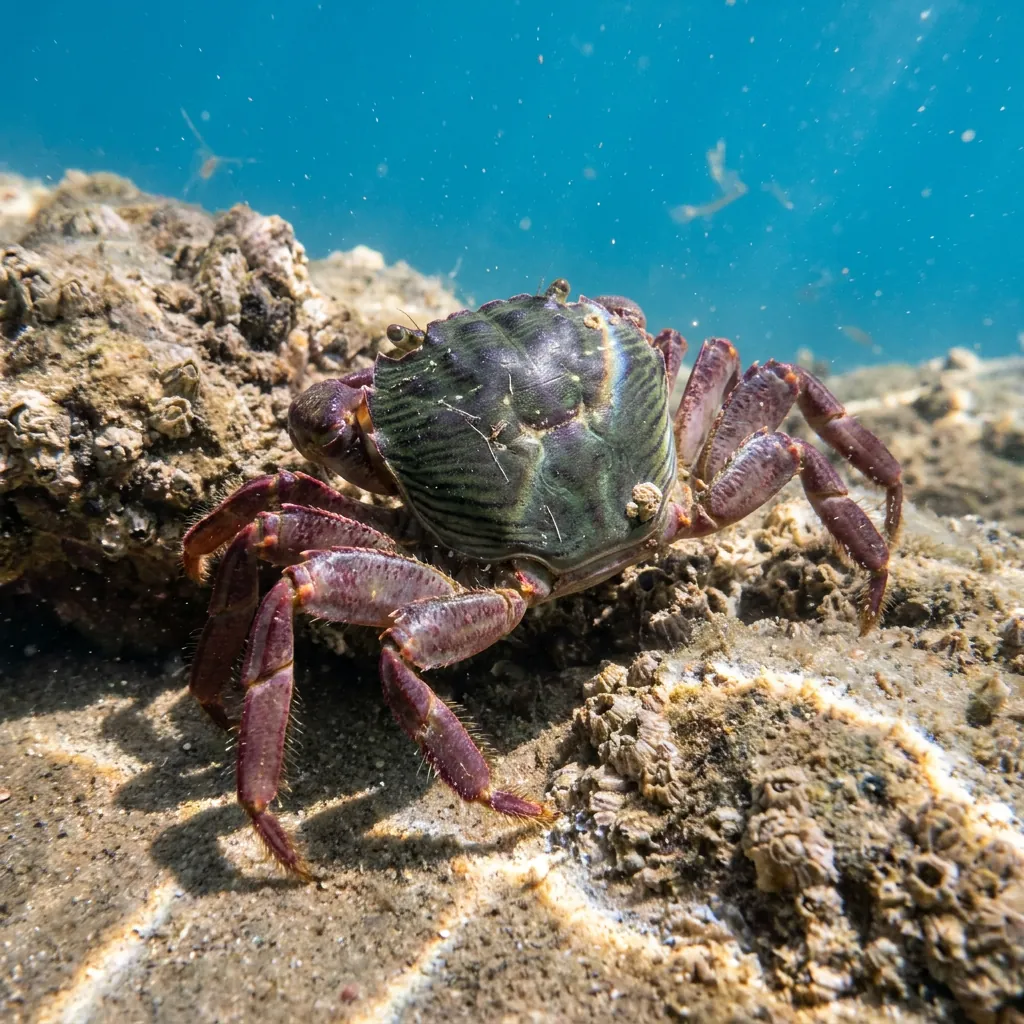
Walk along a rocky Pacific shoreline and you are likely to see this crab scuttling for cover. The striped shore crab is one of the most familiar crabs of rocky and hard-mud seashores, spending much of its life out of the water entirely.
Also known as: lined shore crab
Several small crabs share these rocky shores. The green stripes crossing this crab's square carapace are the mark that separates it from plain-coloured shore crabs nearby.
This crab has a square carapace, coloured brown, purple or black with green stripes running across it. Its claws are red-purple with a mottled, striped pattern on top and pale grey-white underneath. The legs share the same purple-and-green mottled look as the claws.
It spends more than half its time out of the water, only submerging now and then to wet its gills, and shelters in rock crevices during the day before coming out at night when predators are less active. It eats almost anything it can find: algae, worms, mussels, snails, small crabs, isopods and even flies, and will eat other crabs of its own kind if they have just moulted and are still soft. On rocky shores it hunts mostly at night, while in tide pools it grazes more during the day. It competes aggressively with other crabs over food but does not defend a fixed territory.
Unlike most crabs, the striped shore crab spends most of its life on dry land, only returning to the water briefly to keep its gills wet.
Describe what you saw and we name it, then keep every species you find in your Oceandex.