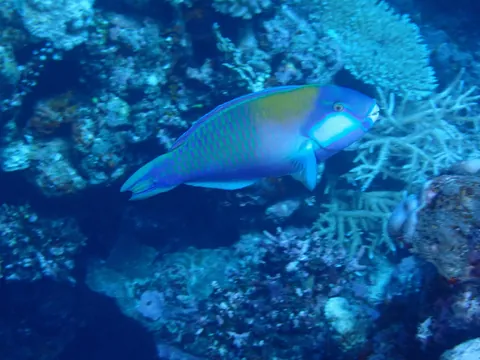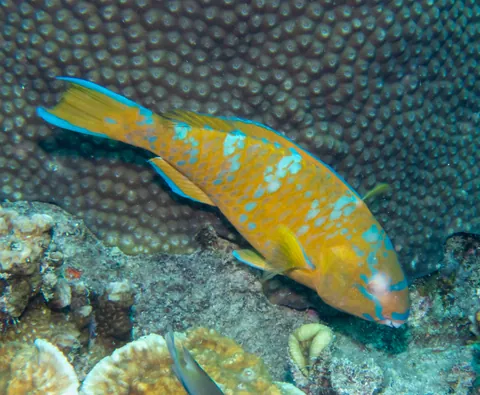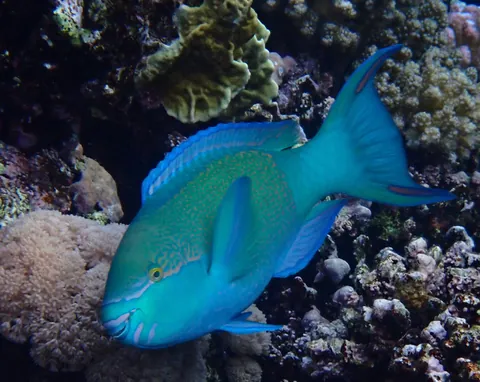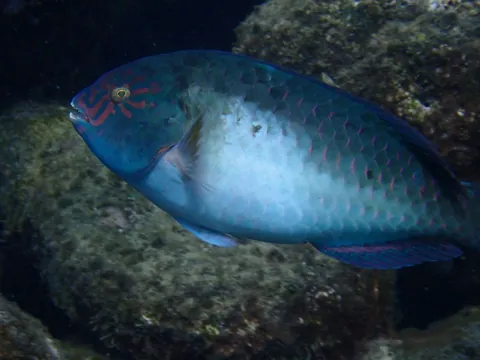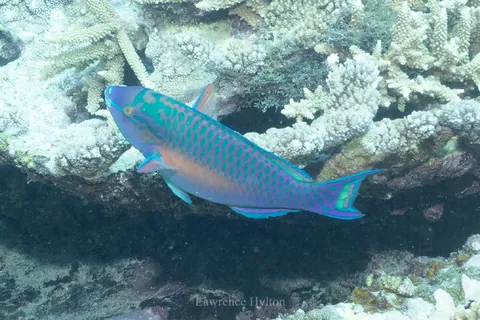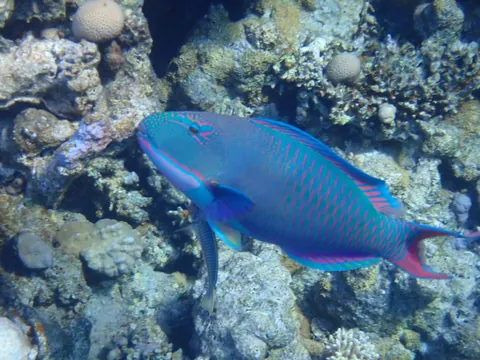
Bicolour parrotfish
Cetoscarus bicolor
Sparisoma viride
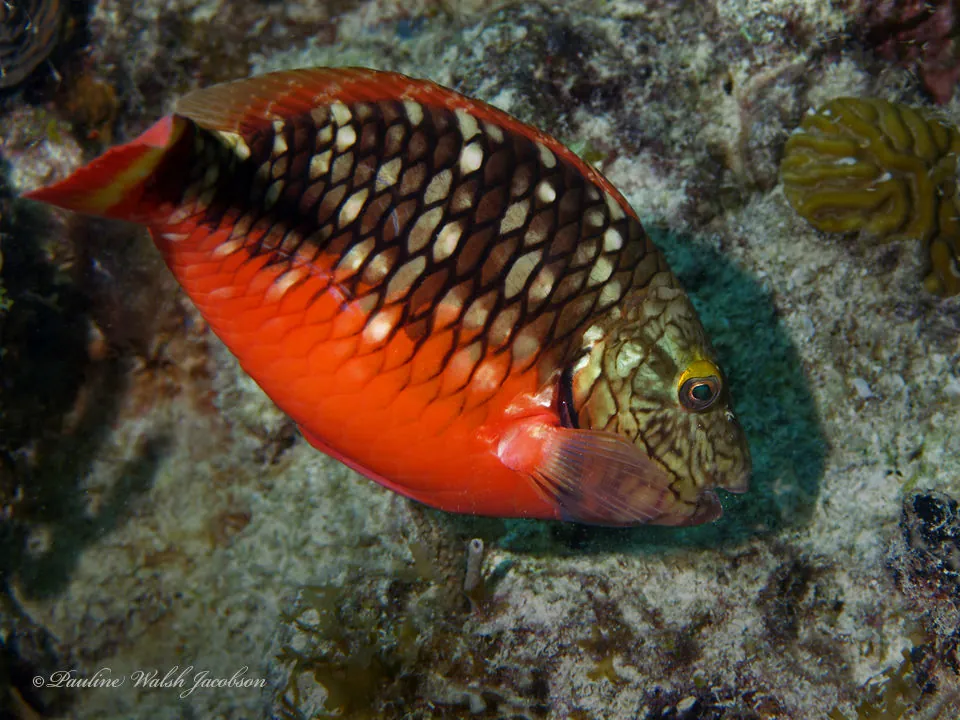
The stoplight parrotfish is one of the most colourful fish on Caribbean reefs, growing to a common length of 38 cm and up to 64 cm. Its bright, changing colours reflect a life that moves through several very different looks.
Also known as: dark green parrotfish, moontail, parrot chub, redbelly
It can be confused with other parrotfish showing similar green or brown colouring. The bright yellow spot at the top edge of the gill cover, giving the species its common name, is the mark to check.
Young fish and females have a brown head and back, with pale-centred scales edged in dark brown, and a bright red lower body and fins. Mature males turn green, with a yellow spot at the top of the gill cover, a yellow bar at the base of the tail, and curved orange-yellow marks on the tail fin.
Lives on shallow coral reefs from 3 to 50 m deep, staying active by day and sheltering under coral boulders at night. Adults settle into a limited home range and are drawn to areas with plenty of algae growth.
Feeds mainly on algae growing on dead coral, scraping and gouging it loose with its teeth in short bursts of feeding. It occasionally bites into living coral as well, though algae make up most of its diet.
This fish changes sex from female to male during its life, and its colour changes along with it. Terminal-phase males hold territories shared with several females, defending the area and mating with them, with breeding happening year-round.
A small share of males skip the usual colour change entirely, keeping the brown and red female-like pattern even after switching sex, so they look just like females while breeding as males.
Describe what you saw and we name it, then keep every species you find in your Oceandex.