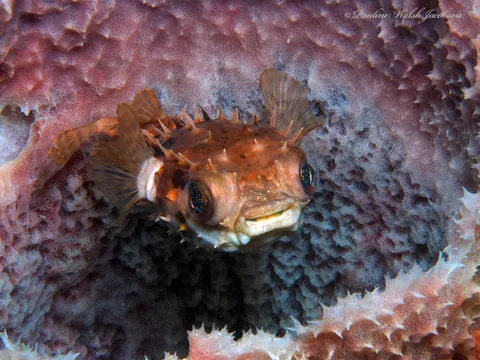
Birdbeak burrfish
Cyclichthys orbicularis
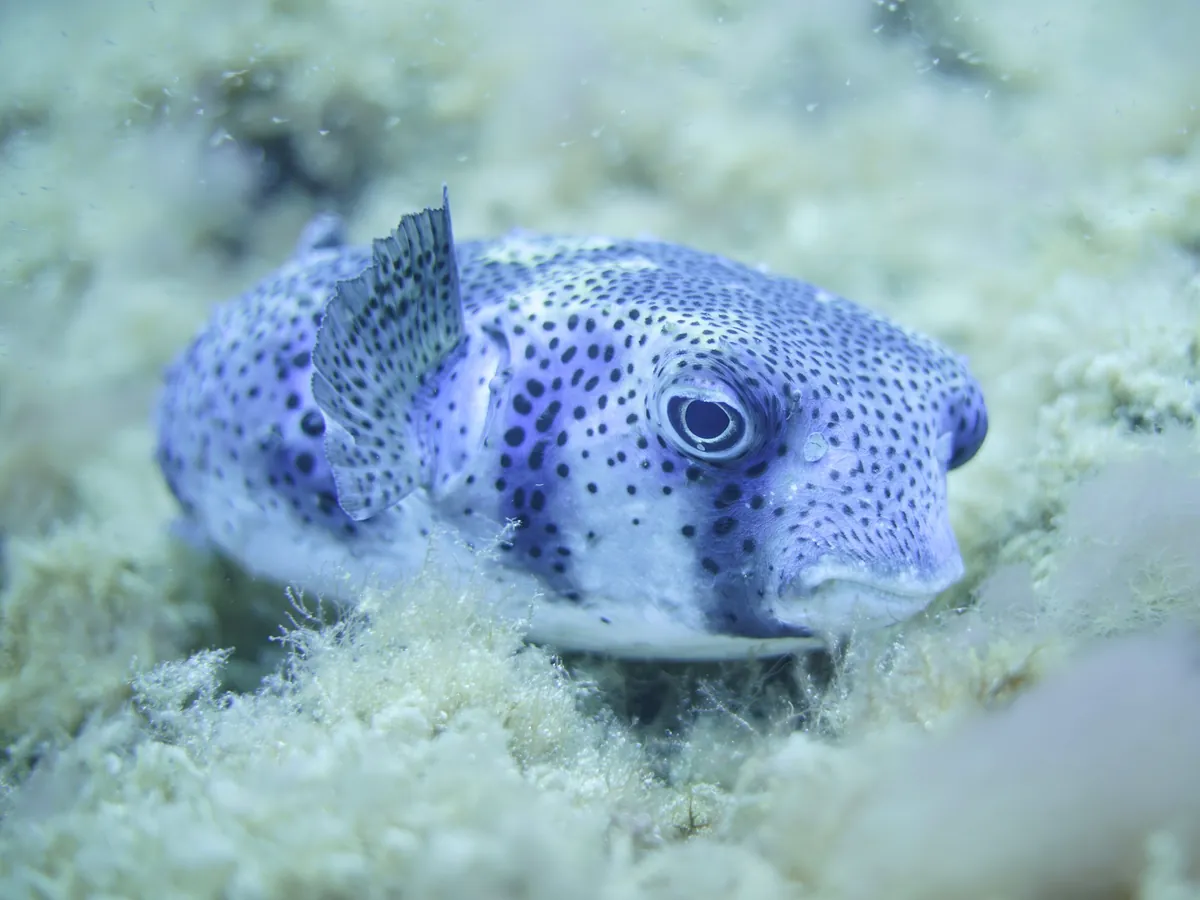
Chilomycterus reticulatus
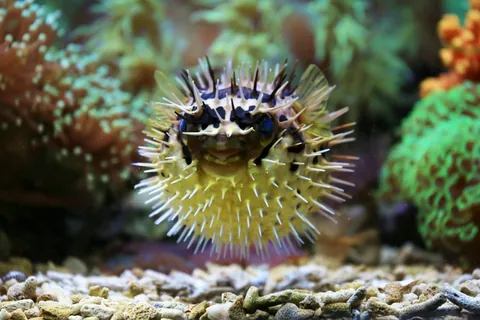
This rotund, spiny fish can puff itself up when threatened and reaches up to 69.7 cm, though most divers see one closer to 30 cm.
Also known as: fewspine porcupinefish, lanternfish, porcupine fish, spotfin burrfish, spotfin porcupinefish, spottedfin burrfish, spottedfin burrfish, porcupinefish, spotfin porcupinefish, pacific burrfish, spotted burrfish, spotfin burrfish, porcupine fish, fewspine porcupinefish, burrfish, spotted burrfish, few-spined porcupine-fish
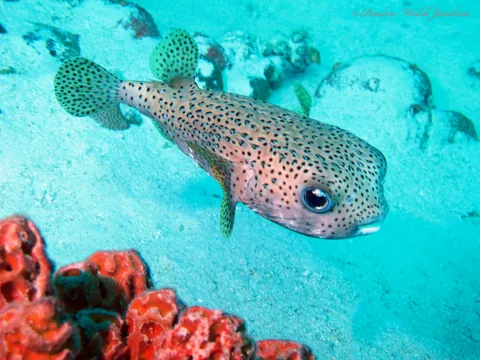
This species can be mixed up with other porcupinefish. The clearest check is the black band running across the throat, combined with a covering of small, evenly scattered spots rather than large dark blotches.
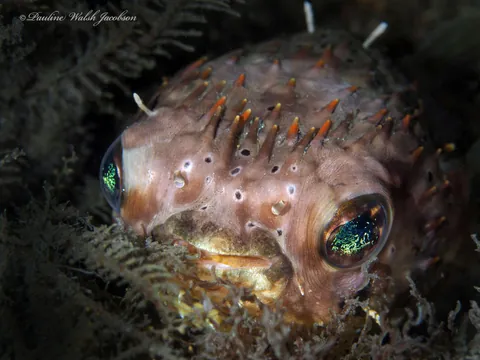
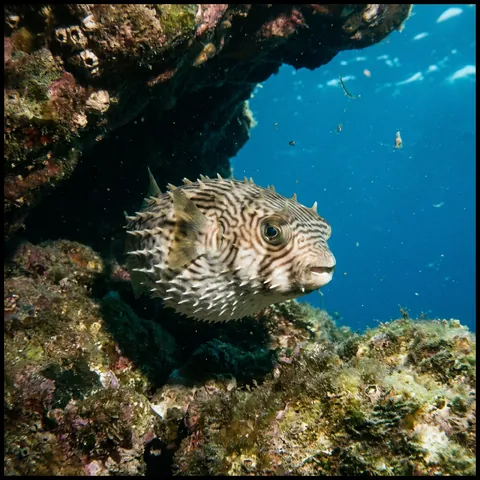
It has a round, blunt head and large eyes, and its teeth are fused into a parrot-like beak with a large mouth. It has no pelvic fins and no spines in its fins, but its whole body is covered in small triangular spines, some reduced to plates under the skin, including a row running from the head to the dorsal fin. Adults are grey to brown with a black band across the throat and small black spots on the upper body and fins. Pelagic juveniles are blue with dark spots reaching down to the belly.
It is found in warm temperate seas worldwide, including the Atlantic, the Gulf of Mexico, the Mediterranean, the Pacific, and the Indian Ocean. Adults live on reefs and over soft seabeds down to 100 m, though they are more common in shallower water. Juveniles drift in open ocean surface waters, often among floating weed.
It feeds on hard-shelled prey such as molluscs, echinoderms (like sea urchins and starfish), and crustaceans, and is active during the day. It is often found washed up on beaches.
At night it wedges itself against the seabed to sleep, bracing its body so it isn't swept away by currents.
Describe what you saw and we name it, then keep every species you find in your Oceandex.