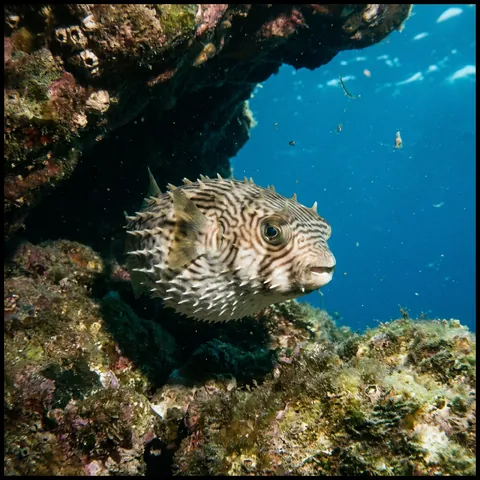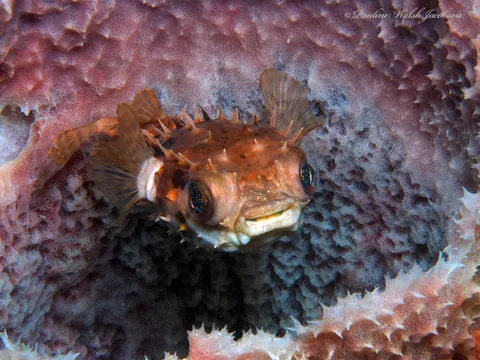
Birdbeak burrfish
Cyclichthys orbicularis
Diodon holocanthus
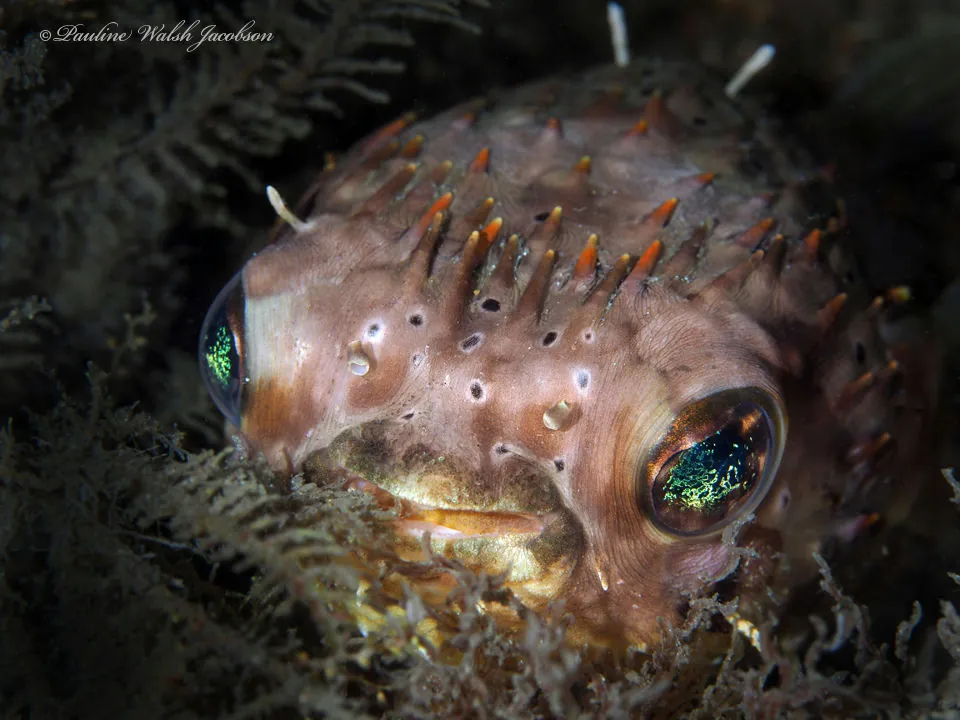
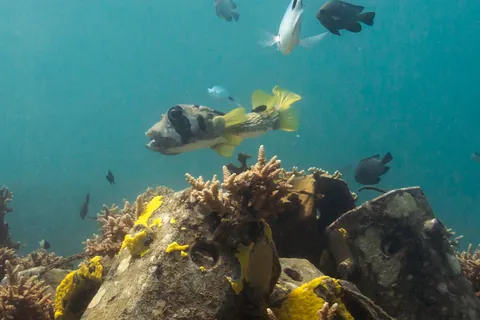
The long-spine porcupinefish, also called the balloonfish, is a slow, round-bodied fish that grows to about 50 cm, though most you meet are nearer 15 cm. Its teeth are fused into a single parrot-like beak. It is inactive by day and does its hunting at night. It is a poor swimmer and does not race away, so it can be watched at close range. Young fish drift in open water and sub-adults sometimes form small groups.
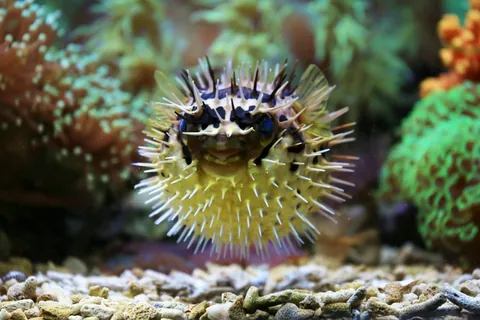
The only fish it is easily confused with is the black-blotched porcupinefish. The spines settle it: this species carries much longer spines than that look-alike.
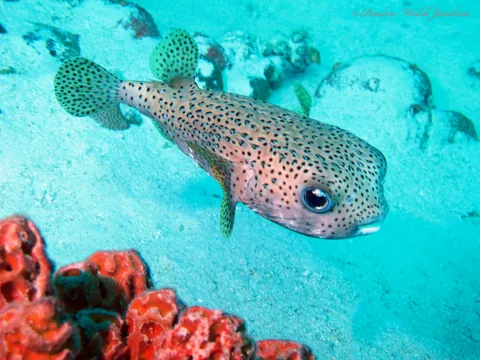
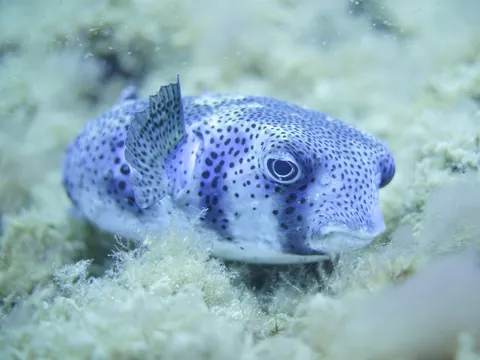
The body is pale, with large black blotches across the back and smaller black spots between them; the number of small spots drops as the fish gets older. The fins have no spots. The whole animal is covered in long spines, which lie flat until they are raised and are longest on the head. There is a large brown bar above and below each eye and a broad brown band across the back of the head.
It is found in tropical and subtropical seas worldwide, in the Atlantic, the Indian Ocean and the Pacific. It is not only a reef fish: it lives over muddy and soft bottoms, in estuaries and lagoons, and on coral and rocky reefs. The recorded depth range runs from about 2 m down to 200 m, but it is usually between 2 and 35 m. By day, look under ledges and in the shade rather than in the open.
It feeds at night on hard-shelled prey: molluscs, sea urchins, snails, hermit crabs and other crabs. Its beak works against hard plates in the roof of the mouth, which lets it crush shells and urchin tests that most fish cannot deal with.
Young long-spine porcupinefish do not start life on the reef. They drift in the open sea, often sheltering under rafts of floating Sargassum seaweed, and only settle onto the bottom once they have grown.
Describe what you saw and we name it, then keep every species you find in your Oceandex.