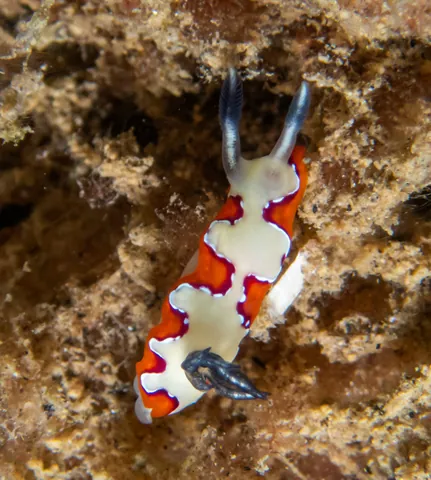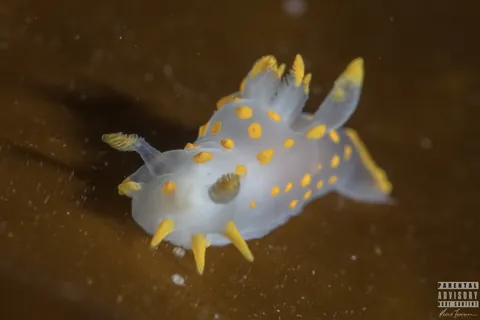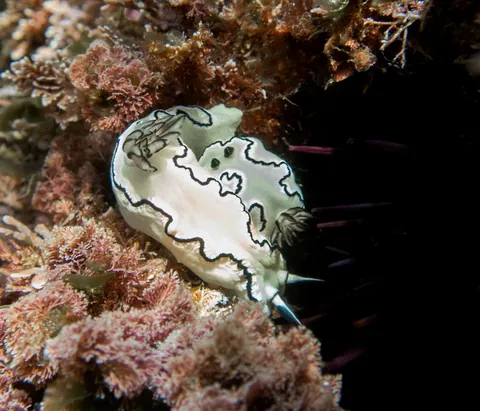
Black-margined Nudibranch
Doriprismatica atromarginata
Hexabranchus sanguineus
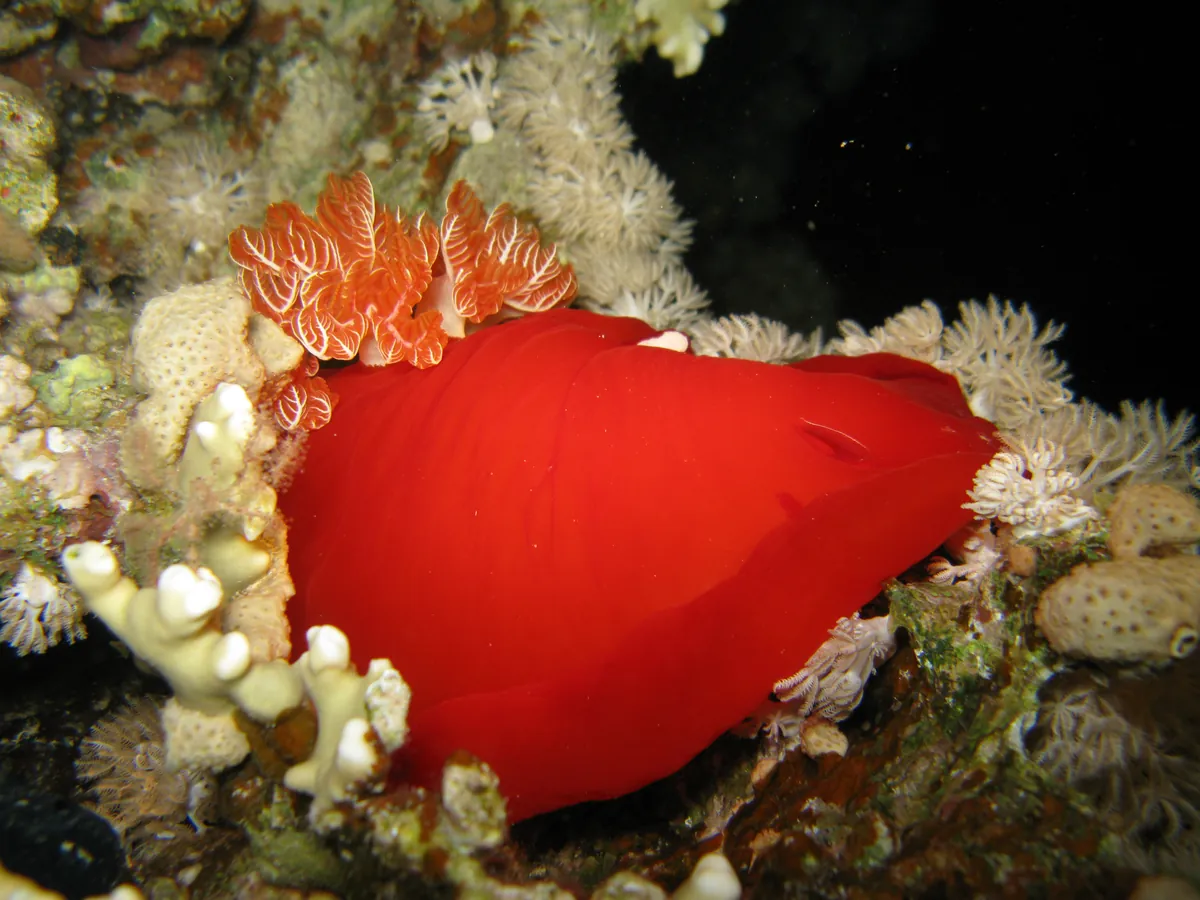
Watch this sea slug unfold from a curled lump into a swirling ribbon of red and white, and you will understand its name. The Spanish dancer is one of the largest nudibranchs, a shell-less marine snail, in the sea, growing up to 25 cm long.
Also known as: bloody spanish dancer, hexabranchus sanguineus, hexabranchus sanguineus (rüppell & leuckart, 1830), red-margined spanish dancer, virtuous spanish dancer
Its size, red-and-white coloring, and swimming display make it hard to confuse with other nudibranchs; a small shrimp riding on its back, the emperor shrimp, is a further tell.
Its soft, flattened body is deep red to orange-red with white or pale spots and a frilled, wavy edge to its mantle, the fleshy cape covering its back. Two retractable horn-like sensory organs, called rhinophores, sit near the front, and a cluster of six feathery gills sits near the tail. When it crawls, the mantle edges curl upward into a raised rim along both sides.
It lives on rocky and coral reefs rich in sponges, its main food, sheltering in crevices from just below the surface down to 50 m, most often between 10 and 20 m.
The Spanish dancer hides in cracks and shadows by day and comes out to feed after dark. It feeds on sponges and stores their chemical compounds in its own tissue as a defense, then passes the same toxins into its egg ribbons, coiled spirals of bright red to pink eggs, to protect them too. If disturbed, it unfurls its curled mantle edges and swims away with sweeping, whole-body undulations.
This species swims by throwing its whole body into sweeping up-and-down waves, a rare escape trick among sea slugs, most of which can only crawl.
Describe what you saw and we name it, then keep every species you find in your Oceandex.