Blue dragon
Glaucus atlanticus
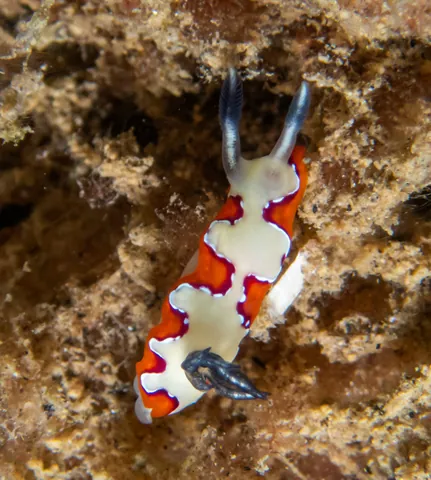
Doriprismatica atromarginata
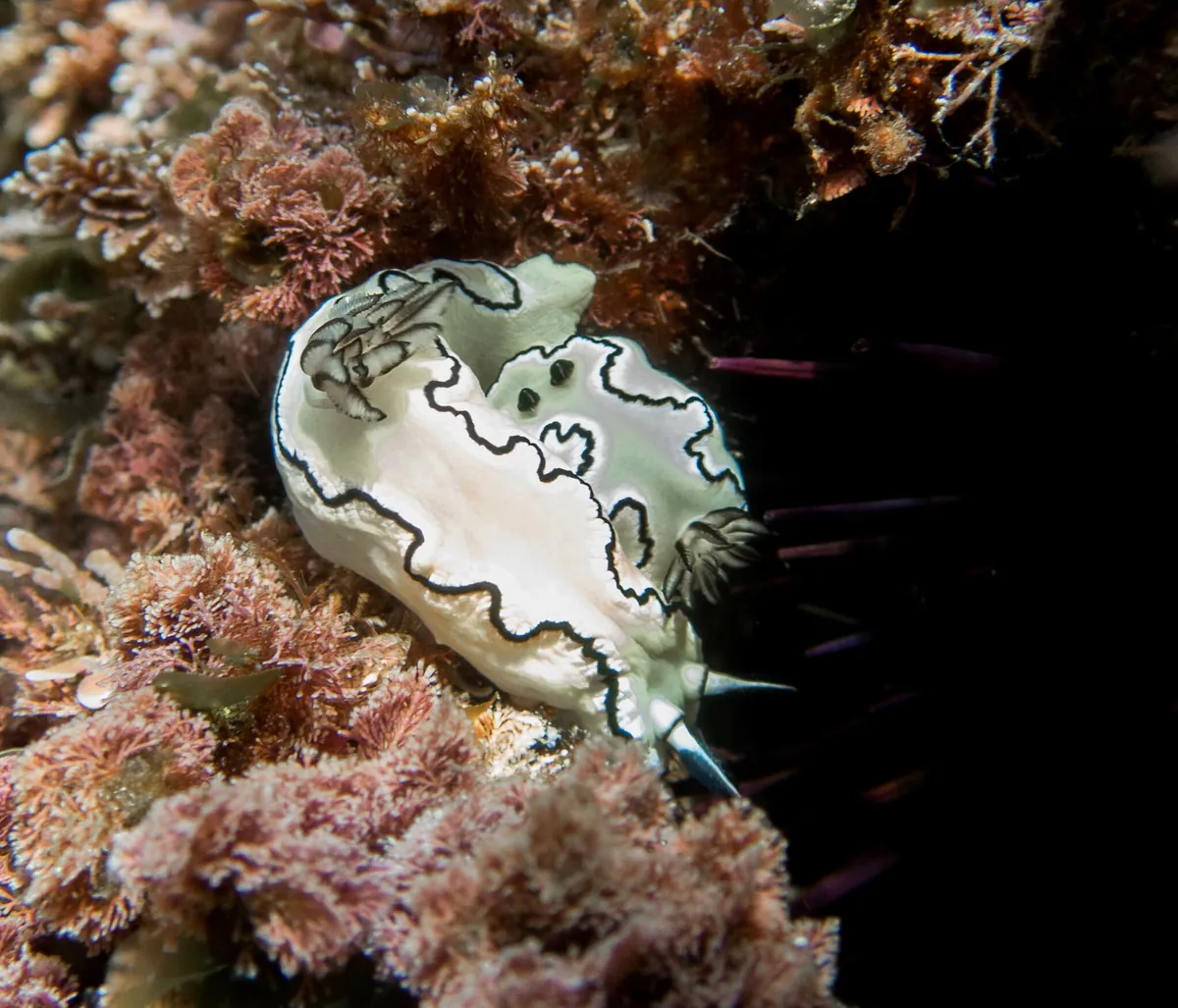
The black-margined nudibranch is a sea slug: a shell-less relative of snails. It is a dorid nudibranch, one of the group that carries a ring of feathery gills on its back. It crawls slowly over reef surfaces in the tropical and sub-tropical Indo-Pacific, grazing on sponges. It is a small animal, growing to about 9 cm. It is also one of the easier sea slugs for a diver to spot, since it moves in the open by day instead of hiding.
Two close relatives share this black-edged, folded mantle almost exactly. The mark that separates them is depth of colour: this species is paler yellow, never as deep a yellow as those two look-alikes, and it is by far the more commonly seen of the three.
The body colour ranges from creamy white through yellow to pale brown. Around the outside of the mantle, the soft skirt of skin that covers the body, runs a clear black line. The mantle is deeply folded, so the black edge ripples. As the animal crawls, these folds can look like a slow wave passing along its side. On the head sit two rhinophores, the pair of club-shaped sensors a nudibranch uses to smell the water; in this species they are black.
Look for it on reefs across the tropical and sub-tropical Indo-Pacific. It has been recorded from about 3 m down to 200 m, so it is well within normal diving depths. It lives where its food lives: on and around sponges growing on hard reef surfaces. It has also been found tucked under a dead coral head. Scan slabs, overhangs and rubble rather than open sand.
This sea slug has another common name, the cheesecake nudibranch, earned from its creamy white to yellow colouring.
Describe what you saw and we name it, then keep every species you find in your Oceandex.