Angelfish
angelfish
Pomacanthus sexstriatus
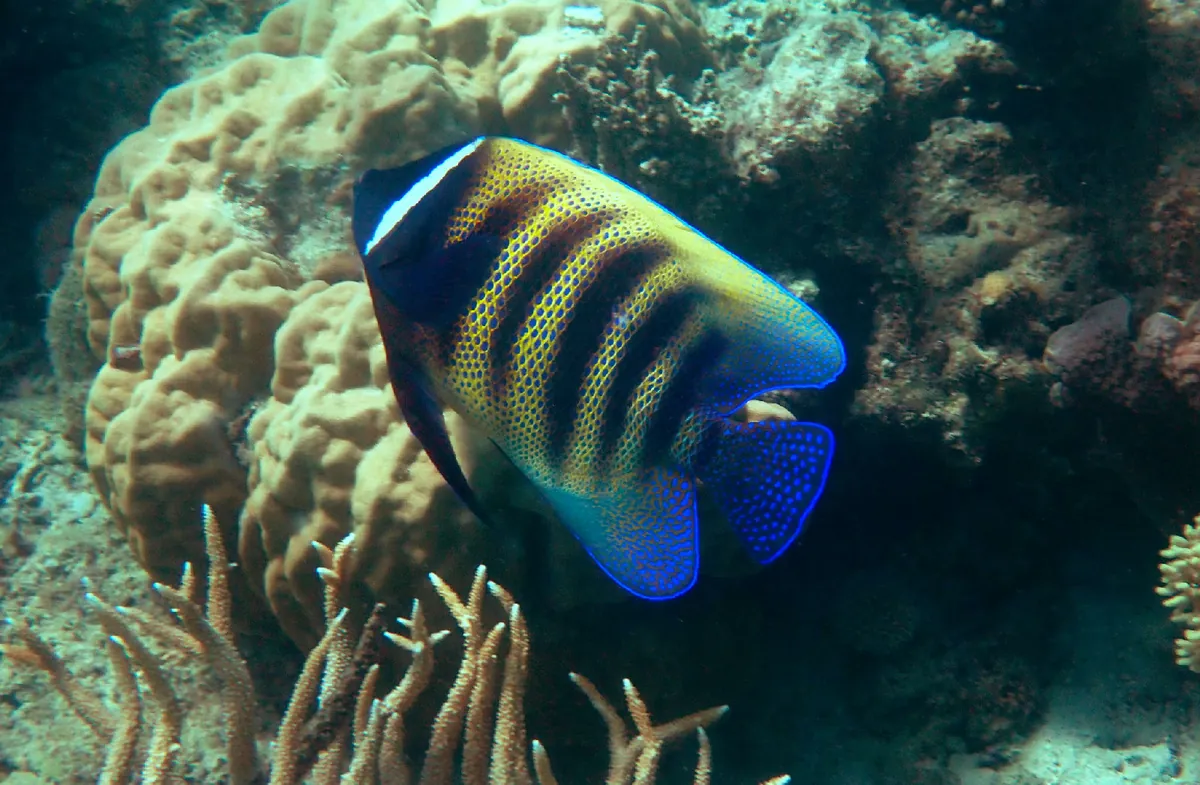
Young and old sixbar angelfish look like two different species, and this reef giant grows to about 46 cm along the way.
Also known as: bluestone kambingan, six barred angel, six-banded angelfish, sixband angelfish, sixbanded angelfish, sixbanded angelfish, sixband angelfish, six barred angel, six-banded angelfish, angelfish, six-banded angel-fish
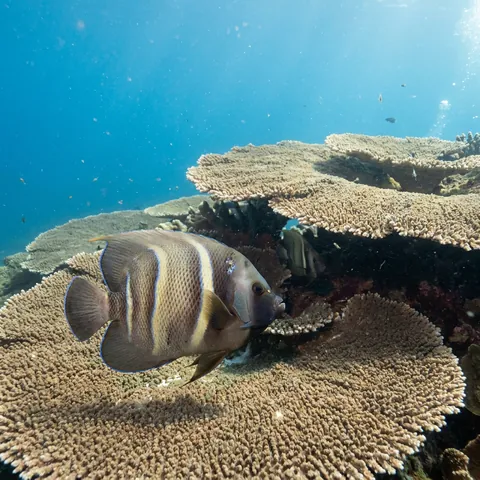
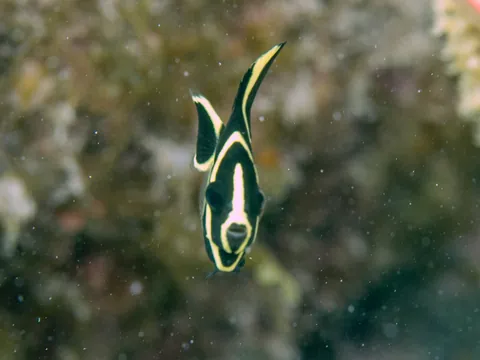
Juvenile and adult sixbar angelfish are so different that a diver could easily mistake them for separate species. But one thing stays the same at every age: the vertical banding. Juveniles show many curved white bars on blue-black. Adults show six black bars, the first one whitish, on yellow-brown. Look at the bars, not the base colour, to confirm a sixbar angelfish at any age.
Adults are brownish-yellow over the body and the fins along the midline, scattered with bright blue spots. Six vertical bands cross the sides: the first, just behind the head, is whitish, and the rest are black. Juveniles look nothing like the adults. They have an overall blue-black body broken up by many vertical white bands, straight near the head and curving more sharply near the tail.
Adults live on lagoon and outer reef slopes with rich coral growth. Juveniles shelter on more protected inner reefs. Both are found across a depth range from about 3 to 60 m.
When harassed, a sixbar angelfish can make a loud grunting sound.
Describe what you saw and we name it, then keep every species you find in your Oceandex.