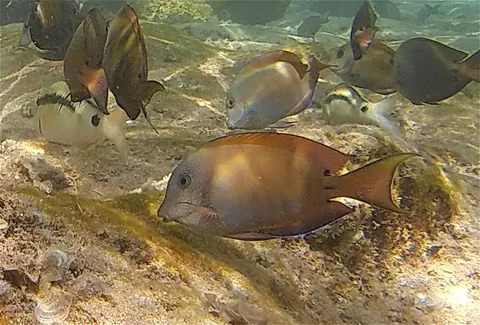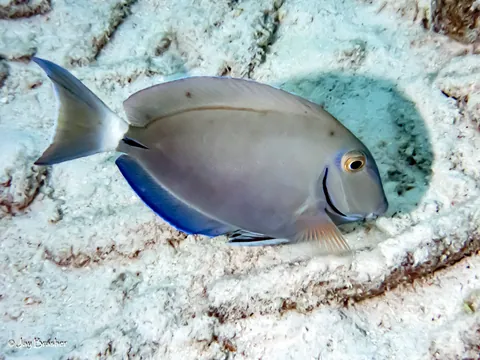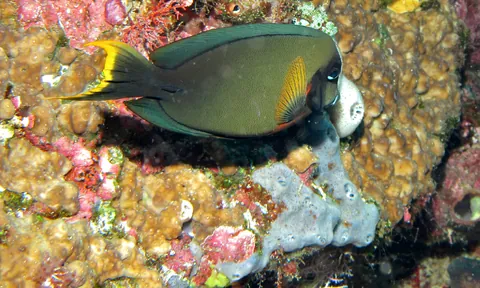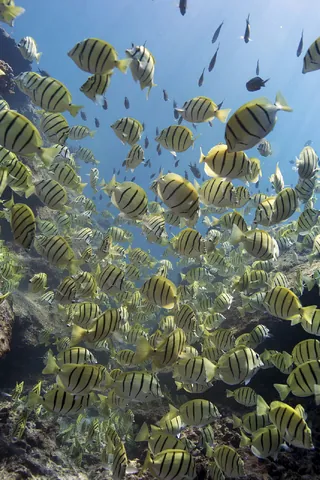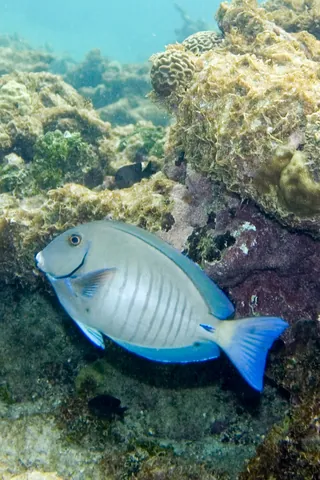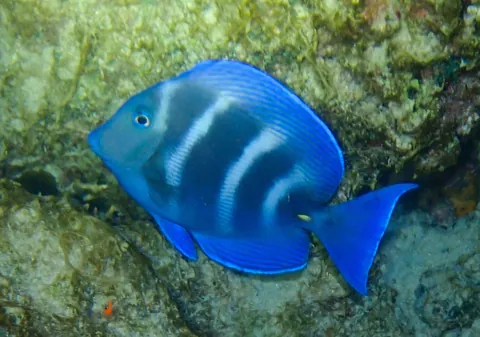
Atlantic Blue Tang
Acanthurus coeruleus
Zebrasoma velifer
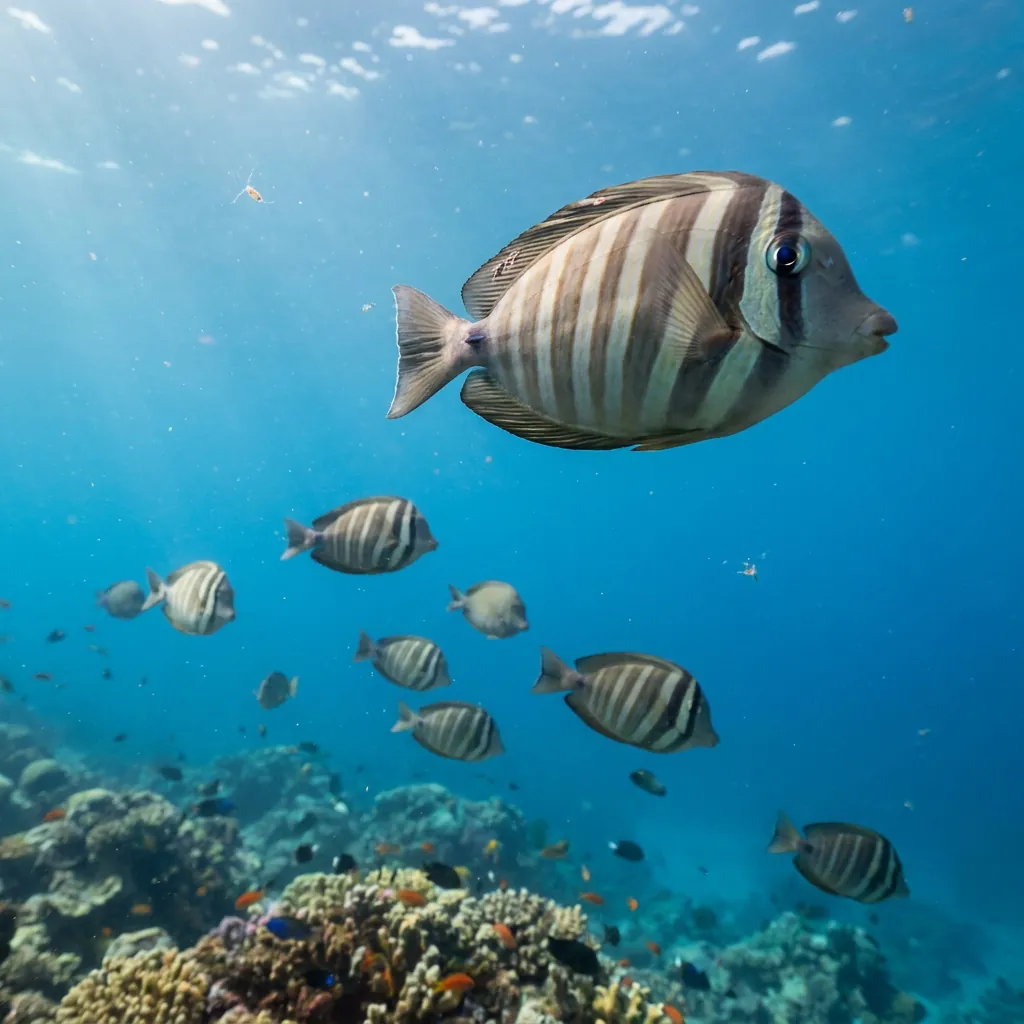
The sailfin tang gets its name from the huge fin along its back, which can make the fish look almost as tall as it is long. It grazes leafy algae over reefs across the Pacific and reaches about 40 cm.
Also known as: sailfin tang, sailfin surgeonfish, sailfin tang, pasific sailfin tang, sail fish tang, ringed tang, purple-lined tang, desjardin's sailfin tang, pacific sail-fin surgeonfish, pacific sailfin tang, sailfin surgeonfish, eastern sailfin tang, pacific sailfin tang, sailfin tang, sailfin surgeon
Several tangs in the genus Zebrasoma share this same tall-finned, disc-shaped build. Check the head: this is the only one with a white head speckled in yellow spots and a dark band through the eye.
The body is disc-shaped and flattened, with an elongated snout typical of its genus. The dorsal and anal fins are unusually tall. When spread, they nearly match the body in height. The body is brownish, crossed by wide grey-brown bars that alternate with narrower yellow ones. The tall fins are dark grey to brown with paler bands. Young fish look similar to adults but carry more yellow.
This tang lives on lagoon and seaward reefs across the Pacific, from the eastern Indian Ocean and Indo-China east to Hawaii and the Pitcairn Islands. Adults range down to 45 m, usually between 2 and 30 m. Young fish stay in shallow, sheltered reefs among rocks or coral, sometimes in cloudy water. Water here typically runs 24 to 28 degrees C.
The sailfin tang is usually solitary, though it is sometimes seen in a pair. It is active by day, grazing leafy algae off the reef. Courtship and spawning happen in the early afternoon, once the tide has started to fall.
This species was first described in 1795. When the genus Zebrasoma was created in 1839, it was the only species placed in it. That makes the sailfin tang the type species, the one fish that defines the whole genus.
Describe what you saw and we name it, then keep every species you find in your Oceandex.