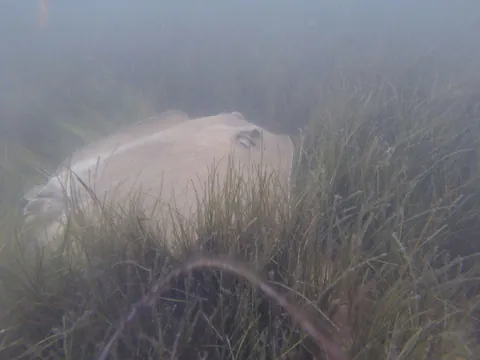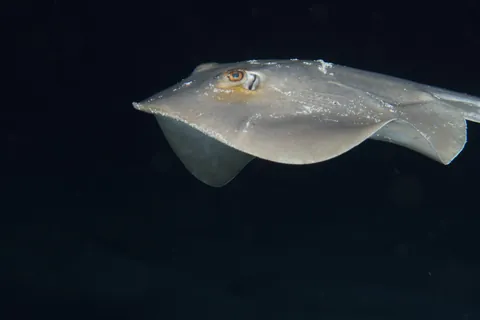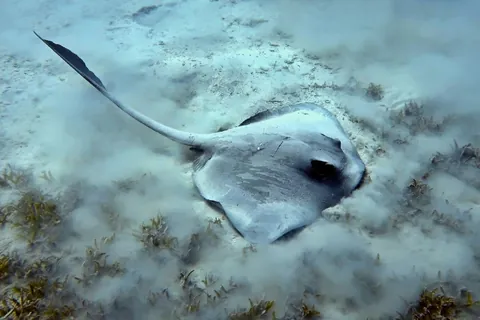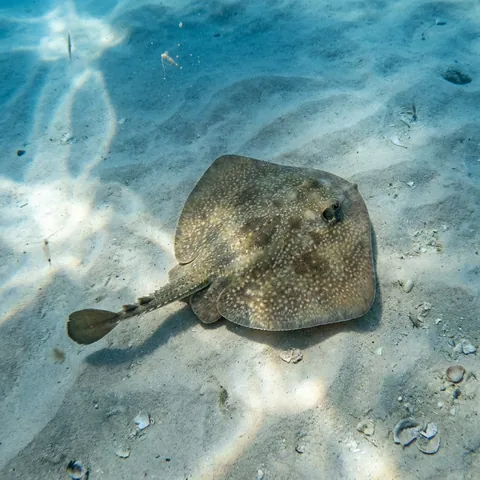
Atlantic Stingray
Hypanus sabinus
Taeniura lymma
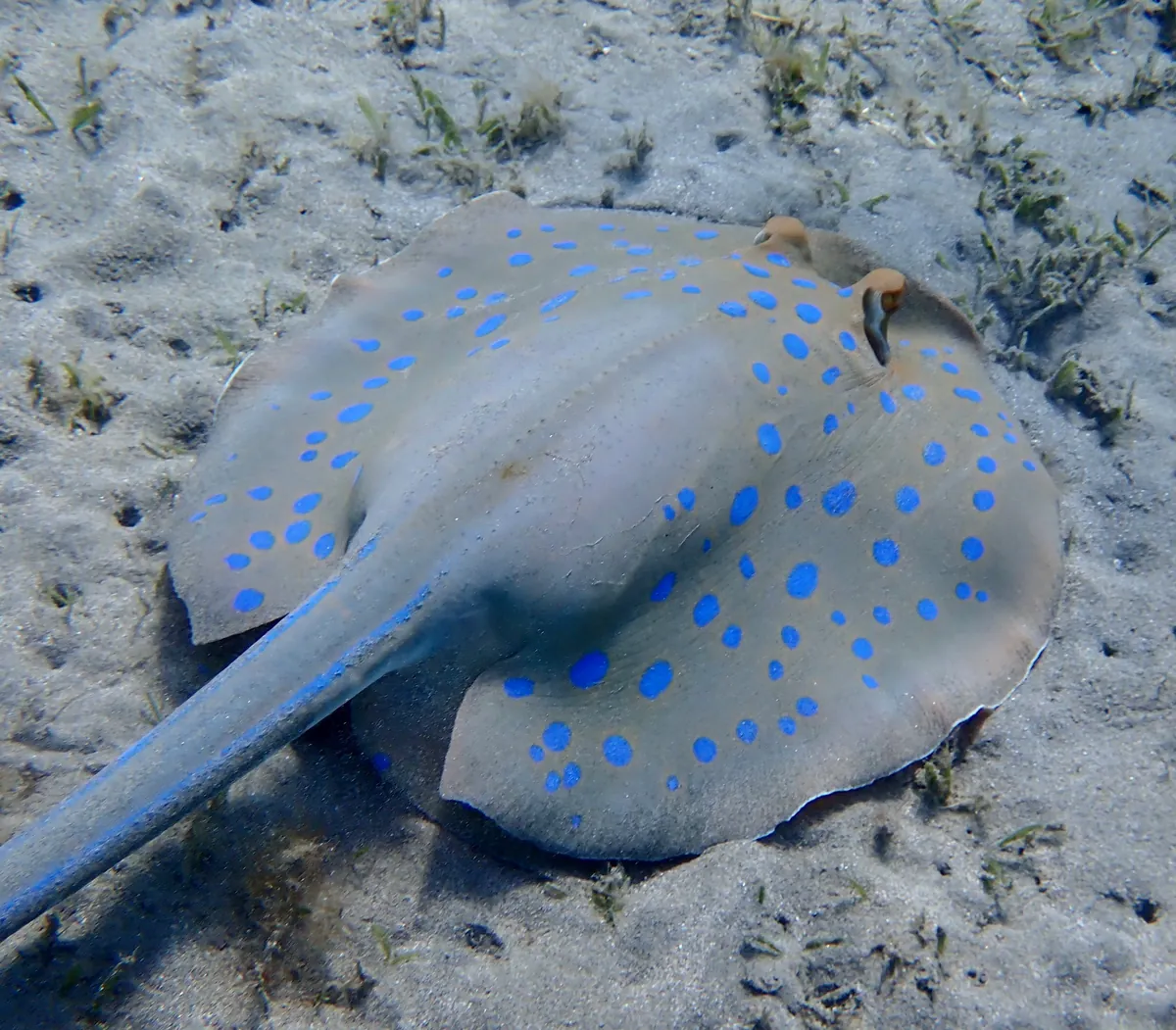
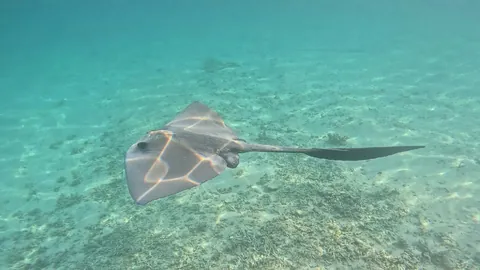
The bluespotted ribbontail ray is one of the most abundant stingrays on Indo-Pacific reefs and one of the easiest to name, thanks to the bright blue spots on its back. It is a small ray, reaching about 35 cm across, and lives in shallow water from 1 to 20 m. Its tail carries venomous spines and it can injure a person, but it would rather leave: when it feels threatened it races off in a zigzag. It is listed as Least Concern.
Also known as: taeniura lymma, blue spotted lagoon ray, blue spotted stingray, blue-spotted fantail ray, blue-spotted lagoon ray, blue-spotted ray, blue-spotted ribbontail ray, blue-spotted stingray, bluespotted fantail ray, bluespotted ribbontail ray, bluespotted ribbontail whipray, bluespotted ribbontailray, bluespotted stingray, fantail ray, lagoon ray, lesser fan-tailed ray, lesser fantail ray, reef ray, ribbon-ray fish, ribbon-tailed stingray, ribbontail ray
The pattern is unmistakable and it does not change: round, bright blue spots scattered over a yellowish-brown oval disc, plus a blue stripe down each side of the tail. Check the tail as well, since it is short and thick with a deep fold underneath, not thin and whip-like. A small ray tucked under a ledge with only its blue-striped tail sticking out is the usual first sighting.
The body is a smooth oval disc formed by the pectoral fins, with a bluntly angular snout. The eyes are large and stick out, and just behind each one is a wide breathing hole, the spiracle, which draws in clean water. The tail is short, thick and flattened, about one and a half times the length of the disc, with a deep fin fold running along its underside to the tip and a low ridge along the top. One or usually two saw-edged spines sit well back along the tail. The upper side is yellowish to brown and covered with round, electric blue spots, and a blue stripe runs along each side of the tail.
This ray lives in shallow water around the tropical Indo-Pacific, from the coast of southern Africa and the Arabian region through Southeast Asia to northern Australia and the islands of the western Pacific. It stays on the bottom, on coral reefs and the sandy flats beside them. It is also common right in the intertidal zone and in tide pools, and it has been seen near seagrass beds.
By day it lies alone in a cave, under a coral ledge or inside wreckage, often with only the tail showing. At night small groups gather and ride the rising tide onto shallow sand flats to feed. Unlike most stingrays, it rarely buries itself. It digs pits in the sand for molluscs, worms, shrimps, crabs and small fish, then traps the prey under its body and works it into the mouth with the disc. Other fish, such as goatfish, often trail a feeding ray to snatch what it misses. When the tide falls the group breaks up and each ray returns to a shelter on the reef. Females carry their young inside them and give birth to live pups, each a miniature of the adult. Hammerhead sharks and bottlenose dolphins hunt this ray.
venomous
Almost every stingray hides by burying itself in sand, but this one hardly ever does. It shelters in caves and under coral ledges instead, and it feeds out in the open on the sand flats at night.
Describe what you saw and we name it, then keep every species you find in your Oceandex.