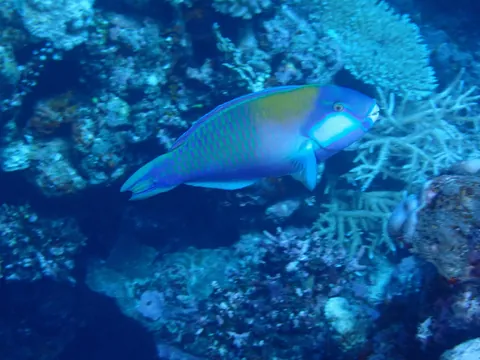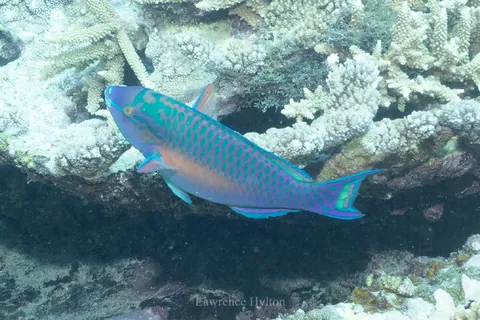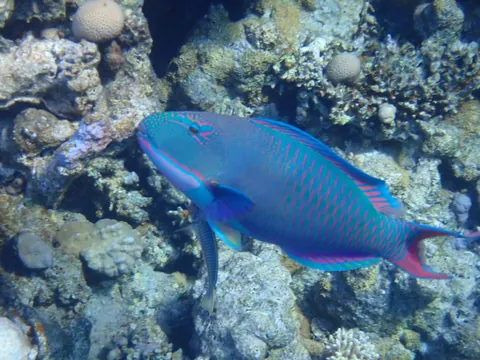
Bicolour parrotfish
Cetoscarus bicolor
Sparisoma aurofrenatum
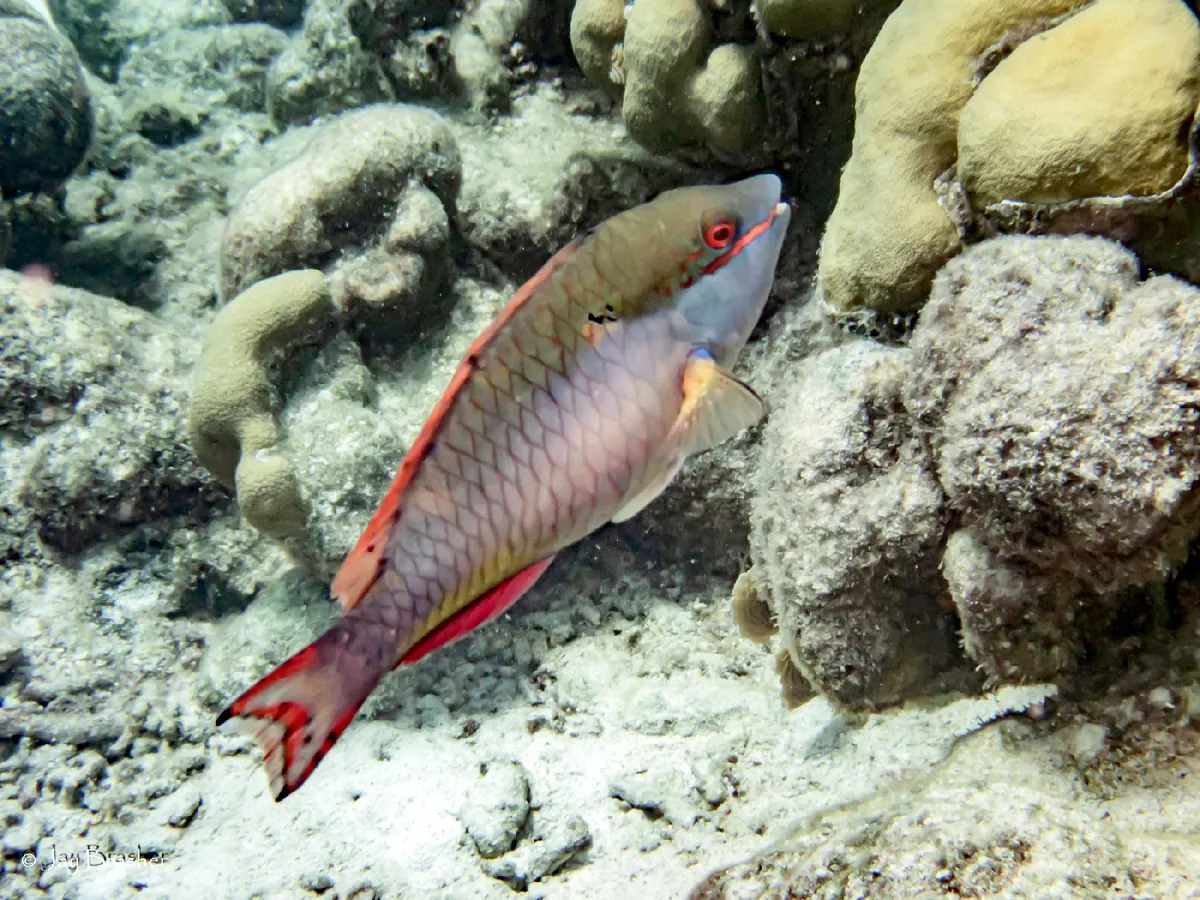
The redband parrotfish is a small, colour-changing reef fish that grazes algae from coral using its fused, beak-like teeth. It shifts through several very different looks as it grows, so the same species can surprise divers twice on one reef.
Also known as: black parrot
Many Caribbean parrotfish share these blue-green and red-brown colour phases. The white spot just behind the base of the dorsal fin stays present through every colour phase, making it a reliable mark for this species.
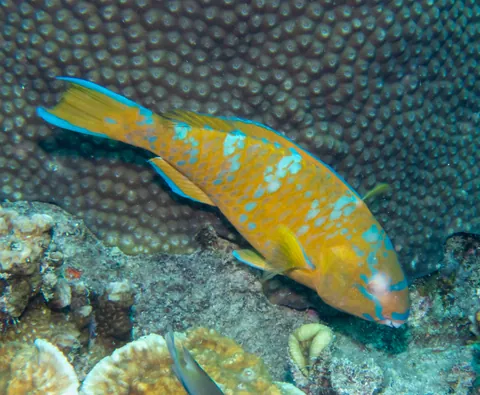
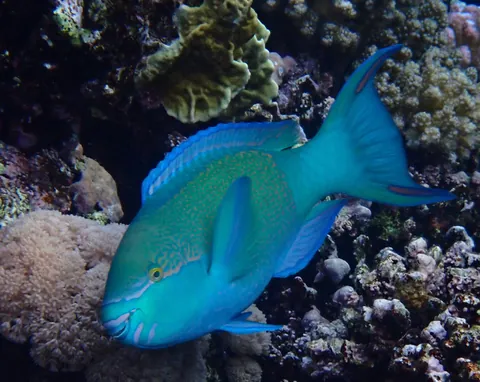
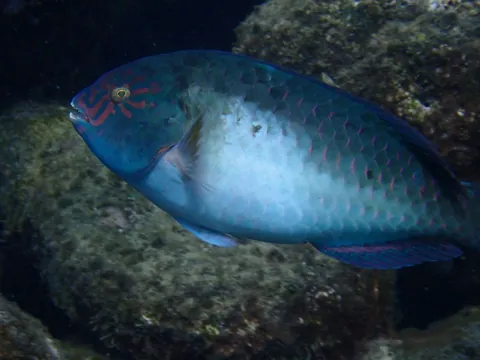
This parrotfish grows up to 28 cm, usually seen around 20 cm. Young fish are red-brown with two white stripes, a black blotch behind the upper gill cover, and a white spot behind the dorsal fin. As adults in the early colour phase, they turn blue-green to olive, keeping the white spot and mottled brown-red fins with two white stripes. Fully grown males in the final phase turn greenish, with a square tail edged in black, a small yellow patch with black dots near the head, and a pink-orange band running from the eye to the corner of the mouth.
It lives on coral reefs at depths of 2 to 20 m, across the Caribbean Sea and the western Atlantic, from Bermuda and Florida down through the Bahamas and Central America to Brazil. Young fish shelter in nearby seagrass beds before moving onto the reef.
This fish swims alone or in small groups, often resting on the bottom, and paddles with its pectoral fins rather than its tail unless it needs a quick burst of speed. It is a protogynous hermaphrodite, meaning some individuals start life as females and later become males. It grazes algae and coral polyps off the rock and coral surface with its beak-like teeth.
Describe what you saw and we name it, then keep every species you find in your Oceandex.