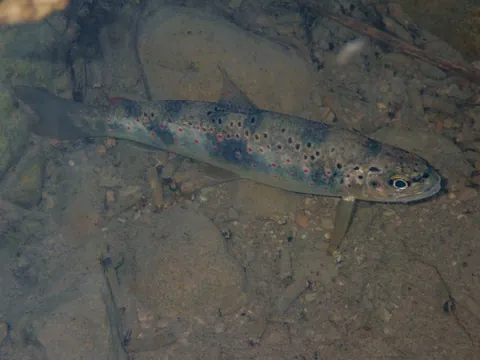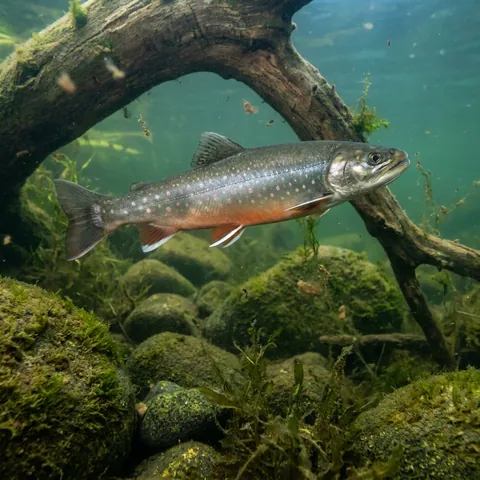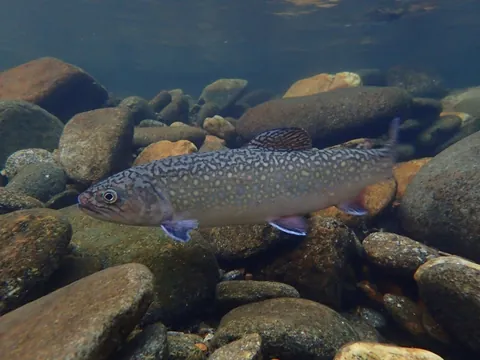
Brook Trout
Salvelinus fontinalis
Oncorhynchus mykiss
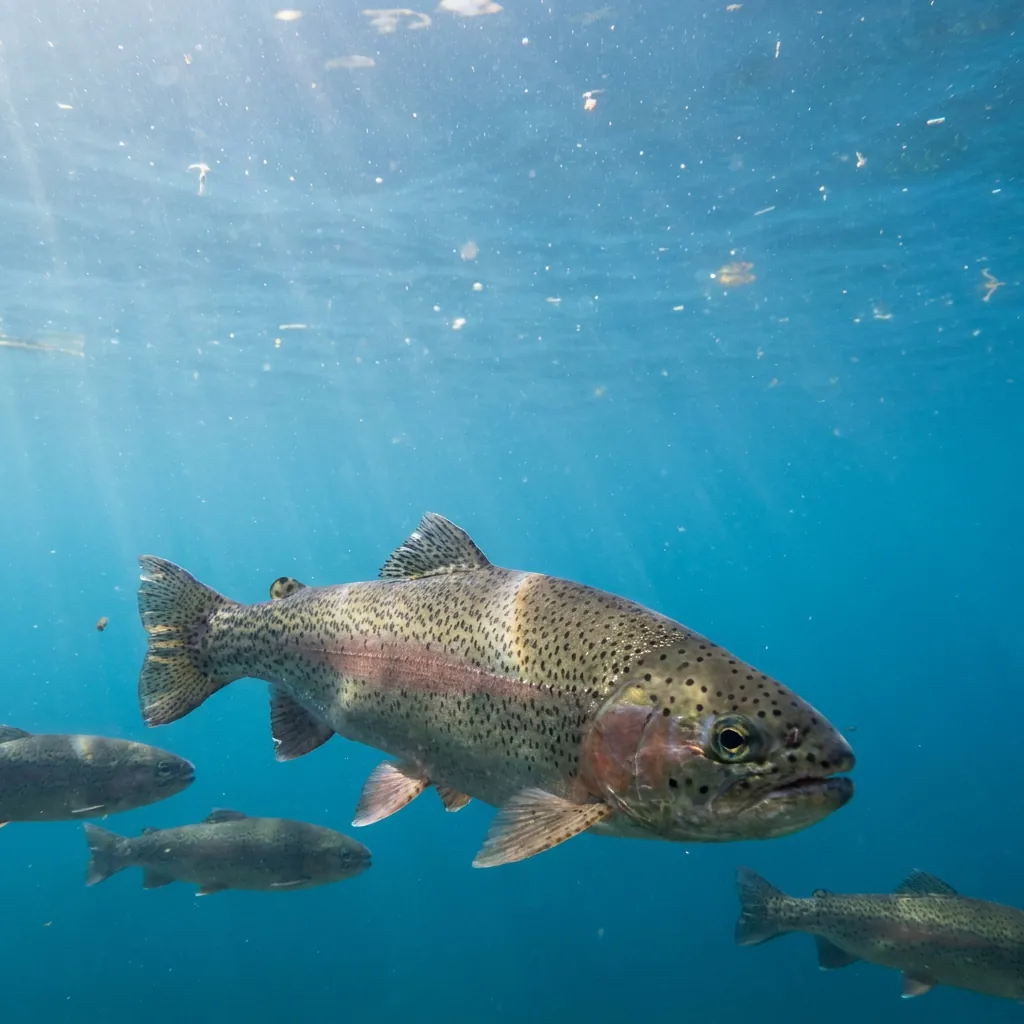
The rainbow trout is a trout native to cold streams that feed into the Pacific, in North America and Asia. Some populations stay in fresh water all their lives, while others, called steelhead, go to sea and return to fresh water to breed after a few years. It has been moved around the world for food and sport and now lives on every continent except Antarctica.
Also known as: steelhead trout, steelhead, pacific trout, baiser, coast angel trout, banana trout, palomino trout, lightning trout, golden rainbow trout, hatchery rainbow
Look along the flank for the broad pink-red band that runs from behind the gill cover to the tail. It sits on the lateral line and is the one mark that holds across the many colour forms. It is strongest on breeding males and can be faint on other fish, so look at the side of the fish, not its overall colour.
Colour varies a great deal between forms and habitats, but adults share a broad reddish stripe running along the side from the gills to the tail. The stripe follows the lateral line, the faint sensory strip along the flank, and it is brightest in breeding males.
Its home range is the coastal waters and streams of the Pacific basin, from Kamchatka in Russia through Alaska and British Columbia south to northern Mexico. River fish use small to medium, well-oxygenated, shallow rivers with gravel beds. Lake fish use moderately deep, cool lakes with shallow, weedy edges, and usually need a gravel-bottomed stream nearby to breed in.
It spawns in spring, once the water has warmed a little: from about January to June north of the equator, and from September to November south of it.
It eats almost anything it can catch. Common food includes the larvae and adults of water insects such as caddisflies, stoneflies and mayflies, land insects that fall into the water, fish eggs, algae, crayfish and shrimp. The share of fish in the diet rises as the trout grows.
The female digs a nest, called a redd, in fine gravel in a shallow, fast stretch just above a pool. She turns on her side and beats her tail up and down to clear the stones, and the eggs drop into the spaces in the gravel.
Many populations have fallen in the native range, especially the sea-run steelhead form. The causes are over-fishing, loss of habitat, disease, invasive species, pollution and cross-breeding with other forms. Some populations are now listed as endangered, threatened or of special concern.
This trout is the standard test animal for water pollution work in the United States: it is an approved indicator species for short-term freshwater toxicity testing, so its tolerance sets the yardstick by which many waters are judged safe.
Describe what you saw and we name it, then keep every species you find in your Oceandex.