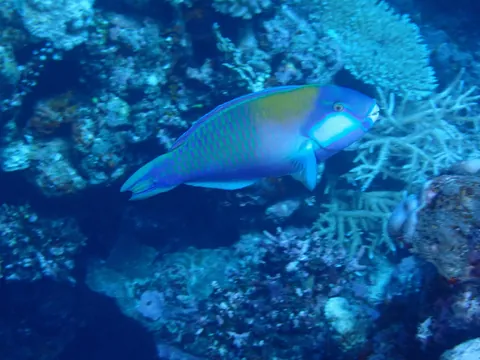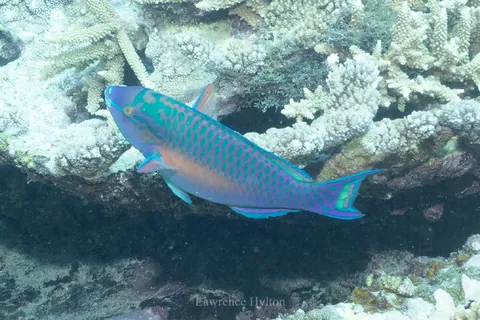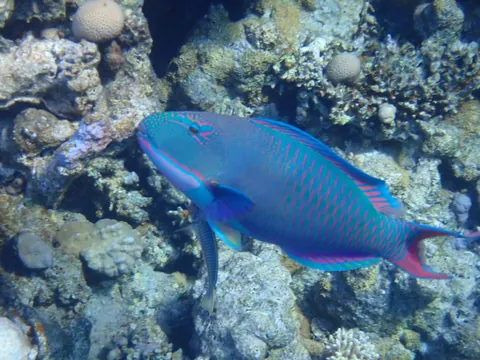
Bicolour parrotfish
Cetoscarus bicolor
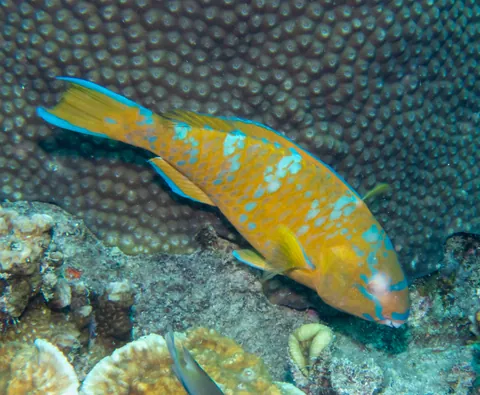
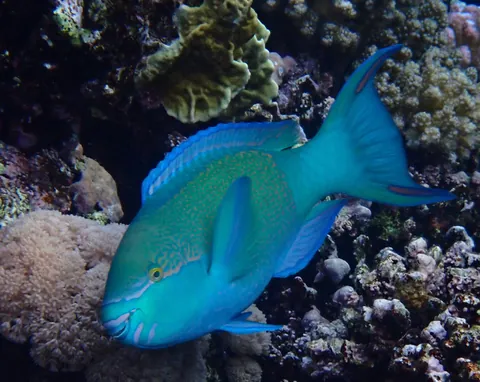
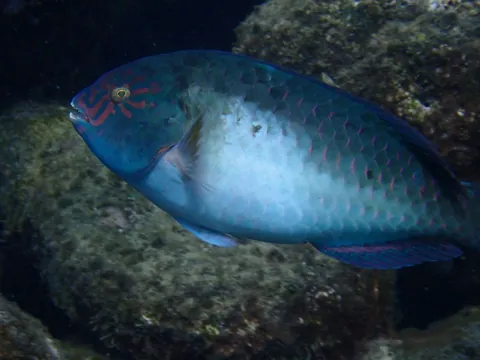
Chlorurus spilurus
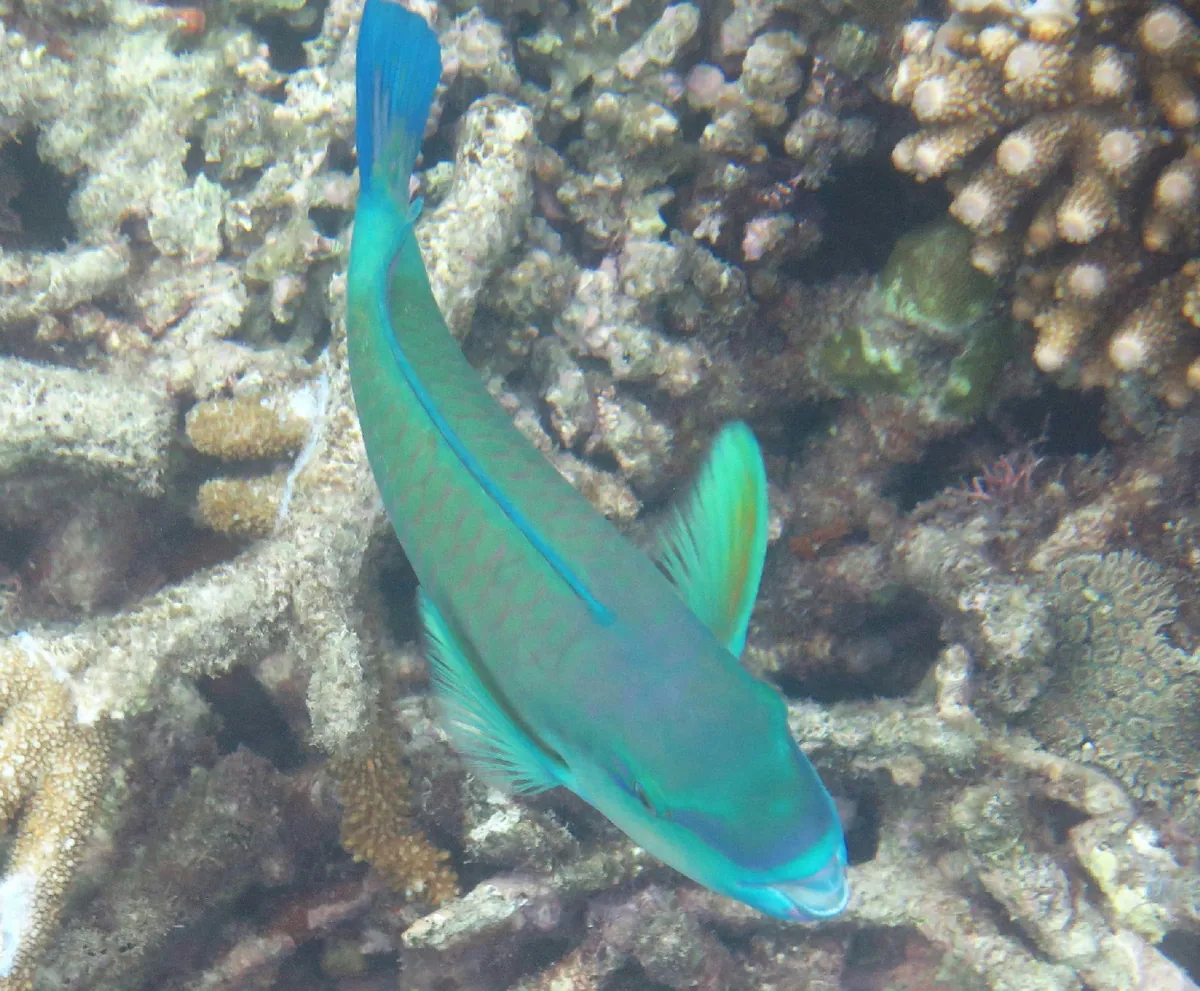
The Pacific bullethead parrotfish is a common sight on coral reefs and in lagoons across the tropical Pacific. Like other parrotfish it has a hard beak instead of separate teeth, and it is strong enough to bite chunks straight off the coral. It feeds on the coral polyps, the small animals that build the reef, and on the algae growing over the coral rock. In Hawaii it is called uhu. Like many parrotfish it lives in two phases with two different looks: an initial phase, which can be female or male, and a terminal phase male. The IUCN lists it as Least Concern.
Also known as: bullethead parrotfish
Work from the back end. On the dark reddish initial phase fish, the tail stalk and tail are white with a dark patch on them. That gives a clean pale rear on an otherwise dark fish, which you can pick out from several metres away. A white beak at the other end confirms it. Green terminal males are harder, because their colour varies. For them, look at the face: three blue-purple lines running around the mouth, and an orange and a white patch on the cheek.
Initial phase fish are dark reddish over the whole body, with a white beak at the front. At the back, the tail stalk and tail fin are white and carry a black patch, so the rear end looks pale and clearly marked off from the dark body. Terminal males look completely different and vary a lot from fish to fish. Their body is greenish, and each large scale is outlined in purple-blue, which gives the flank a net-like pattern. Around the mouth there are three purple-blue stripes, and on the cheek an orange patch and a white patch.
In Hawaiian legend, a giant parrotfish named Uhumaka'ika'i was said to be the parent of all fish, until it was killed by two heroes, Kawelo and Makuakeke.
Describe what you saw and we name it, then keep every species you find in your Oceandex.