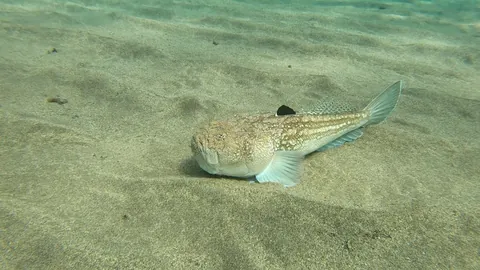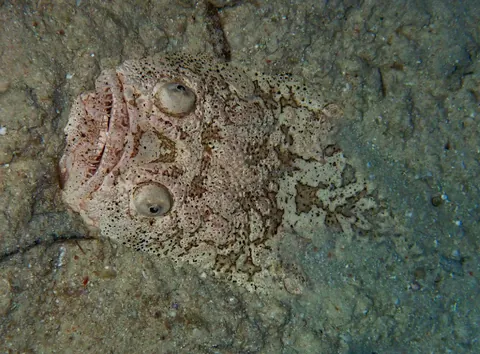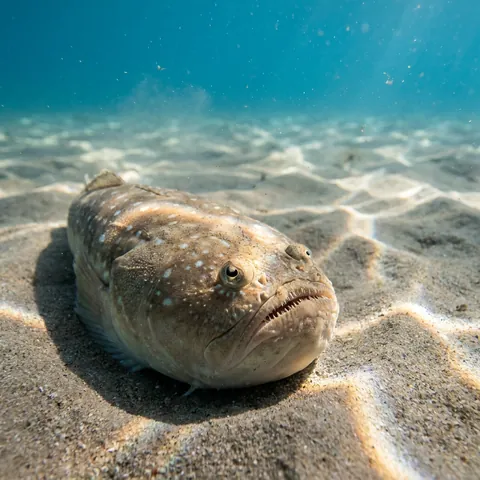
Southern Stargazer
Astroscopus y-graecum
Astroscopus guttatus
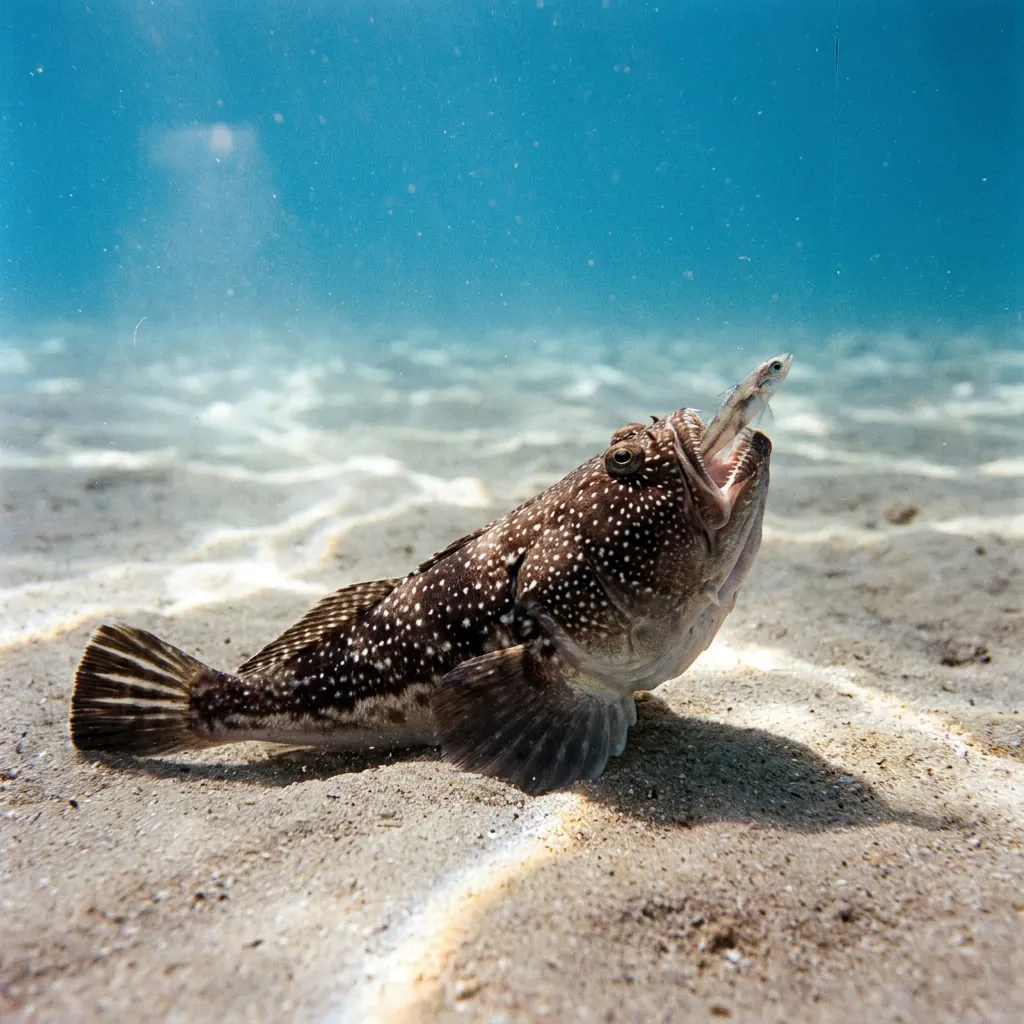
The northern stargazer spends most of its life hidden, buried in sand with only its eyes and mouth showing, waiting to ambush any small fish that swims too close overhead.
It closely resembles the southern stargazer, but the two rarely overlap in range. Where they might, look at the white spots on the back: the northern stargazer's are smaller and packed closely together, while the southern stargazer's are larger and more spread out.
This fish has a blackish-brown body covered in white spots that grow larger toward the tail, with three dark stripes running along its white tail. Its body is flat and wide with a large head, and both eyes sit on top of the head rather than the sides. An electric organ sits just under each eye, giving that spot a jelly-like look.
It lives on soft, sandy seabeds and around rocky reefs along the coast, from New York south to Virginia. It buries itself in the sand and rarely swims, so divers are more likely to spot only its eyes and the top of its head poking through the bottom.
It lies buried in sand, covering up to three-quarters of its body, and waits for small fish to pass overhead before striking. If disturbed it can dig itself deeper, under as much as 30 cm of sand. The electric organ under each eye can shock threats from above and stun prey, and young fish travel in schools before settling permanently on the sandy bottom as adults.
Listed as Least Concern, with an unknown population trend and no known major threats. It is occasionally caught as bycatch in bottom trawls but is not targeted or used.
Its scientific name, Astroscopus guttatus, means "speckled one who aims at the stars", a nod to both its spotted back and its upward-facing eyes.
Describe what you saw and we name it, then keep every species you find in your Oceandex.