Northern Stargazer
Astroscopus guttatus
Astroscopus y-graecum
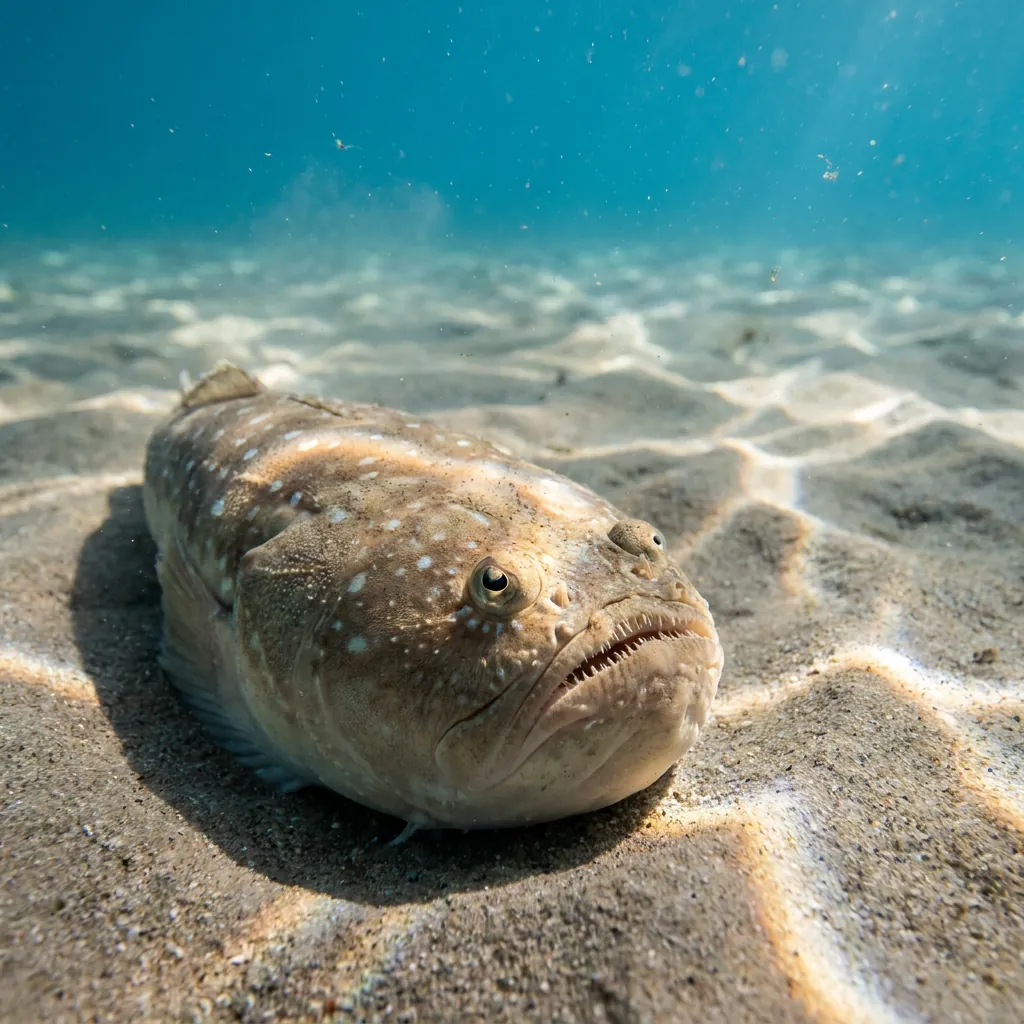
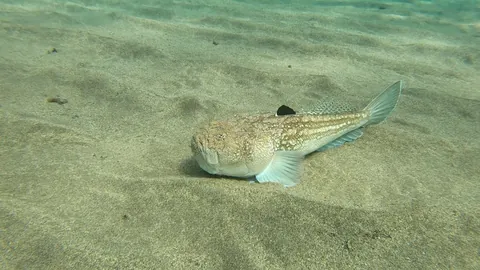
The southern stargazer spends most of its life hidden, buried in sand with only its eyes and mouth showing, waiting to ambush prey. It carries a venomous spine and can deliver an electric shock, so it is best admired from a distance.
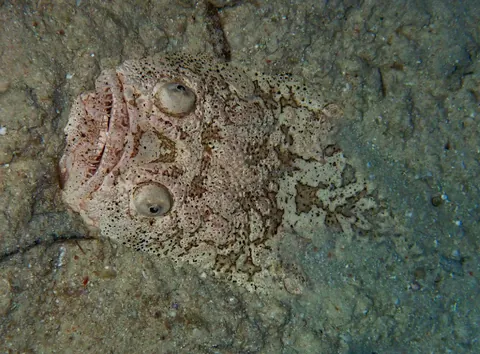
A pair of eyes and a mouth poking out of open sand, with nothing else visible, marks this out as a stargazer rather than a flatfish or ray. Related stargazer species look very similar, and no single visible mark in the evidence tells them apart underwater.
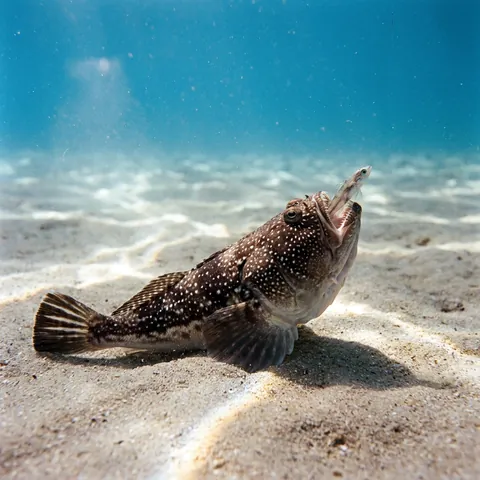
This fish has a brownish body covered in small white spots, with black-and-white lined pectoral fins and three dark stripes on its tail fin. Its eyes sit on top of its head and protrude slightly upward, so it can see while buried, and its nostrils are guarded by fringed, comb-like flaps that keep sand out. It has no scales on top of its head, though the rest of its body is scaled. A spine near the gill cover carries venom, and an organ behind each eye can produce an electric shock, mainly for defence.
It lives on the seafloor over sandy, silty, or soft rubble bottoms, mostly inshore and close to reefs. It ranges through the western Atlantic from North Carolina south through the Gulf of Mexico to the Yucatan, and along the Caribbean coast of Central and South America down to Rio de Janeiro, though it is absent from the West Indies.
This fish buries itself in sand using its pectoral fins, leaving only its eyes, nostrils, and part of its mouth exposed, and lies still until prey swims close. Just before it hunts, its body pales to a light yellow-grey. It strikes head-on even though its mouth and eyes point upward, so it often has to circle and reposition before landing a hit, and it will go after prey its own size or larger, swallowing it by stretching its stomach wide.
Spawning happens in late spring and early summer, on the bottom, with small clear eggs that drift up toward the surface. The see-through larvae live in open water at first, feeding on their yolk sac and then on other larvae, before settling to the bottom as juveniles. Young fish typically move into shallow, sandy bays, where their eyes gradually shift from the side of the head to the top as they grow into adults.
Just before this fish starts hunting, its body changes colour from brown to a pale yellow-grey, an outward sign of its mood that gives away when it is about to strike.
Describe what you saw and we name it, then keep every species you find in your Oceandex.