Northern Stargazer
Astroscopus guttatus
Uranoscopus scaber
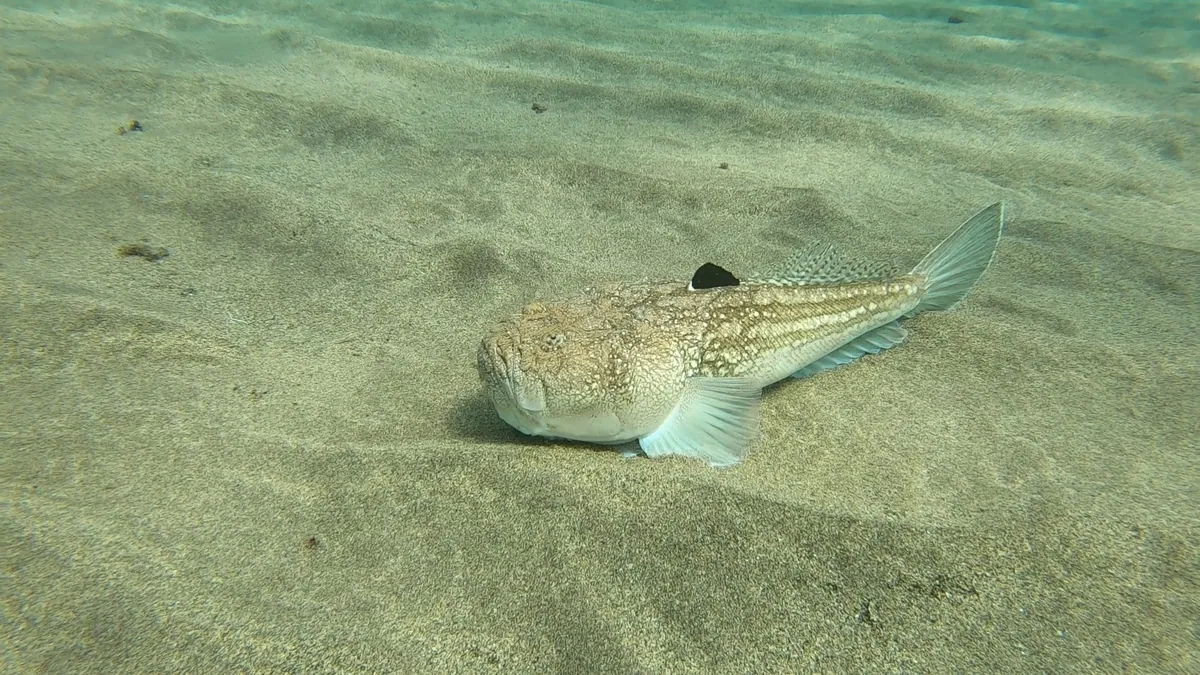
The stargazer spends most of its life buried in the seabed, waiting with only its eyes showing. It grows up to 40 cm long and is one of the few fish able to generate its own electric pulses.
Also known as: stargazer, stargazer, atlantic stargazer
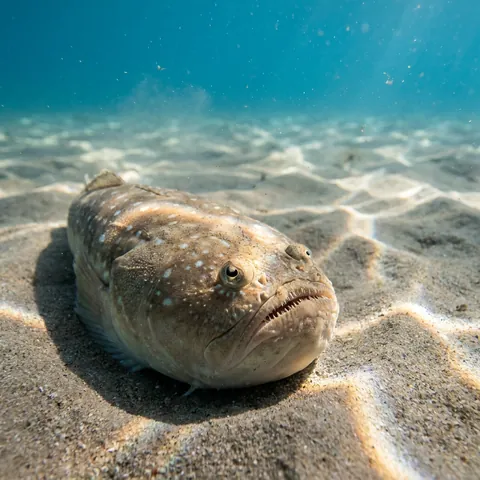
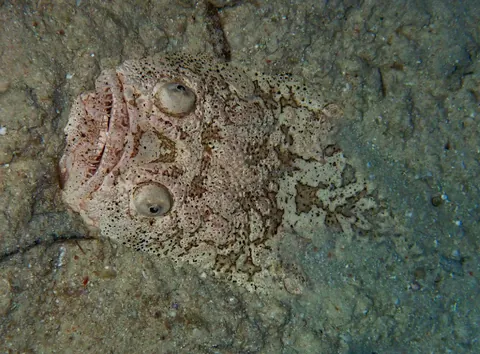
It is easy to overlook against other buried ambush hunters. The giveaway is its eyes and huge mouth sitting on top of a flattened head, angled straight upward, the only part visible when it is buried.
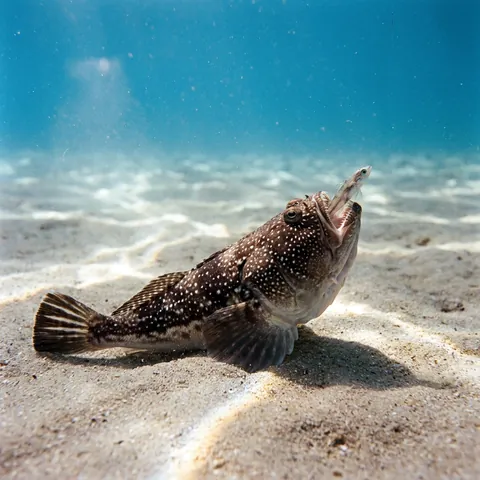
Its body is flattened from top to bottom, and its head and mouth point upward rather than forward. The mouth is large, the body is brown with many small pale spots, and the belly is lighter. A short strip of skin hangs from the lower jaw.
It lives on sandy or muddy sea floors along the upper continental slope, from 15 down to 400 metres. It is common in the Mediterranean and Black Seas and along the Atlantic coasts of Europe and Africa.
It rests buried in sediment for long periods, staying almost motionless. Shoulder spines can deliver a painful sting if handled, and it produces electric pulses both while feeding and when disturbed.
It is an ambush hunter, lying hidden with just its eyes exposed and twitching the skin strip on its jaw to lure prey close. When something comes near, it lunges and swallows it in a fraction of a second. It feeds mainly on fish larvae, small fish, and small crustaceans, and occasionally on molluscs, worms, and plant material.
It spawns between April and September, depending on the region, releasing eggs that drift in open water. The larvae and juveniles also stay adrift before settling to the bottom as adults.
It is thought to represent a transitional stage in how electric organs evolved in fish, generating electric pulses without being able to sense them.
Describe what you saw and we name it, then keep every species you find in your Oceandex.