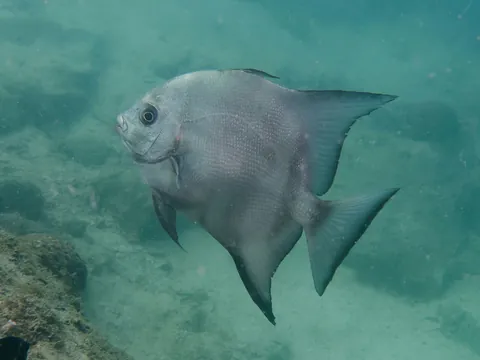
Atlantic Spadefish
Chaetodipterus faber
Platax teira
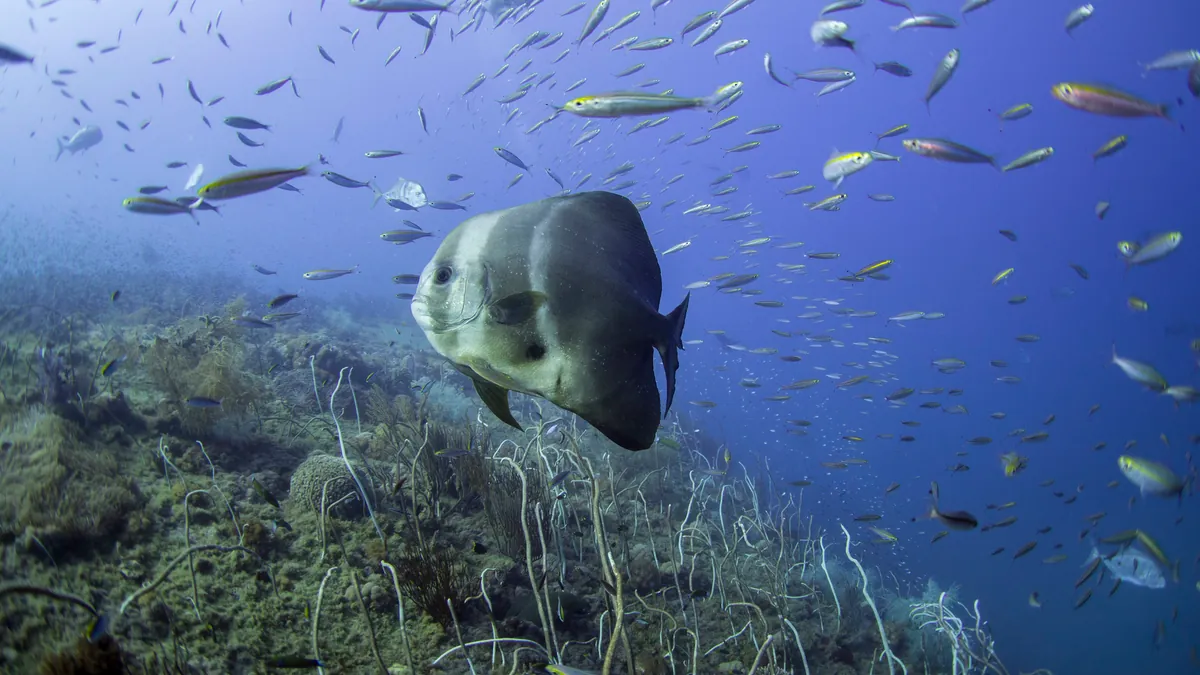
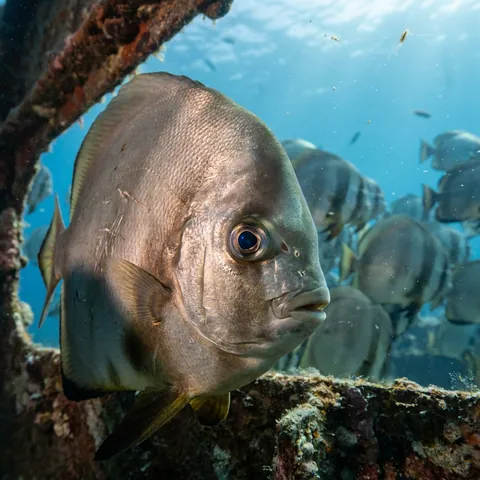
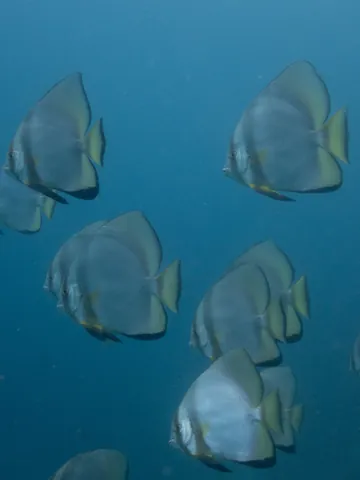
The longfin batfish is a tall, disc-shaped silver fish that grows to about 70 cm. Divers meet it hanging in mid-water in small groups, often around wrecks, sometimes in larger schools. It is an omnivore and eats plankton, small invertebrates, animals attached to the reef and seaweed.
Also known as: longfin batfish, tiera batfish, longfin baitfish, spadefish, round faced batfish, roundface batfish, longfin spadefish, batfish, teira batfish, orbicular batfish, tall-fin batfish, tiera batfish, longfin spadefish, blunthead batfish, spotbelly batfish, tail-fin batfish, tiera batfish, roundface batfish
Body shape first: a flat silver disc, roughly as tall as it is long, seen edge-on like a plate. Because the banding can fade away completely, do not rely on the bars. Look instead for the black blotch low on the body, just behind and below the pectoral fin, which stays visible, and on big adults for the steep, almost vertical forehead above the eye.
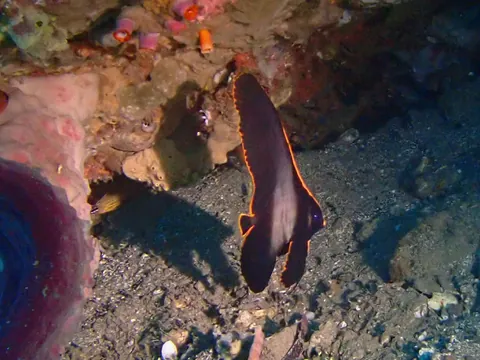
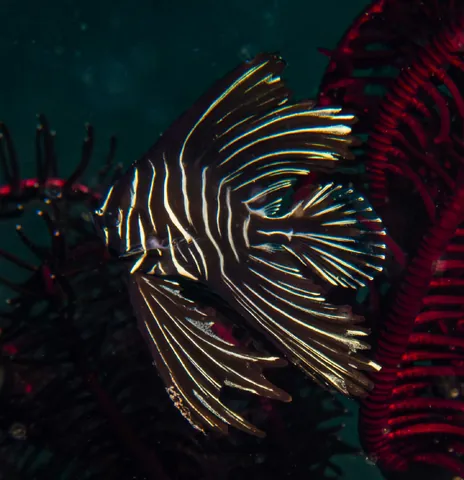
Seen from the side the body is almost a circle, very flat and about as deep as it is long, with a low hump on the neck. The colour is usually silver, grey or brownish, often with a yellow tint. Two dark bars cross the front of the body: one through the eye, and one running from the start of the back fin, past the rear edge of the gill cover and the base of the pectoral fin, down to the belly, where it usually ends in a black blotch. There is often a second smaller dark streak where the anal fin starts on the underside. The fins are dusky yellow with black edges at the rear. Large adults grow a bony hump on the forehead, so the front of the head becomes almost vertical. Larger juveniles have very long pelvic fins and long front rays on the back and belly fins, which give the fish a kite-like outline.
The species lives across the Indo-West Pacific, from the Red Sea and East Africa east to Papua New Guinea, north to southern Japan and south around Australia. Juveniles stay in shallow, sheltered inner reefs, while adults use sheltered bays, lagoons and seaward reefs, and also live well offshore. Records for the species run from 3 to 25 m. It is regularly seen around shipwrecks and artificial reefs, and it also gathers under floating seaweed and drifting rubbish.
This fish can change its look quickly. It shifts from plain silvery white with no bars to brown with strong dark banding while you watch, then fades back again. Very small juveniles drift among floating debris, and as they find one another they group up. As they grow they spend more time in open water and form large schools that shelter under big rafts of Sargassum seaweed, which build up after the wet season. Adults are usually seen in small groups.
This batfish can shift its own colours while you watch it, fading from plain silvery white to dark banded and back again within minutes. Adults also gather in schools that shelter beneath huge rafts of floating Sargassum seaweed after the rainy season.
Describe what you saw and we name it, then keep every species you find in your Oceandex.