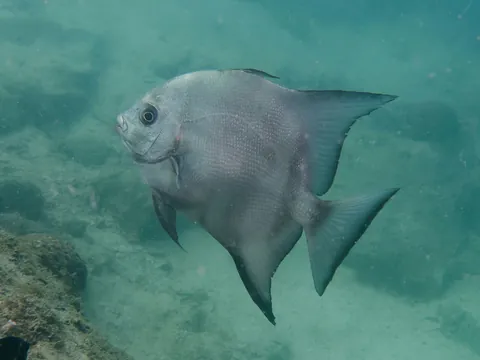
Atlantic Spadefish
Chaetodipterus faber
Platax pinnatus
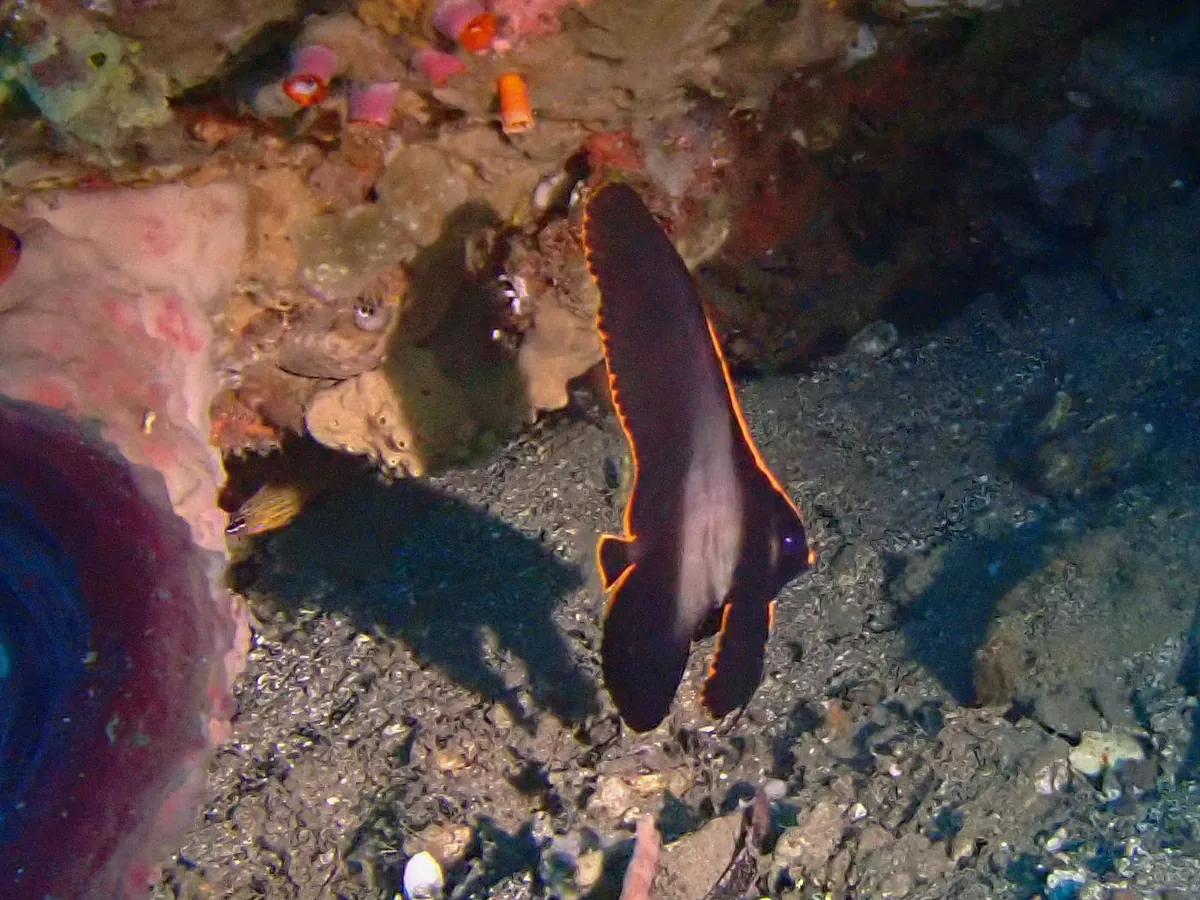
The dusky batfish leads a double life. As a juvenile it disguises itself as something dangerous; as an adult it transforms into a plain, disc-shaped reef fish that gathers in loose crowds over open ground.
Also known as: dusky batfish, dusky batfish, spadefish, batfish, long-finned batfish, pinnate batfish, spadefish, shaded batfish, pinnate spadefish, longfinned batfish, round batfish, dusky batfish, pinnate spadefish, butterfly-fish, leaf-fish, long-finned batfish, pinnate batfish, shaded batfish, sunfish, turbot, seabat
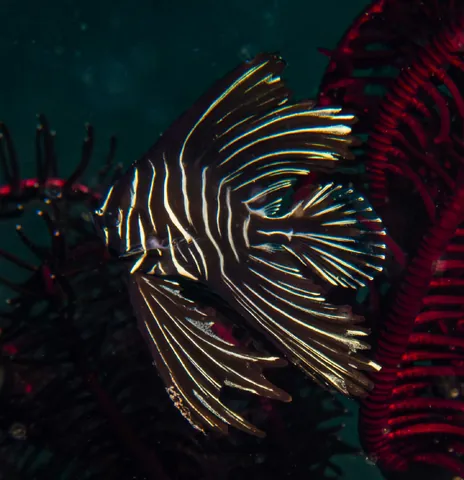
Juveniles are shaped and coloured to mimic a toxic flatworm, and at a glance the two can look alike. The giveaway is the fish's fins: a flatworm has none, while the juvenile batfish's long, trailing dorsal and anal fins ripple as it swims.
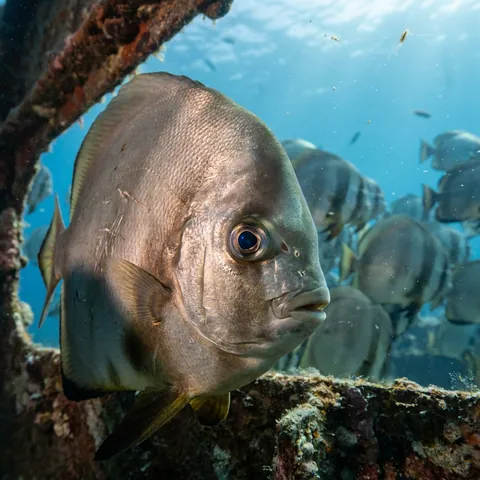
Adults grow up to 45 cm long and have a round, strongly flattened, disc-shaped body, deeper than it is long. Their colour is silvery, marked with a dark vertical bar running through the eye and a second one at the base of the pectoral fin, while the back, tail, and anal fins are yellow. Juveniles look completely different: mostly black, with the body and fins outlined in bright orange, and the dorsal and anal fins drawn out into long, trailing extensions.
Adults live along steep outer reef slopes, sheltering under overhangs at depths of 15 to 30 m. Juveniles use very different ground, hiding in mangroves and in caves or under ledges on sheltered inner reefs.
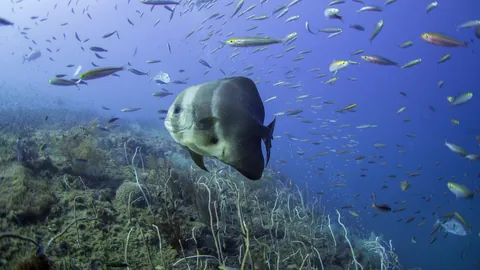
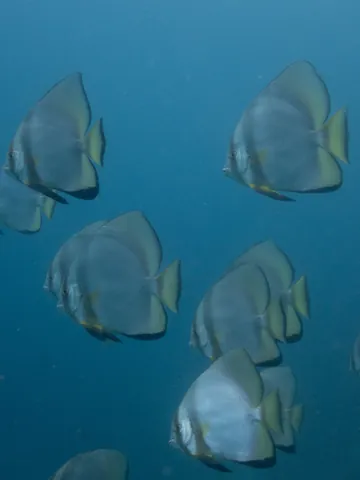
Adults are usually solitary but sometimes gather into large schools that move together over open, sandy ground. They feed on algae, jellyfish, and other soft-bodied drifting animals, and have been seen keeping algae growth on coral in check. Juveniles rely on camouflage rather than schooling, staying hidden and still in their shelters.
Carl Linnaeus named this fish in 1758, calling it pinnatus, meaning "finned", for the long, trailing dorsal and anal fins seen on the young.
Describe what you saw and we name it, then keep every species you find in your Oceandex.