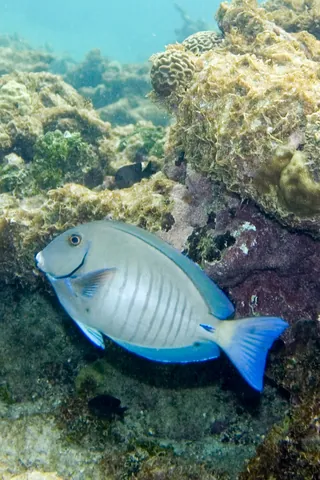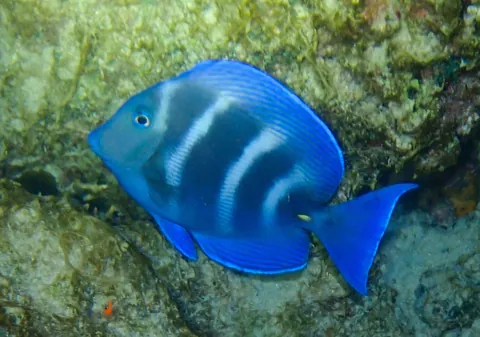
Atlantic Blue Tang
Acanthurus coeruleus
Acanthurus lineatus
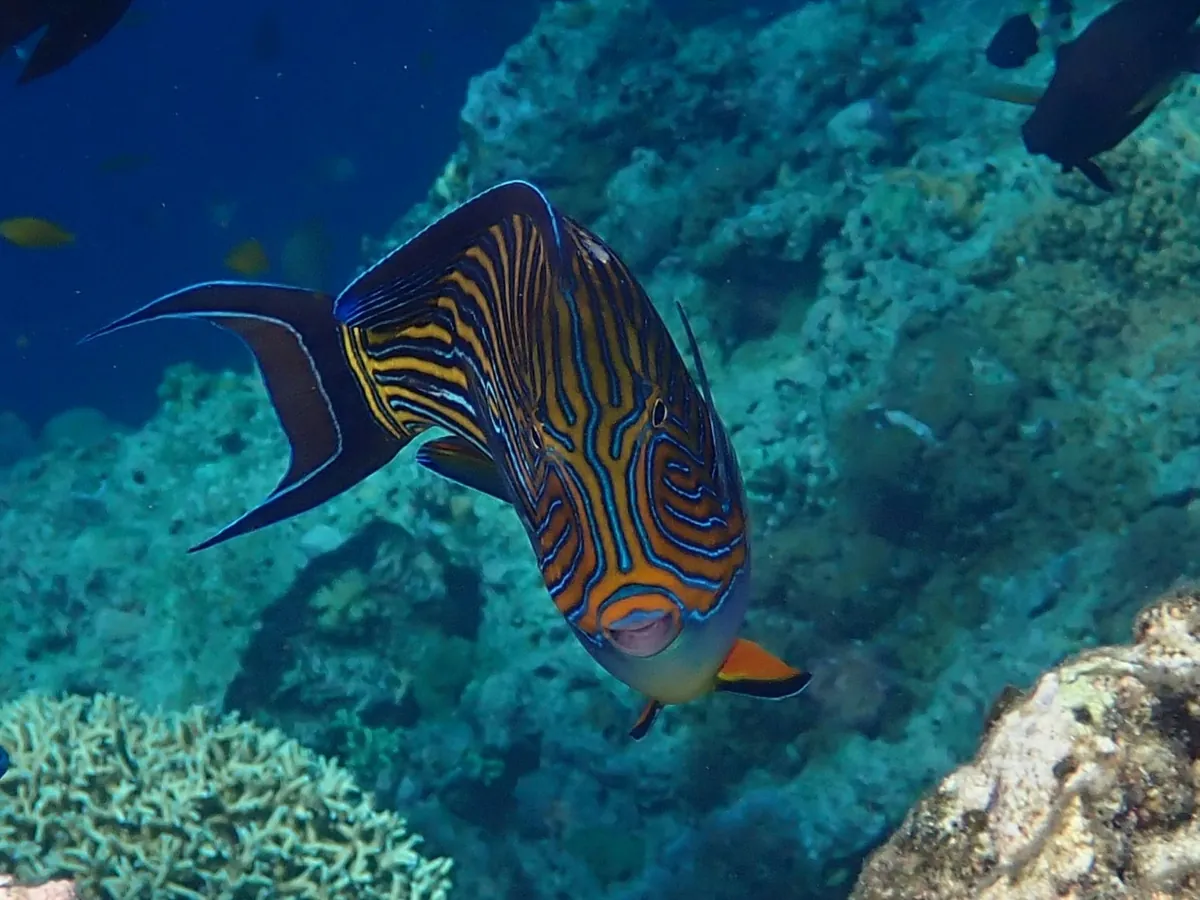
The lined surgeonfish is a boldly striped fish of the shallowest, roughest part of the reef. It is a grazer that crops algae off hard surfaces through the day, and it is almost never still. Adults reach about 38 cm, though most are nearer 25 cm. Handle with respect: the blades at the base of its tail are the sharpest problem this fish presents.
Also known as: blue-lined surgeonfish, clown surgeonfish, clown surgeon, zebra surgeonfish, blue linned surgeonfish, clown surgeonfish, bluebanded, bluelined surgeonfish, blue-banded surgeonfish, bluebanded surgeon, striped surgeon, spoted box crab, bluebanded surgeonfish, blue-lined surgeonfish, lined surgeon, striped surgeonfish, lined surgeonfish, striped surgeonfish, striped tang, lined surgeon, zebra surgeonfish, bluelined surgeonfish, clown tang, clown surgeonfish
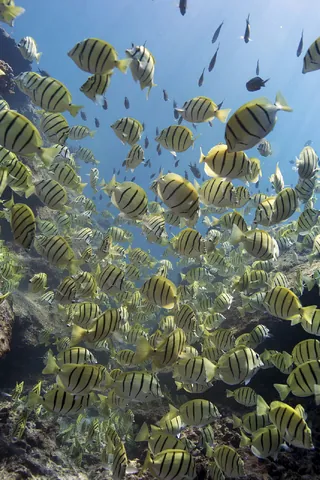
Look for bright blue and yellow stripes, each one outlined in black, running the length of the upper body, above a plain grey belly. The setting helps: this is a fish of the top few metres in moving water, so a strongly striped surgeonfish in the surge on the reef crest is very likely this one. The stripes are fixed and easy to read from several metres away.
The body is deep and flattened from side to side, with a crescent-shaped tail. Most of the flank carries blue and yellow stripes running lengthwise, each stripe outlined in black, and the top of the head is striped in yellow. The belly is plain greyish, which makes the striped upper body stand out even more. The pectoral fins on the sides have dark rays, and the small pelvic fins underneath are yellow-brown with black edges. On each side of the tail base sits a sharp, blade-like spine.
This surgeonfish lives across the Indo-Pacific, from East Africa east to the western Pacific and out to Polynesia and Hawaii, north to Japan and south to the Great Barrier Reef. It is a fish of the shallows: exposed seaward reefs in the surge zone, where the swell breaks and washes back, and the shallow gutters cut into them. It is recorded down to 15 m, but most sit in only 1 m to 3 m of water. Juveniles keep to shallow rubble ground.
Adults are territorial. A large male holds a well-marked feeding patch and a group of females within it, and defends it against intruders. Adults also form schools, and they gather in large numbers to spawn. Juveniles live alone and stay out of sight among rubble. Feeding is almost constant grazing on algae through the day, with crustaceans taken now and then.
Every surgeonfish carries a blade at the base of the tail, but in this species the spine is venomous, and a cut from it causes a wound far more painful than the cut alone would explain.
Describe what you saw and we name it, then keep every species you find in your Oceandex.