Angelfish
angelfish
Holacanthus passer
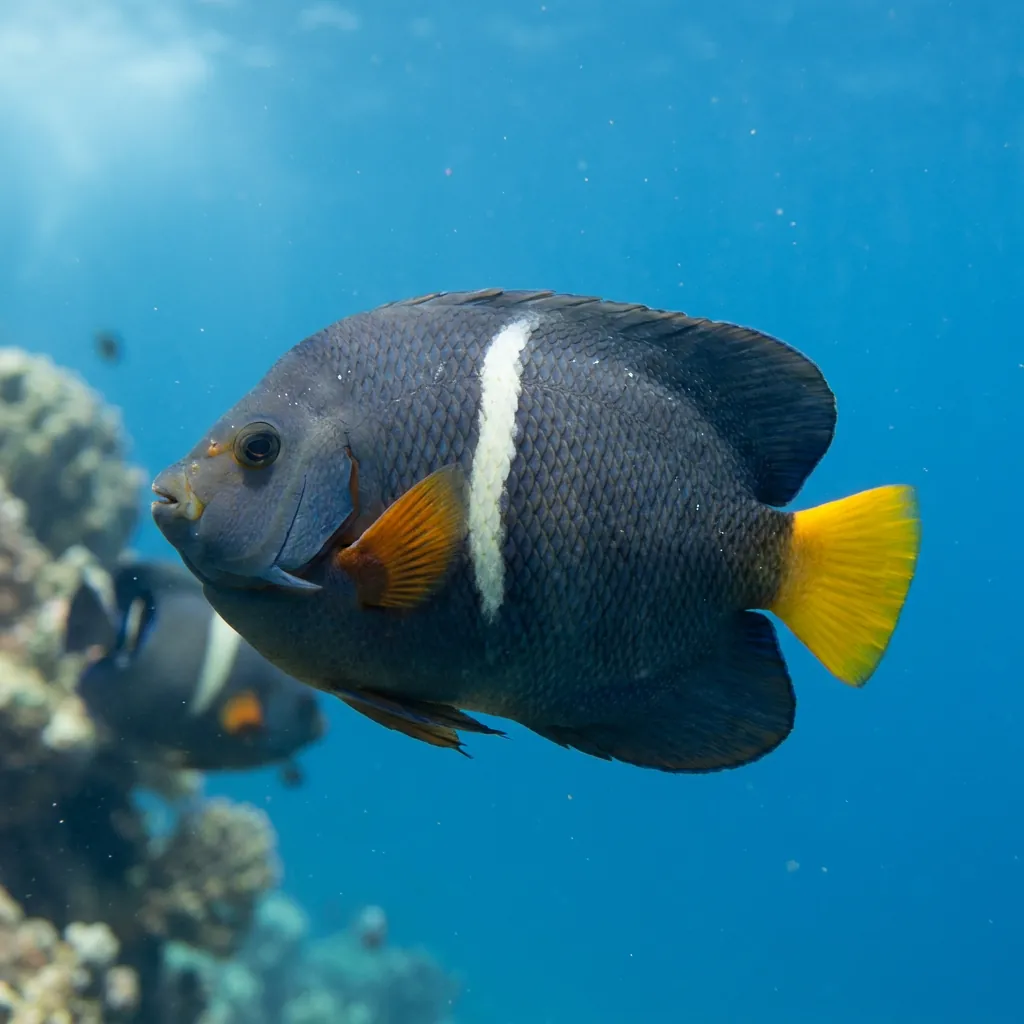
The King Angelfish is a striking reef fish of the eastern Pacific that changes its look completely as it grows up. Adults can reach up to 35.6 cm, though most divers see fish closer to 15 cm.
Also known as: passer angelfish
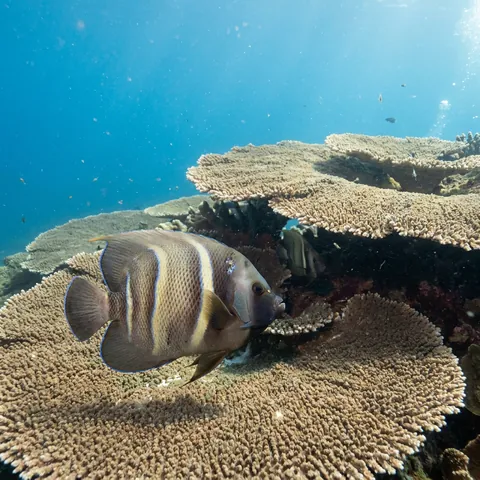
Two close relatives, found further offshore, look almost entirely blue with no yellow tail. An adult King Angelfish is told apart by its yellow tail fin and the white stripe near its head.
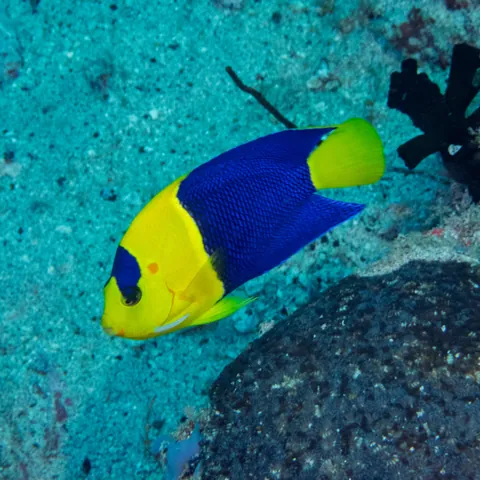
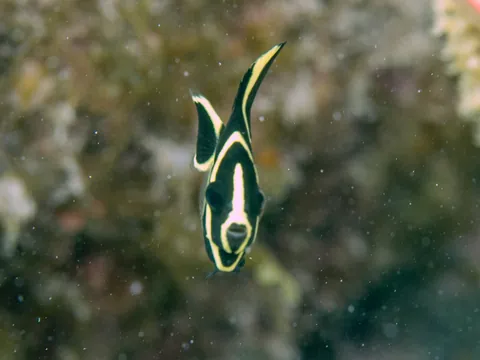
Juveniles are orange-yellow with blue-rimmed dorsal and anal fins, blue stripes toward the tail, and an orange mask around the eye. Adults lose the stripes and turn brown or blue depending on the light, with a yellow tail, a yellow patch at the mouth, and a white stripe near the head. Like other angelfish, it has a defensive spike hidden under the lower cheek. Females tend to have yellow pelvic fins, while males have white ones.
This is a reef fish of the eastern Pacific, from Peru north to the Gulf of California and out to the Galapagos, usually in 4 to 30 m of water. It stays close to the middle and bottom of rocky reefs, often near crevices in large boulders, and juveniles sometimes turn up in tide pools.
Pairs tend to stay together long-term in the northern part of the range, while females further south are more often solitary and defend their own territory. At sunset, males gather and act aggressively to defend courtship territory before females arrive to choose a mate. Courting pairs swim, flutter, and spin together before rising to spawn near the surface.
Active by day, the King Angelfish feeds on sponges, other invertebrates fixed to the reef, zooplankton in the water column, and algae growing on rock. It is an important sponge-eater, having been recorded feeding on nearly every sponge species surveyed in parts of its range.
Pairs are monogamous and spawn daily around sunset during the breeding season, scattering their eggs into the water rather than guarding a nest. A single pair can release tens of thousands of eggs a day. The eggs drift for about 20 hours before hatching, and the tiny fry live off a yolk sac until they are ready to feed on zooplankton.
The King Angelfish is listed as least concern, but overfishing led Mexico to grant it special protection in 1996 and to close two fisheries in the Gulf of California in the early 2000s. The species appears to have recovered since the fishing ban, though there is little recent data on its numbers.
The King Angelfish sometimes acts as a cleaner fish, picking organic matter, including other fish's droppings, off the bodies of other reef fish it forms mutual partnerships with.
Describe what you saw and we name it, then keep every species you find in your Oceandex.