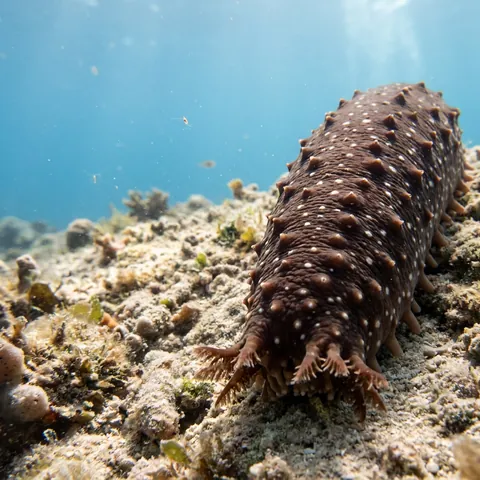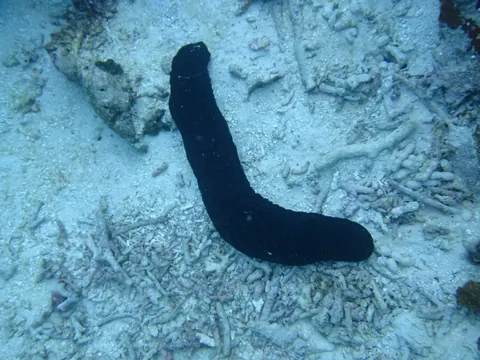
Black sea cucumber
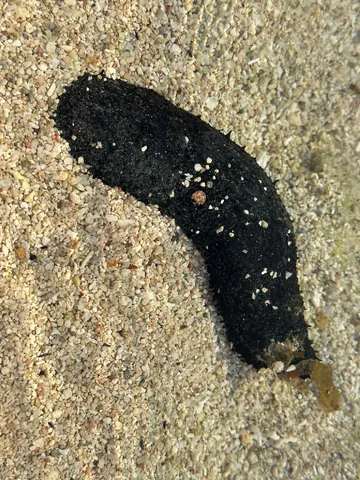
Holothuria atra
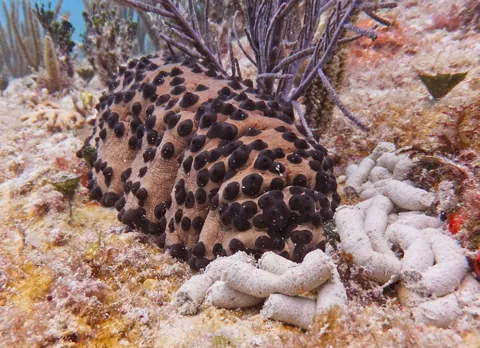
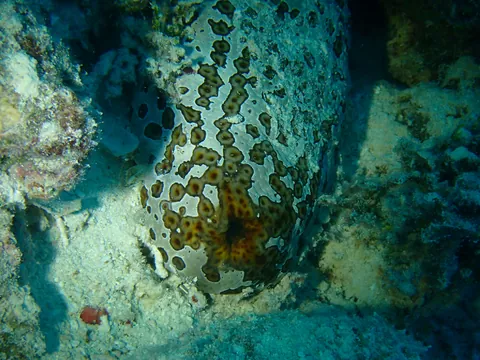
Pearsonothuria graeffei
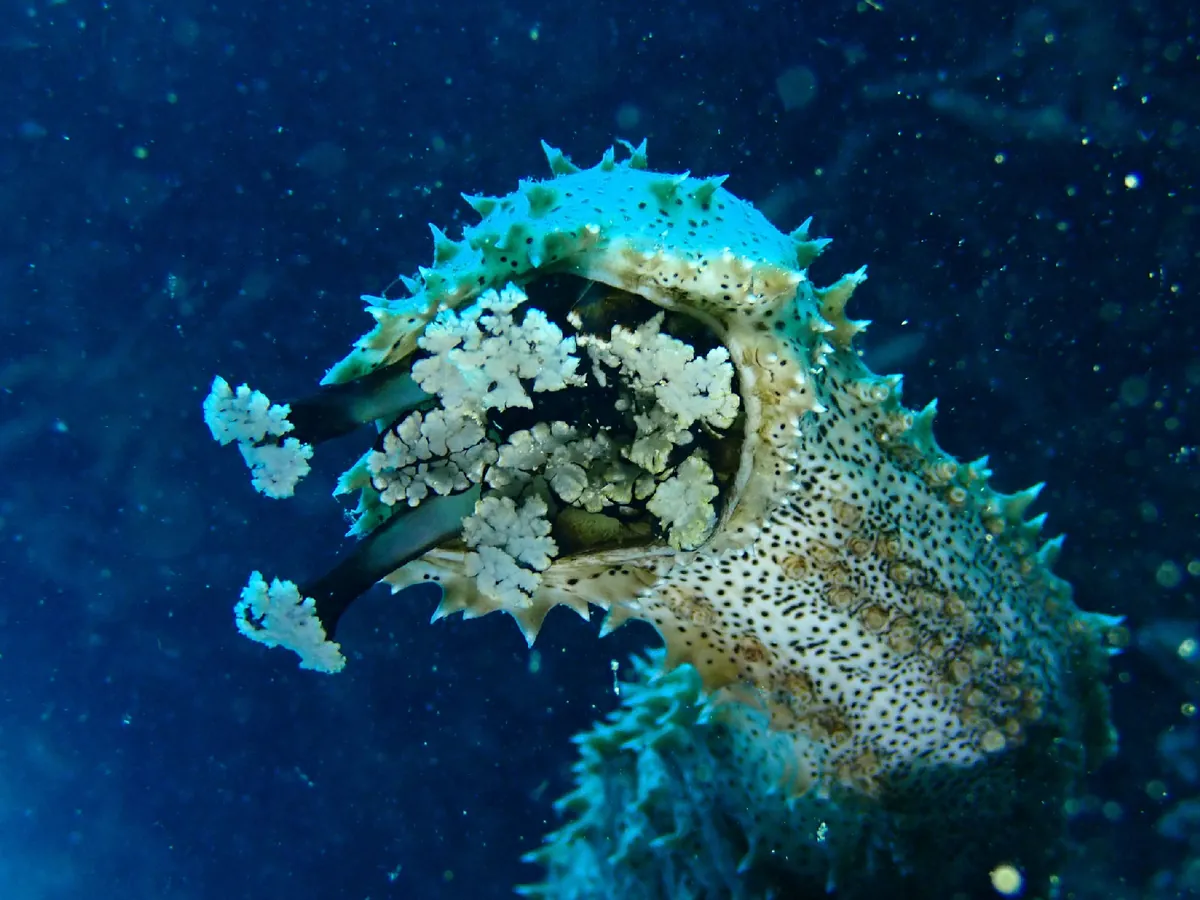
Graeffe's sea cucumber is a soft-bodied animal in the same broad group as sea stars and sea urchins. It rests on the reef as a roughly cylindrical, thin-walled body and feeds with a crown of tentacles at one end. It grows to about 45 cm long, though most animals are nearer 35 cm, and can weigh up to about 1.3 kg. It is the only species in its genus.
Also known as: blackspotted sea cucumber, blackmouth sea cucumber
The feeding crown gives it away. Look for the ring of broad, leaf-shaped tentacles that are black on the upper side and white beneath, each on a black stalk. That two-tone crown is readable from a metre away whenever the animal is feeding. Behind it the body is pale with black speckles and a rough, prickly surface.
The body is pale brown and white, marked with black speckles and covered in small thorn-like bumps. At the front, ringing the mouth, sit up to 24 tentacles shaped like leaves or paddles. Each one stands on a black stalk and is black on the upper side and white underneath. Several rows of tube feet, the short flexible stalks that grip the seabed, run along the underside. The other end of the body carries the anus.
It lives in the tropical Indo-Pacific, from the East African coast east through Indonesia and the Philippines and out into the South Pacific. It is a coral reef animal and is rarely found deeper than about 30 m. It favours reef slopes close to the coast and is most abundant on coral mixed with hard, chalky red algae. It is thinly spread even where it lives, so you may swim a long way between animals.
It is a scavenger. It roams the seabed, sifts the sediment with its feeding tentacles, and passes anything organic to its mouth. It also feeds on the surface of coral colonies and sponges. Its day is tied to the light: it starts moving within a few minutes of dawn and keeps going until about half an hour after sunset. Then it stops, raises its rear end, pulls its tentacles back into its mouth and stays still through the night. It spawns at the same time as other reef echinoderms, including crown-of-thorns starfish and the long-spined sea urchin Diadema setosum.
Many sea cucumbers fire out sticky white threads, called Cuvierian tubules, when something disturbs them. This one holds back and seems to release them only under extreme stress. The threads carry toxins that stop nerve signals passing, and two of those chemicals are being studied as possible painkillers and anti-cancer drugs.
Describe what you saw and we name it, then keep every species you find in your Oceandex.