Alexandria pompano
Alectis alexandrina
Gnathanodon speciosus
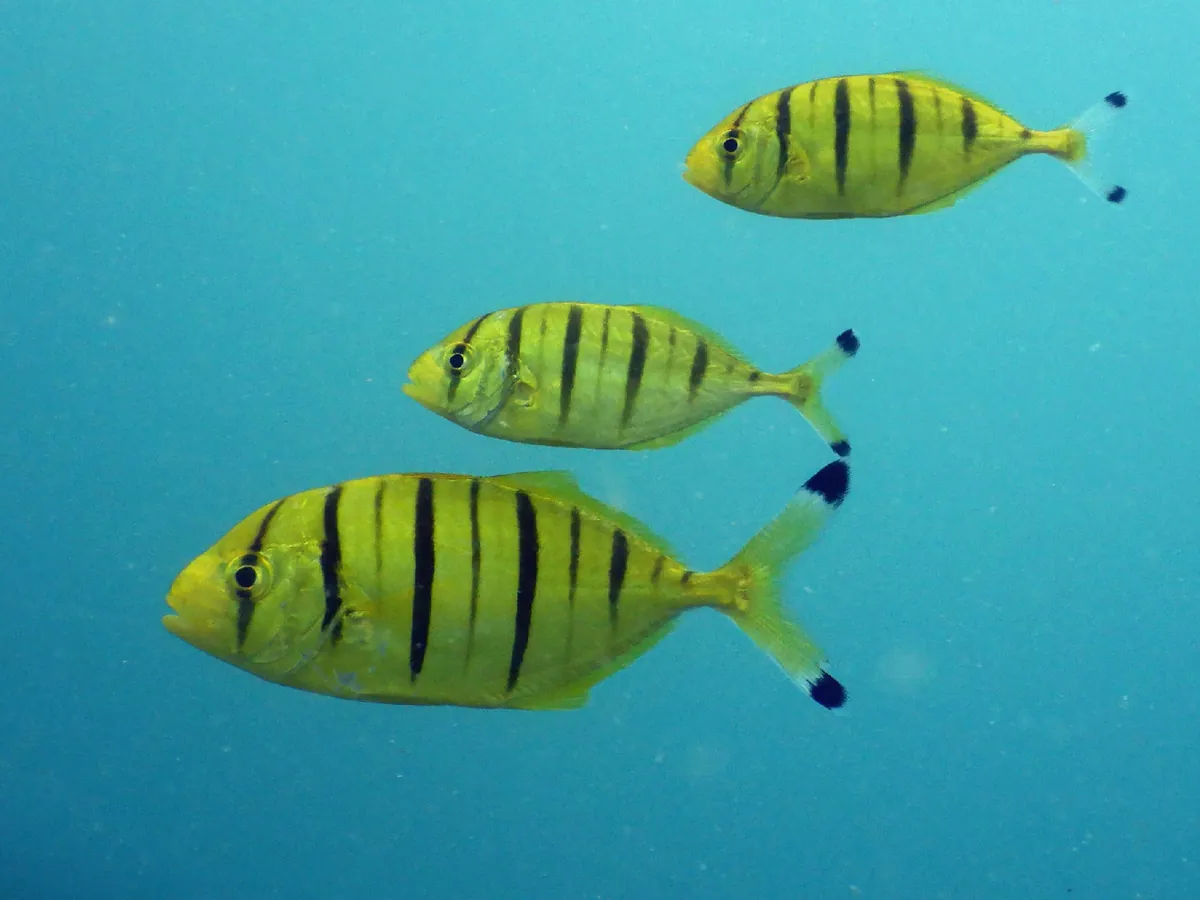
Young golden trevally often swim close to much bigger animals for safety, sometimes even trailing next to a diver's face for a while, flashing bright golden yellow as they go.
Also known as: golden toothless trevally, golden trevally, yellow jack fish, golden fish, yellow ulua, golden toothless trevally, kelat, golden jack, king fish, jack, golden horsmackerel, banded trevally, banded horse mackerel, king trevally, golden trevally, trevally, horse mackerel, golden kingfish, golden kingfish, golden jack, banded trevally, king trevally
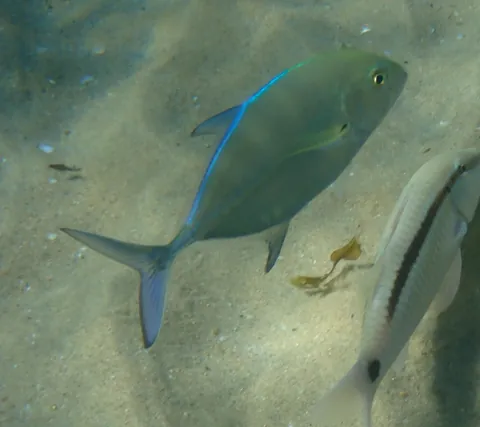
Its shape looks like other jacks and trevallies, but its mouth gives it away: the golden trevally can shoot its lips forward into a tube to suck prey out of sand or cracks, a trick most similar-looking trevallies cannot do. In young fish, the bright golden-yellow body is also a clear sign.
This jack has a flat, oval body, with a back that curves out a bit more than its belly. Its mouth is soft and very flexible, and it can shoot forward into a tube shape. Larger fish lose all their teeth, while smaller ones keep a row of tiny teeth in both jaws. Young fish are bright golden yellow all over, body and fins alike. It grows up to 120 cm and 15,000 g, though 75 cm is more common.
It lives across the warm parts of the Indian and Pacific Oceans, from the East African coast and Red Sea through South East Asia and Australia to the central Pacific islands and the coast of Central America. It likes clear water near shore, over rocky and coral reefs and open sand flats, down to about 80 m deep.
Adults are usually alone or in small groups. Young fish gather in bigger schools and often swim close to larger animals such as groupers, sharks, or even jellyfish, to stay safe. Young fish sometimes do this with divers too, sticking close to a diver's face for part of the dive.
It hunts by day, using its tube-like mouth to suck prey out of cracks in the reef and out of algae. It can also filter sand for buried crustaceans, molluscs, and other small animals, spitting out the sand and swallowing the prey. It also eats small fish, and has been seen chasing down fleeing prey in some places.
In Hawaii, spawning has been recorded from late February to early October, with a peak between late April and early September. Spawning ties to the moon's first and third quarters and happens in the evening and into the night.
The golden trevally is the only species in its genus, Gnathanodon, a name built from Latin words meaning 'toothless jaws' - a nod to the tooth loss already described above.
Describe what you saw and we name it, then keep every species you find in your Oceandex.