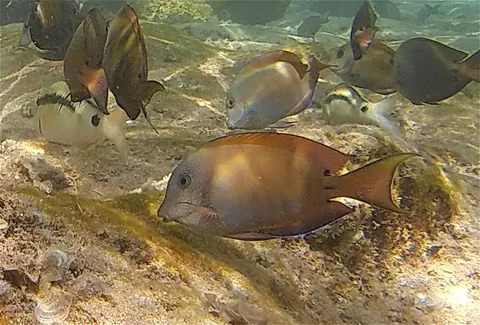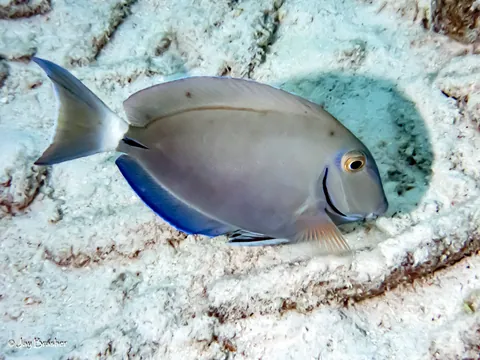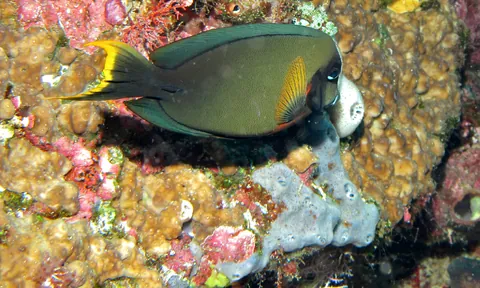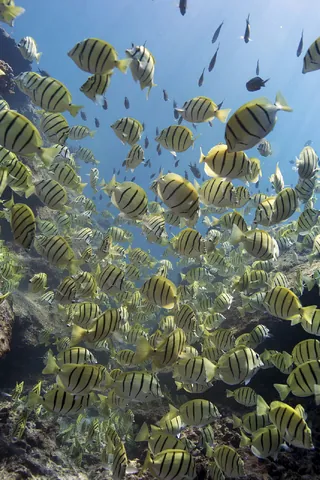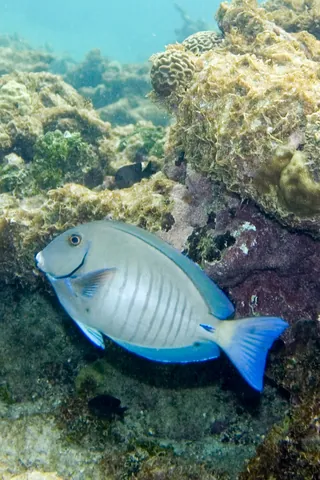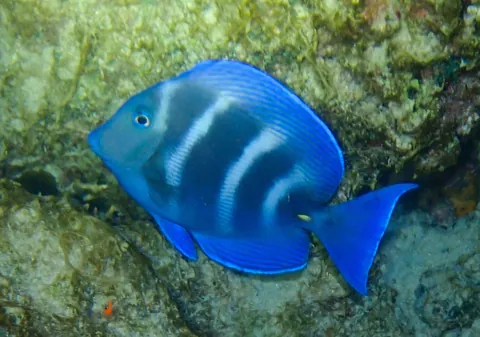
Atlantic Blue Tang
Acanthurus coeruleus
Acanthurus nigricauda
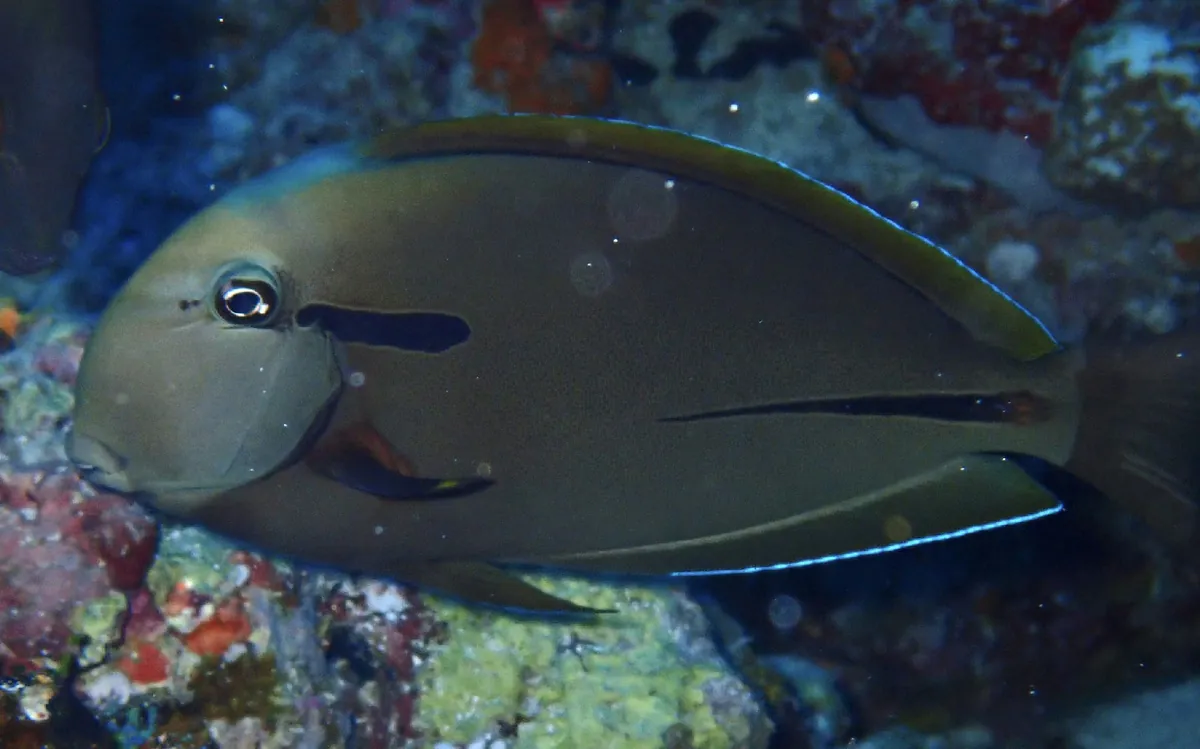
The eyeline surgeonfish is a deep-bodied reef fish named for the bold black stripe that runs from its eye toward the gill cover. Unlike most of its close relatives, it likes sand and rock more than coral, and it grazes the algae-covered seabed in bays and lagoons.
Also known as: blackstreak surgeonfish, epaulette surgeonfish, black-barred surgeonfish, eye-line surgeonfish, eye-line surgeon
People often mix this fish up with the doubleband surgeonfish, which lives on the same reefs. The eyeline surgeonfish has one bold black stripe (its 'epaulette') running from behind the eye to the gill cover. The doubleband surgeonfish, as its name says, has two such bands instead of one.
The eyeline surgeonfish has a deep, flat body, a curved forehead, and large eyes. Tiny scales cover its skin and give it a smooth look. Its lateral line, the faint stripe of sense organs along its side, is hard to see. Body colour ranges from pale grey to dark brown or almost black, and can change with the fish's mood, while the head is usually paler than the body. The back fin is yellowish with a black line edged in blue. The side fins have an orange base banded in grey and yellow. The crescent-shaped tail has a white base and a dark outer edge bordered in blue.
Eyeline surgeonfish live across the warm Indian Ocean and the western and central Pacific, from East Africa and Madagascar to islands in the central Pacific, and from southern Japan south to Australia. Unlike most of its relatives, it likes sandy and rocky bottoms in bays, lagoons, and reef slopes more than open coral. It stays down to about 30 metres, usually shallower than 15.
This surgeonfish grazes all the time on sandy patches near reefs, but it barely eats the algae growing there. Most of what it swallows is fine organic matter trapped in the algae, not the algae itself.
Describe what you saw and we name it, then keep every species you find in your Oceandex.