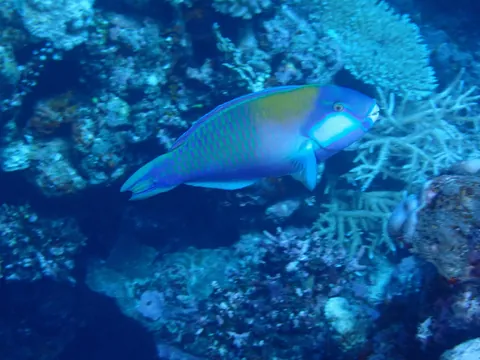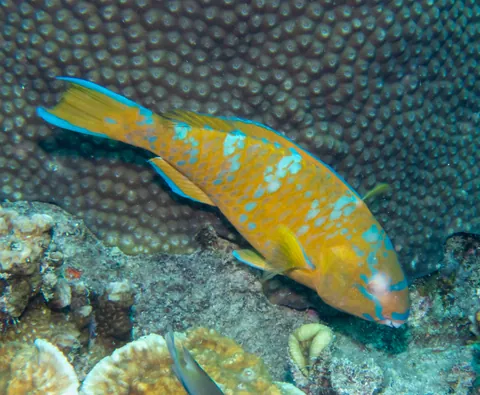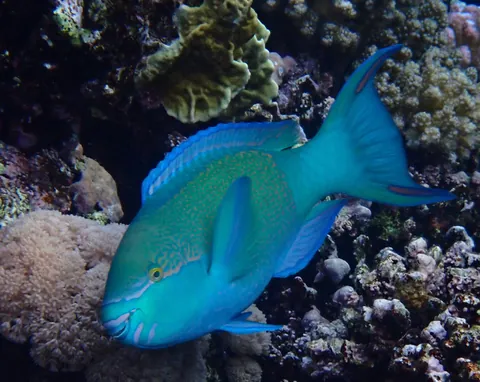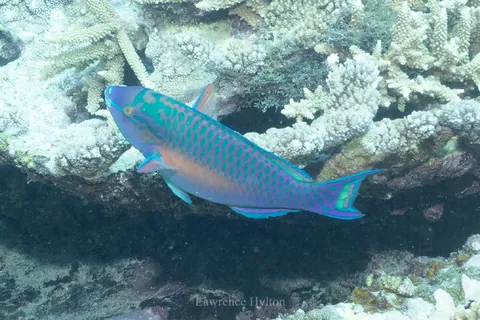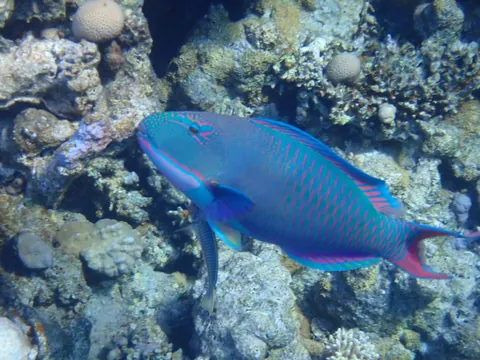
Bicolour parrotfish
Cetoscarus bicolor
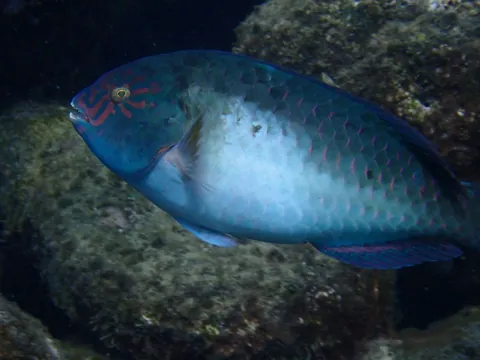
Scarus niger
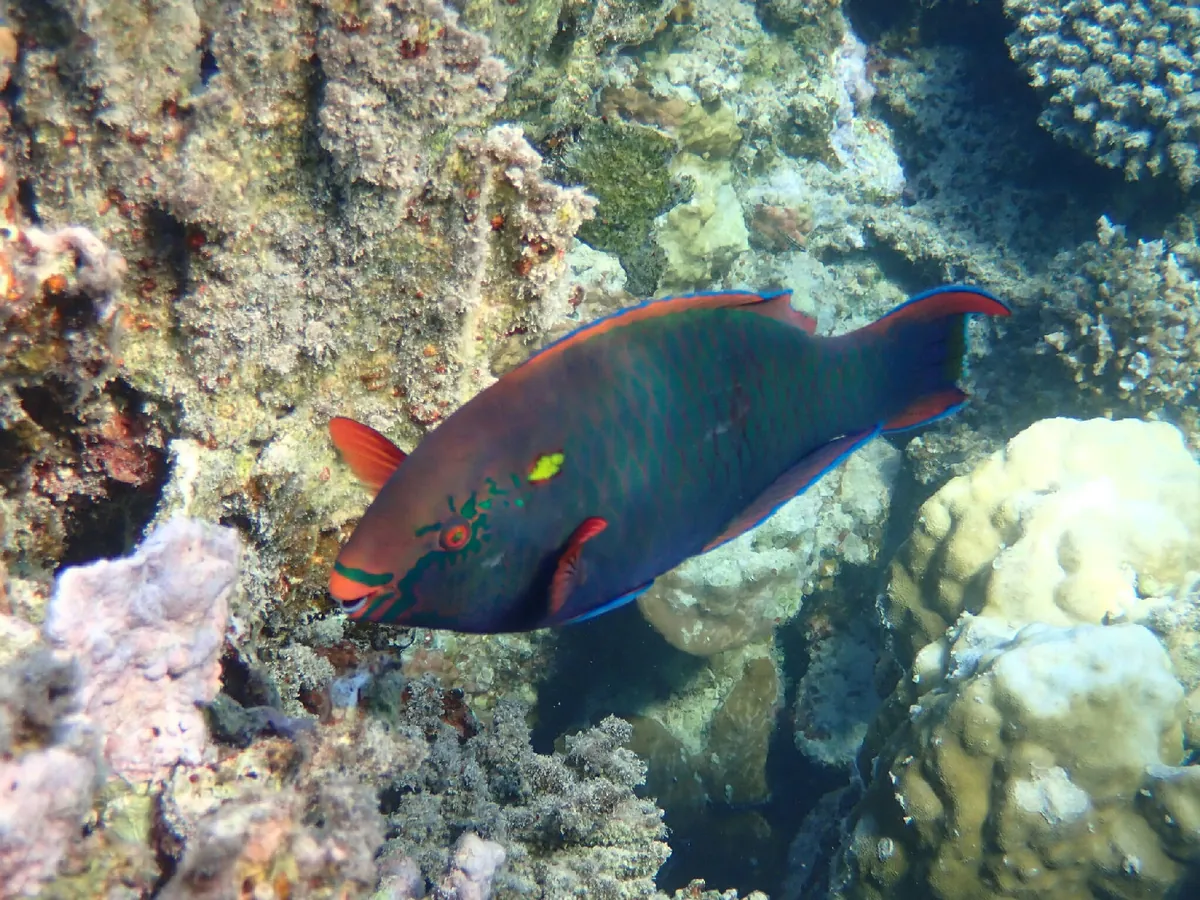
The dusky parrotfish is a small parrotfish of clear Indo-Pacific reefs. Like its relatives it scrapes its food off hard surfaces with fused, beak-like tooth plates. It reaches about 40 cm and stays shallow, down to around 20 m, so most divers meet it well inside a normal dive. You usually see one on its own, or a male with a few females nearby.
Also known as: black parrotfish, swarthy parrotfish, swarthy parrotfish, dusky parrotfish, parrotfish, black parrotfish, swarty parrotfish, swarthy parrotfish, parrot fish
On a male, look for the bright dot: a yellow or green spot with a dark rim, sitting high above the gill opening at the end of a line that runs back from the mouth through the eye. It is always there, even when the rest of the head pattern differs from fish to fish. On a female, look instead for the wavy black and white stripes along the side, set against a red head and belly.
Males and females look very different. A male is reddish brown at the front, with a red upper lip and dark bands around the mouth, and turns greenish towards the tail, where every scale is edged in dark. The markings on the head vary from fish to fish, but a male always carries one fixed mark: a small yellow or bright green dot with a dark rim, set high at the end of a line running from the mouth, through the eye, to the top of the gill opening. A female is red on the head, belly and fins, with wavy black and white stripes along the side and dark green bands around the mouth and eye. The tail is rounded in small females and grows into long, trailing points in large adults.
It eats algae growing on hard surfaces and on dead coral, and, unlike some larger parrotfish, it does not usually bite into living coral. It feeds most in the morning and the afternoon and eases off around midday and sunset, and it follows no fixed route. Where the coral is dense and offers more cover, the fish range over a smaller area and live more tightly packed. It is also less aggressive towards other parrotfish than many of its relatives: in crowded places it simply shrinks its feeding area instead of fighting for it.
This parrotfish is a protogynous hermaphrodite, which means it starts life as a female and can turn into a male later. In a group of females only, the dominant female may make that change. Males hold a small harem and spawn with one female at a time, as a pair. After spawning, the sex organs shrink sharply.
For a parrotfish this one is a hurried eater. It takes more bites in a given time than other parrotfish species do. But each bite removes so little that it grinds away far less reef rock than the bigger parrotfish beside it.
Describe what you saw and we name it, then keep every species you find in your Oceandex.