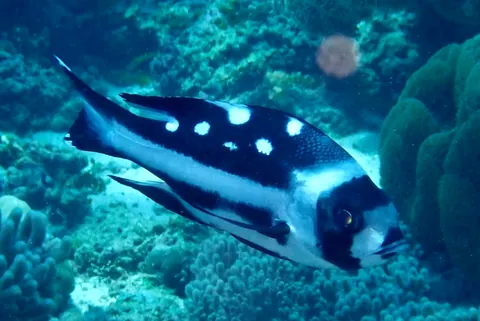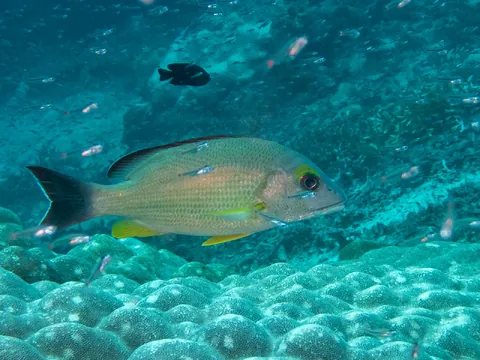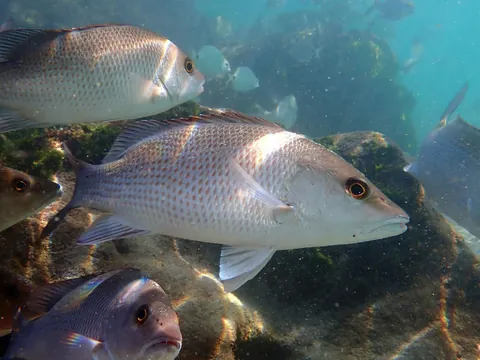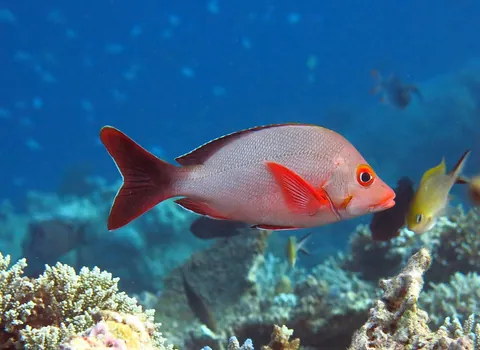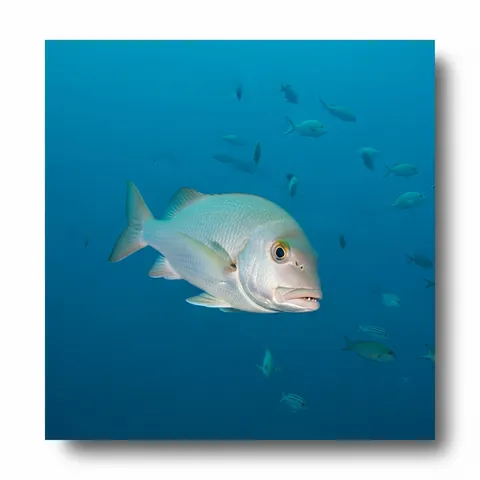
African forktail snapper
Apsilus fuscus
Lutjanus kasmira
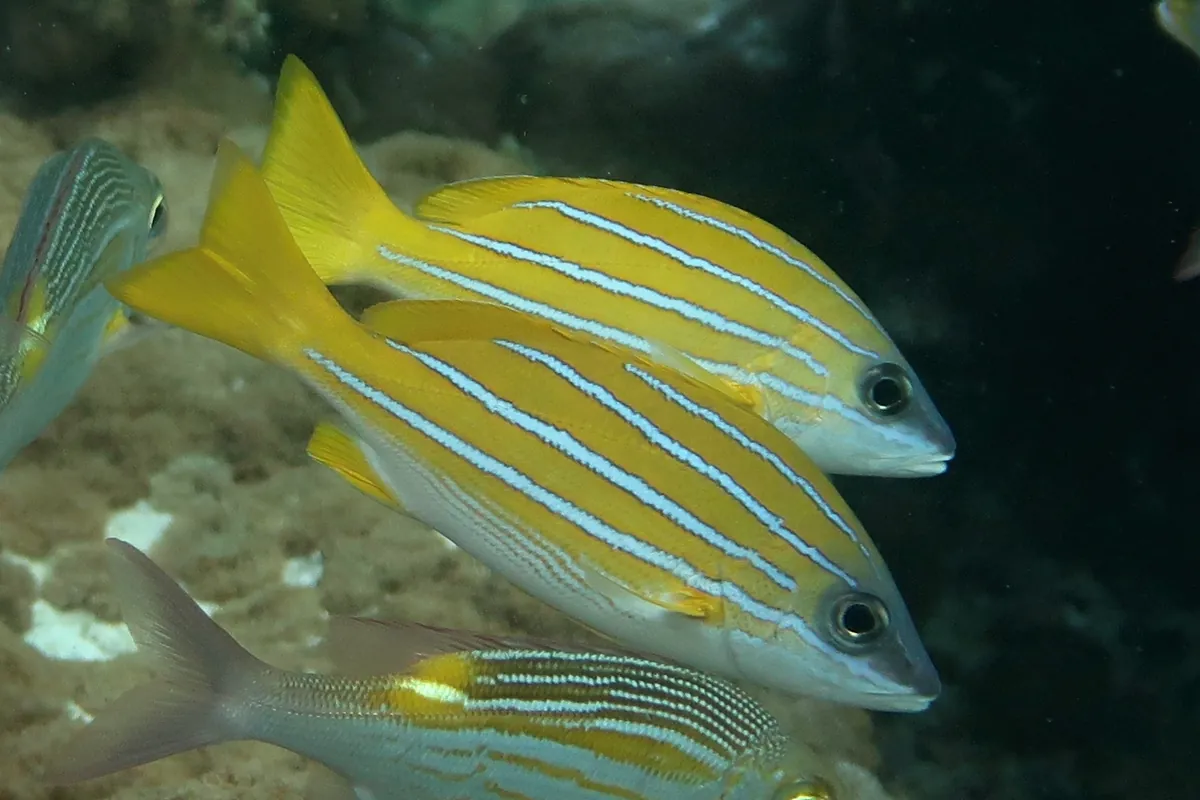
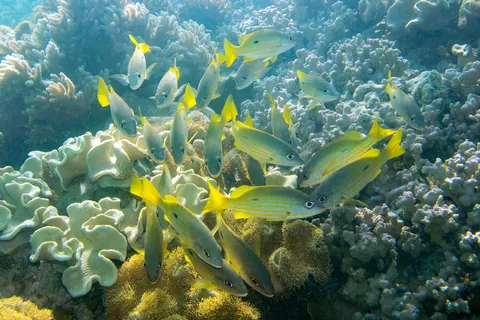
The common bluestripe snapper is a small, brightly coloured reef fish found from the Red Sea to the central Pacific. It is caught commercially and as a game fish, and is also kept in aquariums.
Also known as: lutjanus kasmira, blue and yellow snapper, blue-banded hussar, blue-banded sea perch, blue-banded snapper, blue-lined sea perch, blue-lined snapper, blue-lined snapper fish, blue-striped seaperch, blue-striped snapper, bluebanded snapper, bluelined seaperch, bluelined snapper, bluestripe seaperch, bluestripe snapper, bluestriped snapper, common blue-strips snapper, four-lined snapper, moonlighter, snapper, yellow and blue seaperch
Look for four bright-blue stripes running along a yellow body — a combination that stands out clearly even at a distance underwater.
Its body is moderately deep, with a steeply sloped forehead. The back and sides are bright yellow, fading to white on the belly, and four bright-blue stripes run the length of the body. Most fins are yellow. It grows up to 40 cm long, though most adults are closer to 25 cm.
This snapper lives on coral reefs, from shallow lagoons to outer reef slopes, usually between 30 and 150 m deep. It often gathers in large groups around coral heads, caves, or wrecks during the day. Young fish shelter over sandy bottoms and seagrass, while older, larger adults become more solitary and move onto deeper reef.
It eats a broad mix of prey, including small fish, shrimp, crabs, stomatopods (mantis shrimp), squid and other cephalopods, and plankton, along with some plant and algal matter.
Spawning happens across most of the year in tropical waters, with a peak in the Andaman Sea around November and December.
harmless
In parts of its range, this snapper is shadowed by a goatfish, Mulloidichthys mimicus, that has evolved to look almost exactly like it. Scientists think the goatfish schools alongside the snapper for protection from predators, since the snapper is likely the less preferred prey of the two.
Describe what you saw and we name it, then keep every species you find in your Oceandex.