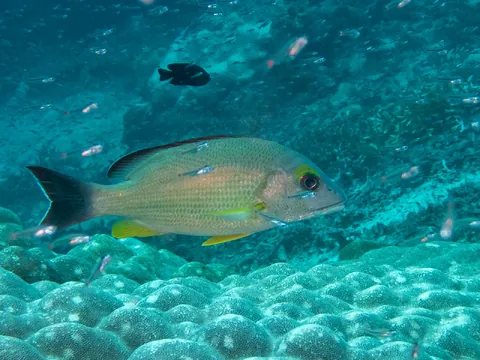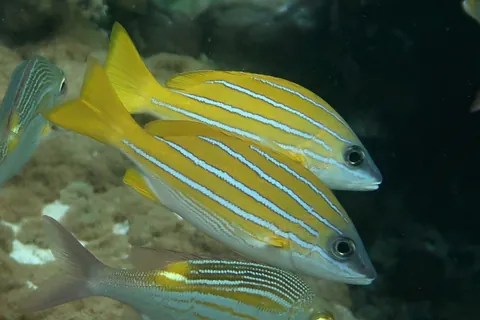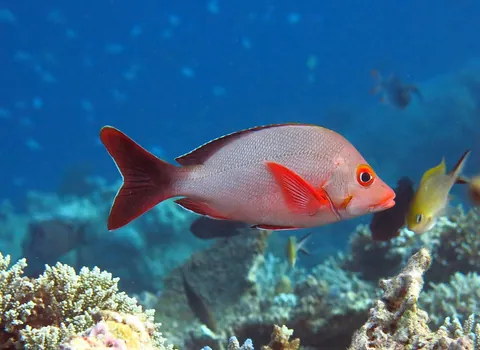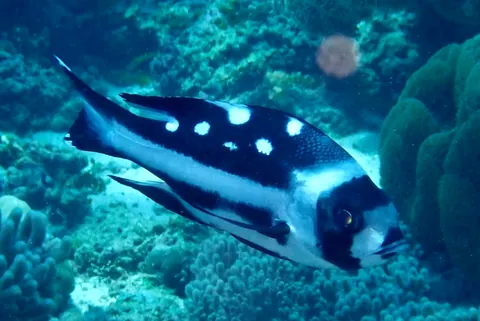
Black and white snapper
Macolor niger
Apsilus fuscus
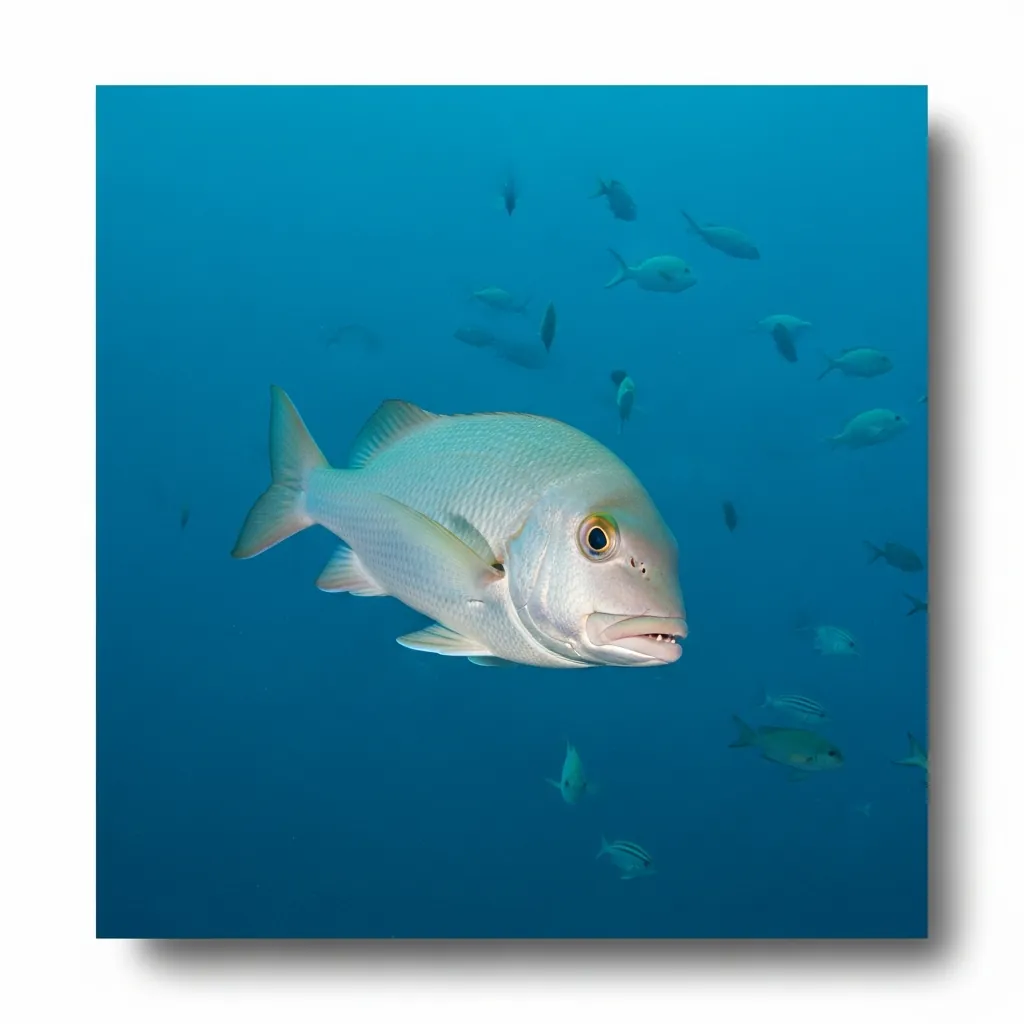
The African forktail snapper is the plain one in a showy family. It wears no stripe, spot or bright fin edge, just even dark brown, and it hunts the rocky reefs of West Africa mostly below the depths where divers usually go. It reaches 75 cm, though 60 cm is more normal, which makes it a solid, heavy-shouldered fish to meet on a deep wall.
Also known as: brown sea-perch
Other snappers on the same reefs carry a stripe, a blotch or a coloured fin edge. Check the flank of this one for any marking and you will find none: it is one even dark brown from head to tail, lighter only underneath. Pair that blank flank with the deeply forked tail and the identification is settled.
The body is fairly long and torpedo shaped, thickest in the middle and tapering at both ends. The tail fin is forked. The back and sides are dark brown, turning lighter on the belly, the chest and the underside of the head. The space between the eyes is wide and rounded rather than flat. The mouth reaches back as far as the front of the eye and is filled with fine, bristle-like teeth.
This snapper lives in the eastern Atlantic, along the west coast of Africa from Mauritania south to Namibia, including the Cape Verde Islands. It is rare in the north of that range. It sits over rock and coral bottoms and is often on reefs, alone or in small groups. Records run from 15 to 300 m, but it is usually deeper than 50 m. Off Ghana it sometimes gathers in shallower water, which may be linked to seasonal upwelling. It hunts small fish, squid and crustaceans.
It turns up in the nets of commercial octopus fisheries as an unintended catch.
Describe what you saw and we name it, then keep every species you find in your Oceandex.