Brown Trout
Salmo trutta
Salvelinus fontinalis
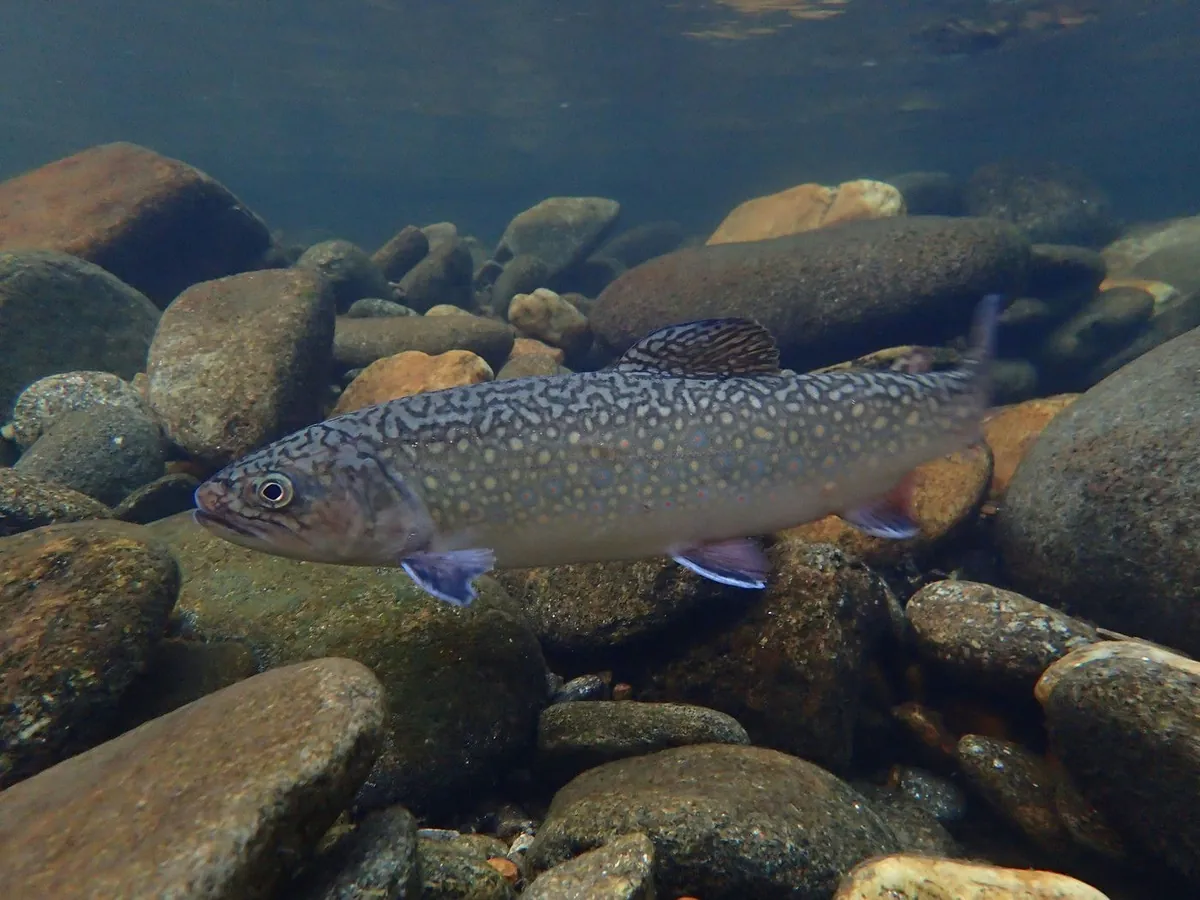
The brook trout is a colourful char (a member of the salmon family) native to cold streams and lakes in eastern North America. Some populations spend their whole lives in fresh water, while others travel to sea and return. Anglers know it by many names, including speckled trout and brookie.
Also known as: speckled trout, brook char, brookie, squaretail trout, coaster brook trout, baiser
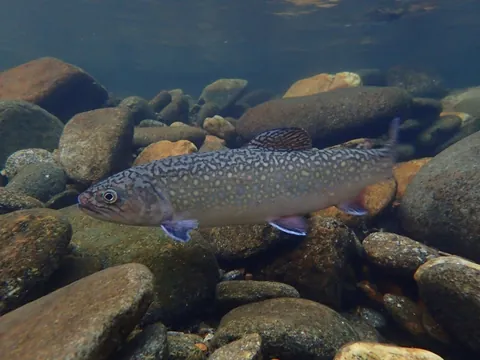
Brook trout share rivers and lakes with lake trout and brown trout, and can even interbreed with both. Check the lower fins: on a brook trout they are orange with a crisp white edge backed by a black stripe, a combination the other two species do not share.
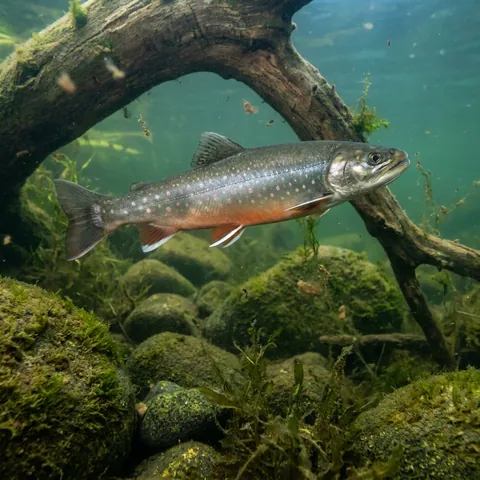
The brook trout has an olive-green back marked with pale, wavy lines called vermiculation. Its flanks carry yellow spots and red spots ringed in blue, fading toward a red-orange belly. The lower fins are orange, edged first in white and then in black.
Brook trout live in cold streams, rivers, and lakes across eastern Canada and the northeastern United States, from the Appalachian Mountains to the Hudson Bay basin and the Great Lakes. Introductions by people have also established wild populations far outside this range, including in western North America, Europe, South America, and New Zealand.
Young brook trout hide among rocks and crevices to avoid predators. As they grow, dark bars called parr marks appear on their sides to help them blend in, fading again once the fish reaches adult colouring.
Brook trout eat a wide mix of food: aquatic insects such as caddisflies, stoneflies, and mayflies, plus insects that fall into the water, crustaceans, frogs and other amphibians, molluscs, and smaller fish. They will even take small mammals like voles that end up in the water.
Females dig a nest, called a redd, in gravel where groundwater rises up through the streambed. Males fertilise the eggs as she releases them, and she then covers the nest with gravel. Water flowing through the gravel supplies the eggs with oxygen until they hatch.
Brook trout are listed as Least Concern, but the species has disappeared from many of its original streams. Forest clearing, dams, pollution, and warmer water have made many rivers unsuitable, and introduced brown trout and rainbow trout have replaced brook trout in parts of their native range. Acid rain has also pushed the species out of some Appalachian streams.
Brook trout can crossbreed with three other species they share water with: lake trout, Arctic char, and brown trout. These pairings produce named hybrids, including the splake (with lake trout) and the tiger trout (with brown trout).
Describe what you saw and we name it, then keep every species you find in your Oceandex.