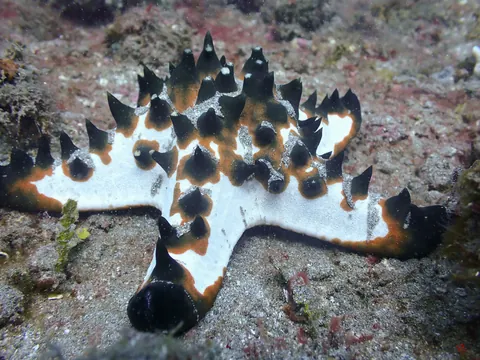
Chocolate Chip Sea Star
Protoreaster nodosus
Linckia laevigata
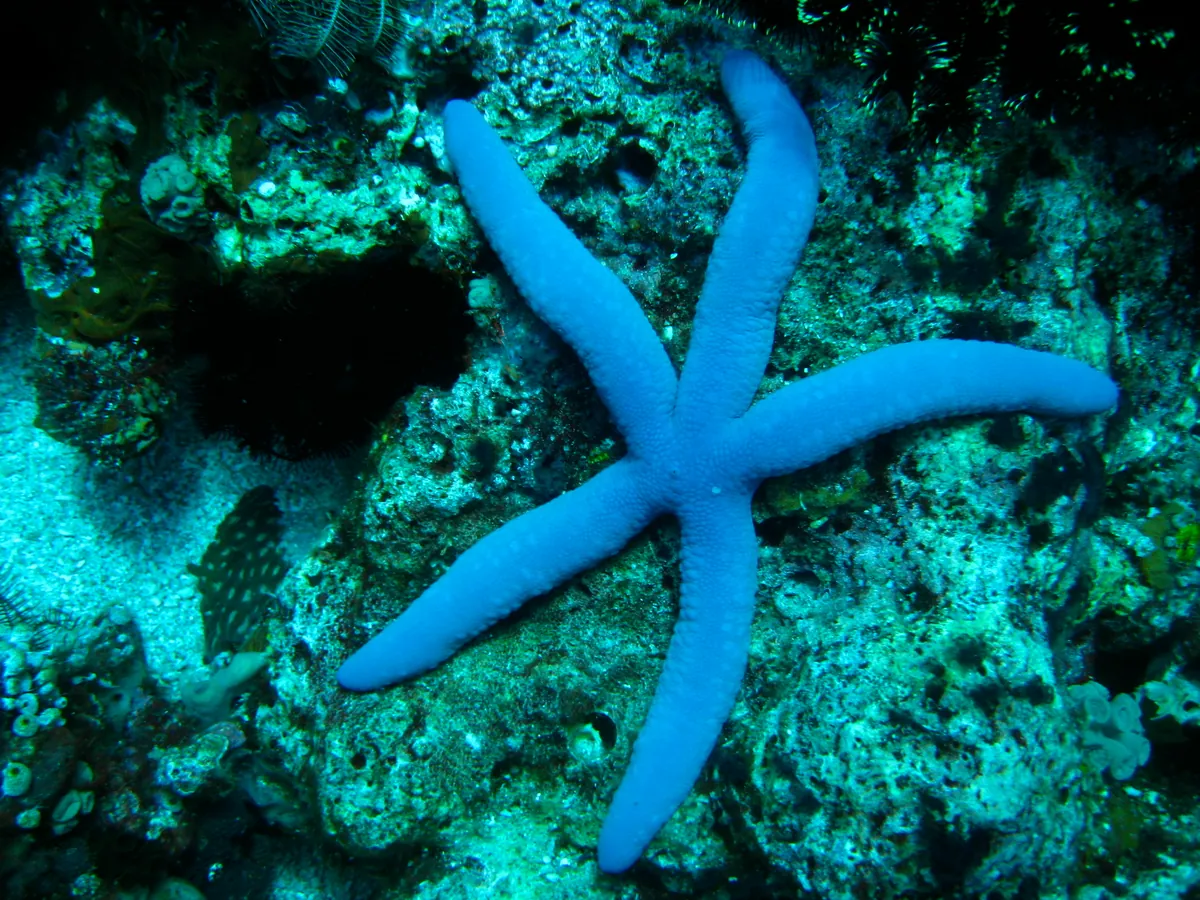
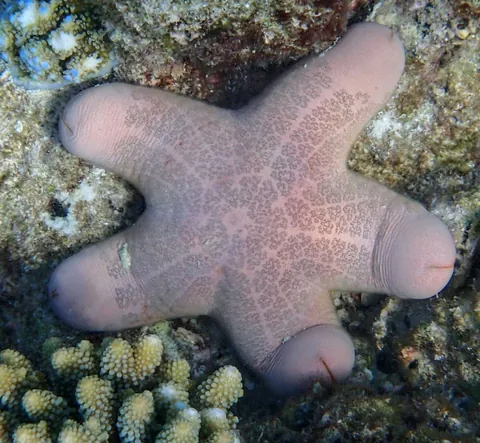
The blue sea star is one of the easiest animals to spot on a shallow tropical reef. It is a slow, firm-bodied starfish that lies out in the open on rock, dead coral and rubble in bright sunlight instead of hiding. It moves slowly over the bottom on rows of tiny tube feet and feeds on detritus, dead animals and the small creatures that live in mats of algae. Young ones stay hidden under corals and rocks. It grows to about 40 cm across and lives from the shallows down to about 60 m. Many individuals are missing one or more arms, which is normal and not a sign of a sick animal.
Also known as: azure sea star, blue linckia, blue star, linckia laevigata, linckia laevigata (linnaeus, 1758)
Do not go by colour alone, because this star comes in several colours. Go by shape: thick, tube-like arms of even width that end in blunt, rounded tips, with no spines or raised plates standing up along the top. If you can see the underside, the short yellow tube feet against the body are the clincher. Arms of unequal length are common and are still the same species.
Most animals are blue: deep blue, light blue, or an even mid blue over the whole body. Aqua, purple and orange animals also turn up. Some have lighter or darker spots scattered along the arms. The arms are long, slightly rounded in cross-section, like firm sausages, and end in blunt, rounded tips rather than points. The underside of each arm carries rows of short yellowish tube feet, the small stalks the animal walks on. The body feels stiff and solid rather than soft or floppy.
A small parasitic snail, Thyca crystallina, lives fixed to the outside of this sea star and feeds on it. If you look closely at a blue star, you may find one or more of these snails sitting on its arms.
Describe what you saw and we name it, then keep every species you find in your Oceandex.