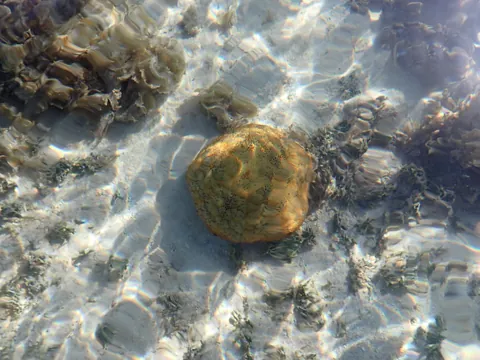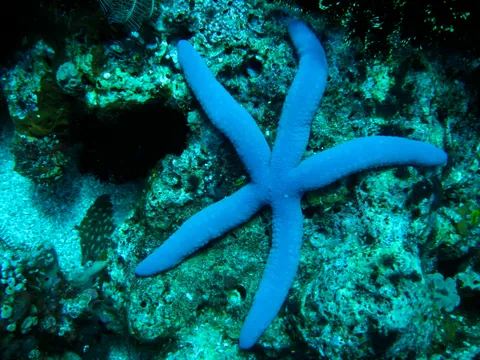
Blue sea star
Linckia laevigata
Asterias rubens
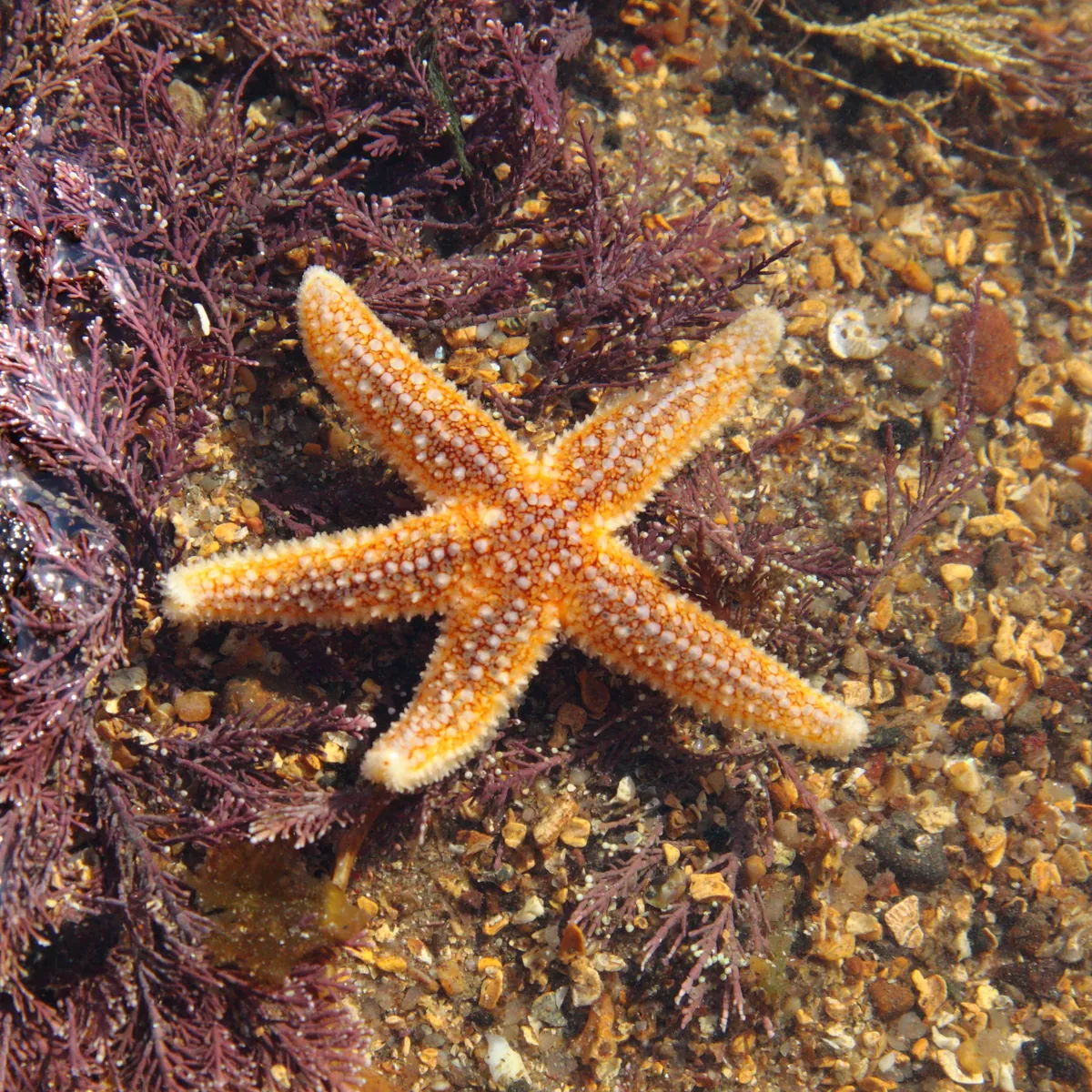
The common sea star is the most familiar starfish of the northeast Atlantic, found on rocky and gravelly seabeds from shallow water to deep water. It has five tapering arms and a stiff, star-shaped body.
Also known as: purple starfish, common starfish, atlantic common sea star, common seastar
Many sea stars share this five-armed shape and similar colours. Look for the single row of short, pale spines running down the centre of each arm - most similar species do not have this stripe.
It has five arms that are broad at the base and taper to a point, with tips that often curl slightly upward. A row of short, pale spines runs along the centre of the upper surface of each arm, flanked by small, soft bumps. The underside of each arm carries rows of tiny tube feet used for moving and feeding. Colour is usually orange or brick red above and paler underneath, though some are purple or pale brown; individuals from deep water tend to be paler.
Lives on rocky and gravelly seabeds across the northeast Atlantic, from Norway south to Senegal, and is largely absent from the Mediterranean. It also occurs in the western Atlantic between Labrador and the Gulf of Mexico, and tolerates brackish water. It ranges from the shallows down to around 650 metres, though it is more common in the top 400 metres.
This starfish can smell its prey, such as mussels, from a distance and crawl toward it. It can also detect the scent of the predatory common sunstar, a starfish that eats other starfish, and move away to avoid being eaten.
Describe what you saw and we name it, then keep every species you find in your Oceandex.