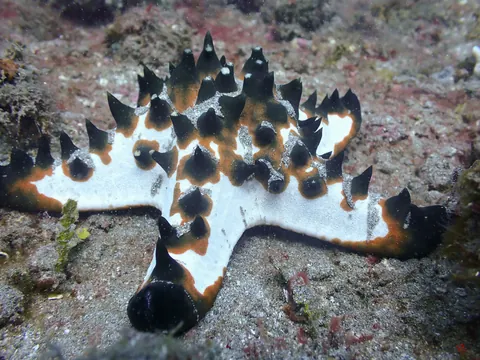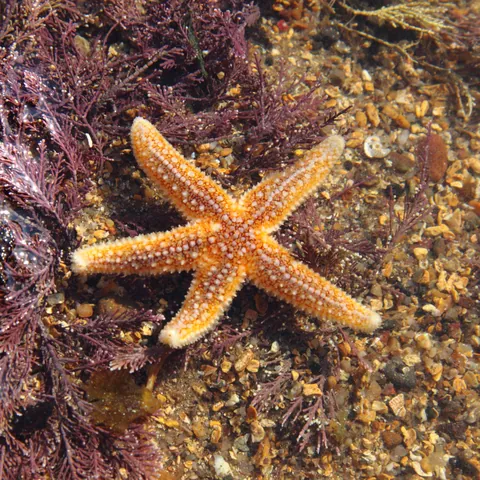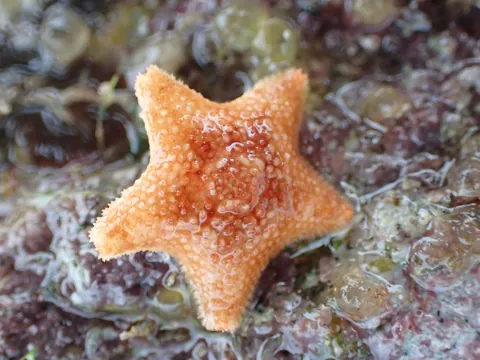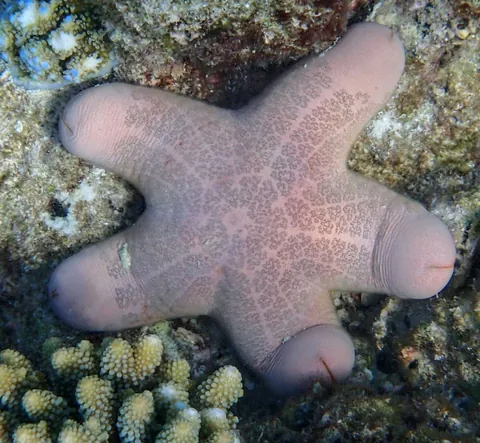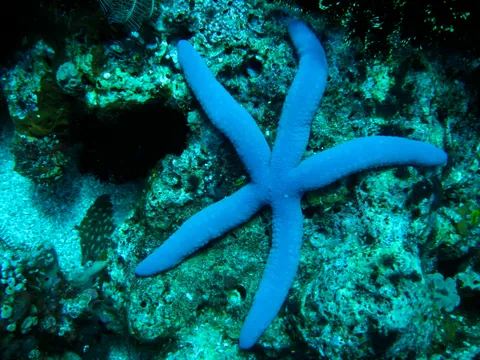
Blue sea star
Linckia laevigata
Culcita novaeguineae
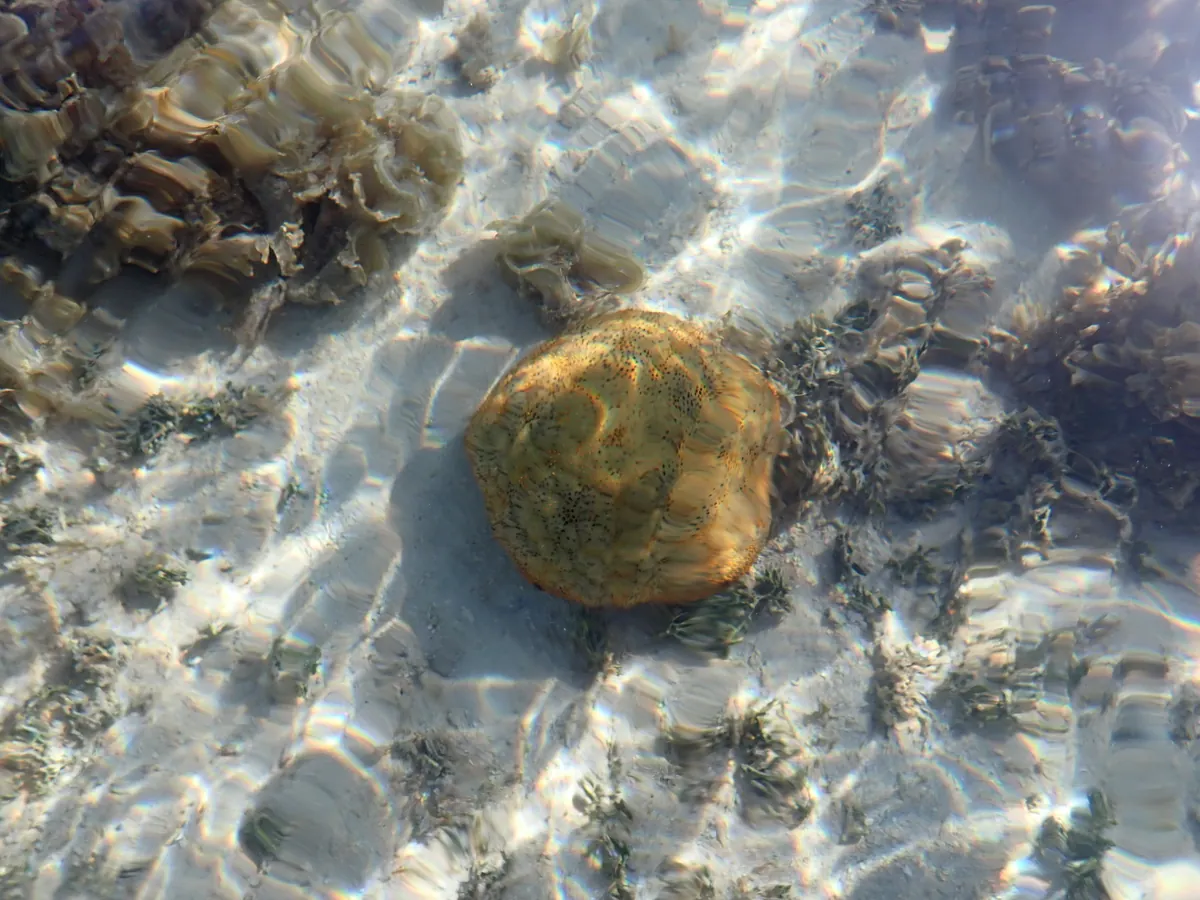
The cushion star is a starfish that does not look like one. It is inflated and pentagonal, more like a fat pincushion than a five-armed star, because its arms are very short and the spaces between them have filled in. It lives on tropical Indo-Pacific reefs, from Madagascar and the Seychelles east to the Philippines, New Guinea, Australia and Hawaii, and has been recorded down to about 90 m. It feeds on detritus and small bottom-living animals, including stony coral polyps.
Also known as: cushion star
Look for a fat, five-sided cushion sitting on the reef with no obvious arms, only shallow corners. That shape alone separates it from the flat, long-armed starfish around it. Turn your light on the underside, if it is visible, to see the rows of tube feet running to a central mouth. Do not use colour: it varies widely and is usually mottled.
A grown animal is a five-sided, puffed-up cushion with hardly any arms. Colour is very variable and usually mottled, mixing lighter and darker shades of fawn, brown, orange, yellow and green. The upper surface may carry small cone-shaped bumps. The underside has rows of tube feet, the small suckered tubes a starfish walks on, leading to a mouth in the centre. The body wall is armoured with chalky plates, and the tube feet can pull back into pits in this armour. The body is hollow and filled with water. Young animals look quite different: flat, star-shaped, with five short, broad arms. As they grow, the gaps between the arms fill out and the body swells.
It lives on living coral reef, along the reef edge and down the slope. Look on hard reef surfaces within normal recreational depths rather than on open sand.
A cushion star can have a lodger. The star pearlfish sometimes lives inside its hollow body, getting in through a groove on the underside and coming back out from time to time to feed.
Describe what you saw and we name it, then keep every species you find in your Oceandex.