African forktail snapper
Apsilus fuscus
Lutjanus fulvus
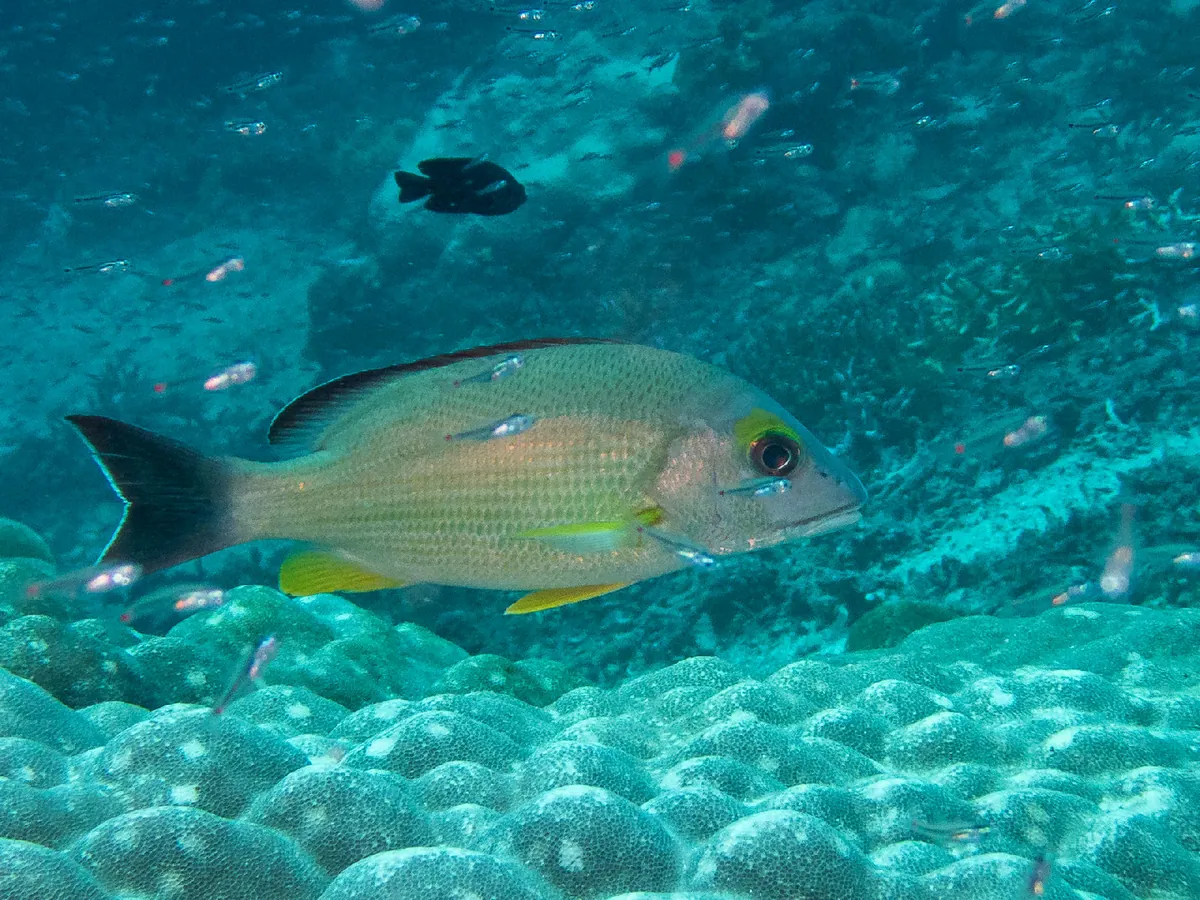
The blacktail snapper is a medium-sized snapper of Indo-West Pacific reefs. It reaches 40 cm, but most fish are about 25 cm. It is found from 1 to 75 m, and it is listed as Least Concern. It rests near shelter by day and hunts at night. It sometimes causes ciguatera poisoning, a poison that builds up in reef fish and makes them unsafe to eat.
Also known as: blacktail snapper, blacktail snapper, blacktailed snapper, flametail snapper, redmargined seaperch, taiva, waigeu snapper, yellow striped snapper, yellowmargined sea perch, yellow striped snapper, yellowmargined seaperch, snapper, waigeu snapper, yellow-margined seaperch, blacktailed snapper, redmargined seaperch, flametail snapper, yellow-margined sea-perch, yellow-margined sea perch, silver snapper, yellow-margined sea perch, yellowmargined sea perch, yellow-margined seaperch
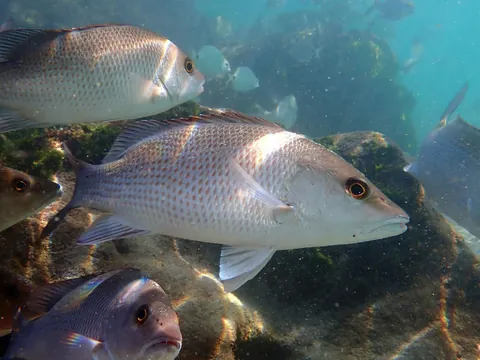
The name says it: on a plain brown-yellow fish, the dark tail and dark dorsal fin stand out, and each is finished with a narrow white edge. That dark fin with a white margin, set against yellow anal and pelvic fins, is visible at normal viewing distance and does not change with mood or background.
The body is a plain orange-brown to pale yellowish or whitish, and each scale has a brownish to yellow edge, giving a faint chequered look. The forehead slopes steeply. The dorsal fin along the back and the tail fin are dark red to blackish with a clean white margin. The anal, pectoral and pelvic fins are yellow, and there is a yellow patch above the eye. Both the dorsal and anal fins are rounded at the rear. Juveniles are marked with yellowish horizontal stripes and have a black band just below the edge of the dorsal fin.
The blacktail snapper lives across the Indo-Pacific, from the Gulf of Aden and East Africa to the central Pacific islands, north to southern Japan and south to Australia. It uses lagoons and semi-sheltered seaward reefs, and it prefers places with deep holes or large boulders to shelter in. Juveniles are sometimes found in shallow mangrove swamps and even in the lower parts of freshwater streams.
Adults are usually alone or in loose groups. They hunt at night, taking fish, shrimps, crabs, sea cucumbers and cephalopods such as squid and octopus. During the day they hang around their boulders and holes.
In the 1950s the Hawaiian fisheries authority released blacktail snappers into Pearl Harbor and off Oahu. The fish spread through the whole Hawaiian chain, where it still lives today, but it never became abundant there.
Describe what you saw and we name it, then keep every species you find in your Oceandex.