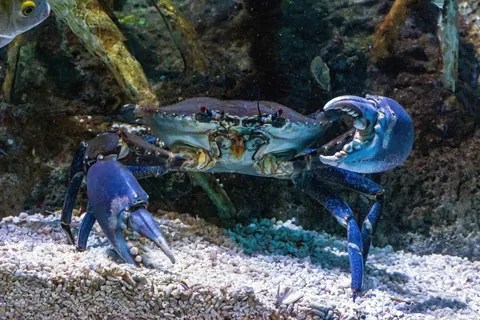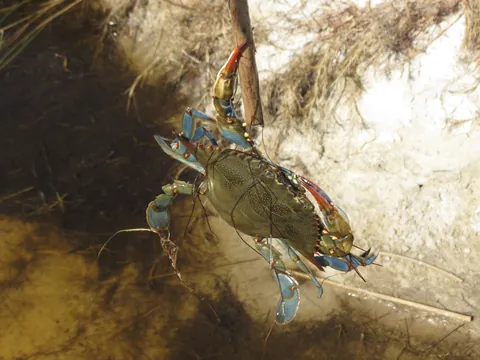
Atlantic Blue Crab
Callinectes sapidus
Stenorhynchus seticornis
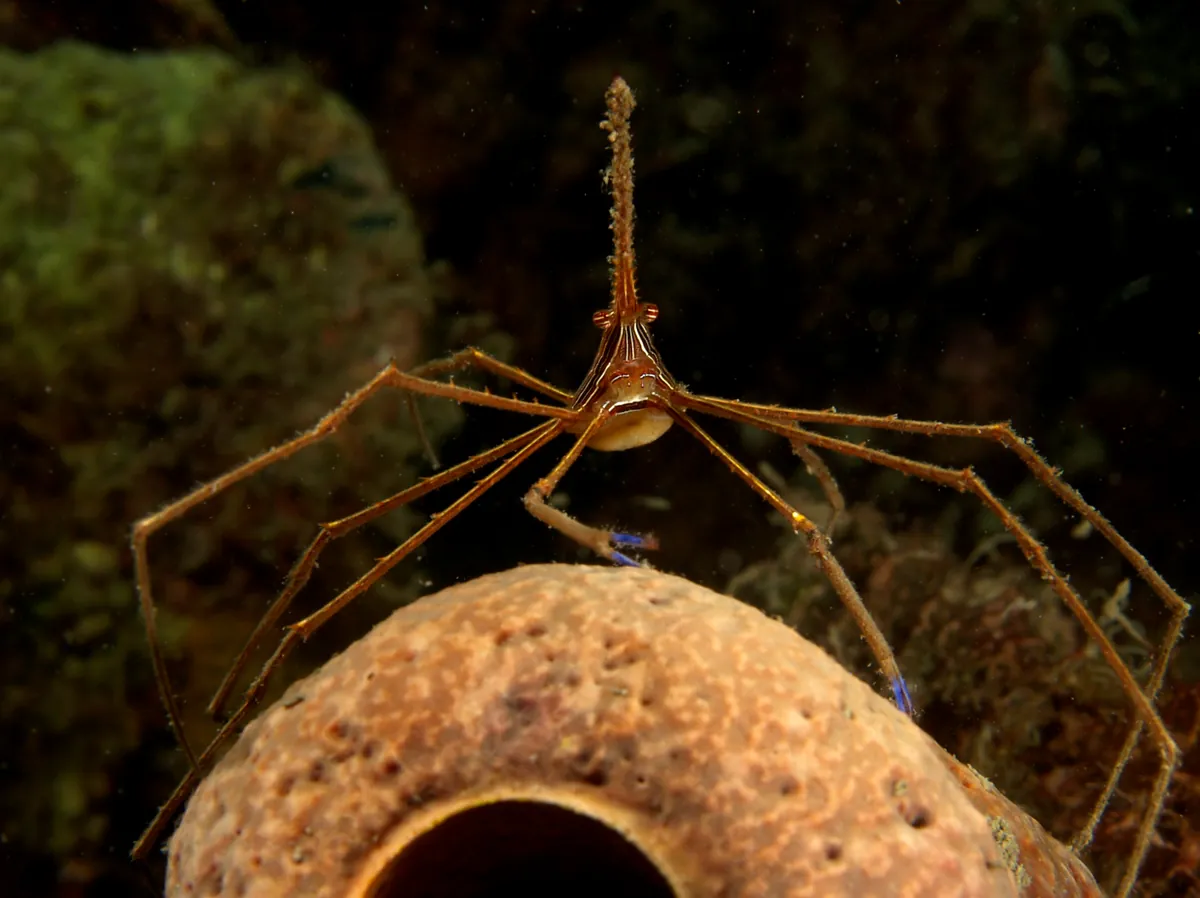
The yellowline arrow crab is a spindly, needle-legged crab that hides by day and hunts by night on reefs across the western Atlantic. Its long, pointed snout gives the species its name.
Its tiny triangular body carries legs many times its own length, tipped with violet or blue claws - no other common reef crab has such an extreme, spindly build.
The body is triangular and small, with a long, pointed snout edged like a saw, and legs far longer and thinner than the body itself. Colours vary widely: the body can be golden, yellow, or cream, marked with brown, black, or shimmering blue lines, while the legs run reddish or yellow and the claws are often tipped in blue or violet.
This crab lives on rock bottoms, coral, and calcareous algae (algae with a hard, chalky skeleton), as well as sandy or gravelly seabeds, from North Carolina and Bermuda south through the Caribbean to Brazil. It is found from as shallow as 1 m down to over 360 m.
It comes out only at night and avoids light, staying hidden by day and moving out to feed after dark on small feather duster worms and other reef animals. It often shelters among the stinging arms of the anemone Lebrunia danae alongside cleaner shrimp, and it will stick bits of debris on its body for cover or defence.
Researchers have logged many reports of this small crab acting as a cleaner for reef fish, moray eels, and squirrelfish - an unexpected partnership for a crab its size.
Describe what you saw and we name it, then keep every species you find in your Oceandex.